Slow parenting is the intentional decision to do less so your child can experience more — more unstructured play, more boredom, more presence, more depth. It's not about being lazy or neglectful. It's about resisting the cultural pressure to overschedule, over-optimize, and over-screen every moment of childhood. The research is clear: children who grow up with space to be children develop stronger emotional health, deeper creativity, and greater resilience.
This matters now more than ever. Childhood anxiety has surged. Schedules are packed. Screens fill every gap. A growing body of evidence — and a growing movement of parents — says it's time to slow down.
What Is Slow Parenting, Exactly?
Slow parenting is a philosophy rooted in intentionality over intensity. It rejects the idea that a good childhood requires constant stimulation, nonstop activities, and wall-to-wall enrichment. Instead, it trusts that children develop best when given time, space, and the steady presence of an attuned parent.
The term draws from the broader "slow movement" — slow food, slow living — which values quality over speed. Applied to parenting, it means fewer extracurriculars and more free play. Fewer screens and more stories. Fewer scheduled activities and more kitchen-table conversations.
Children need time to become themselves — through play, through solitude, through the slow accumulation of experiences that aren't directed by adults. Overscheduling robs them of the very thing they need most: unstructured time to discover who they are.
Slow parenting is not a rigid set of rules. It's a lens. Before saying yes to another activity, another app, another commitment, you ask: Does my child need this, or does the culture expect it?
Why Is Slow Parenting Gaining Momentum Now?
Because the data on modern childhood is alarming.
The CDC reports that childhood anxiety diagnoses rose from 7.1% in 2016 to 10.6% in 2022 — a 49% increase in just six years. That's not a blip. That's a trend, and it's accelerating.
10.6%
of U.S. children ages 3-17 had a current anxiety diagnosis in 2022, up from 7.1% in 2016
Source: CDC National Health Interview Survey, 2022
Jonathan Haidt's The Anxious Generation traces this surge to two colliding forces: the decline of free play and the rise of phone-based childhood. Children went from spending afternoons climbing trees and inventing games to spending them on supervised schedules and supervised screens. The result is a generation with less autonomy, less resilience, and more anxiety than any before it.
Meanwhile, literacy is in crisis. The National Assessment of Educational Progress found that 37% of fourth graders scored below the basic reading level in 2022 — the lowest in decades. Children are consuming more content than ever but reading less than ever.
And parents feel it too. A Pew Research survey found that 54% of parents believe their child spends too much time on screens, with many describing their child's relationship with devices as addictive. The discomfort is widespread. Slow parenting offers a coherent response.
Is Slow Parenting Just Lazy Parenting With a Better Name?
No. And this is the most common misconception.
Lazy parenting is disengaged. Slow parenting is deeply engaged — just not in the way the culture rewards. It takes more intentionality to sit with your child through boredom than to hand them a tablet. It takes more courage to pull them out of their third extracurricular than to keep driving the carpool.
Slow parenting is active. You're choosing what to say no to. You're protecting margins in your child's schedule. You're showing up fully during the moments that matter instead of splitting attention across a dozen commitments.
Slow parenting requires more of the parent, not less. It asks you to tolerate your child's boredom, resist comparison with other families, and trust a process that doesn't produce Instagram-worthy results. That's not laziness. That's discipline.
Think of it this way: a fast-food meal requires no effort. A home-cooked meal from scratch requires more. Slow parenting is the home-cooked meal. It looks simpler on the outside. It demands more on the inside.
What Does the Research Say About Slowing Down?
The evidence spans developmental psychology, neuroscience, and education — and it consistently points in the same direction.
Unstructured play builds executive function. A 2023 study from the University of Colorado found that children with more free play time showed stronger planning, problem-solving, and self-regulation skills than peers with more structured activities. The mechanism is straightforward: when children direct their own play, they practice decision-making in low-stakes environments.
Boredom sparks creativity. Research from the University of East Anglia found that children who experienced moderate boredom generated more creative solutions on subsequent tasks than children who were continuously entertained. The brain needs idle time to make novel connections.
54%
of U.S. parents say their child spends too much time on screens, with many describing the relationship as addictive
Source: Pew Research Center, 2024
Overscheduling increases anxiety. A 2024 study published in the Journal of Family Psychology found that children enrolled in four or more weekly extracurricular activities had significantly higher anxiety scores than children enrolled in one or two. The tipping point wasn't the activities themselves but the loss of downtime between them.
Present parenting strengthens attachment. When parents are physically and emotionally present — not multitasking, not checking phones — children show higher attachment security and stronger self-esteem. The quality of a ten-minute fully-present interaction outweighs an hour of distracted togetherness.
How Do You Actually Start Slow Parenting?
You don't overhaul your life overnight. That would be very un-slow. You start with small, deliberate shifts that create space for depth over speed.
1. Audit Your Child's Schedule
Write down every recurring commitment your child has in a week. School. Sports. Lessons. Tutoring. Playdates. Screen time. Now ask: Which of these does my child love? Which are here because I think they should be?
The goal isn't to eliminate everything. It's to create at least two to three unscheduled afternoons per week where your child has no agenda. Nothing to do. Nowhere to be.
2. Protect Boredom
This is the hardest part. Your child will say "I'm bored." You'll feel the pull to fix it — to offer a screen, suggest an activity, solve the problem.
Don't. Boredom is not a crisis. It's a doorway. Research shows that children who sit with boredom for 15-20 minutes consistently find their own creative solutions. The ones who never reach that threshold — because a screen intervenes — never develop the skill.
💡 The boredom script
When your child says "I'm bored," try this: "That's okay. Sometimes the best ideas come when there's nothing to do." Then wait. Resist the urge to rescue. Within 20 minutes, most children will invent something — a game, a drawing, an imaginary world — that no adult could have scheduled.
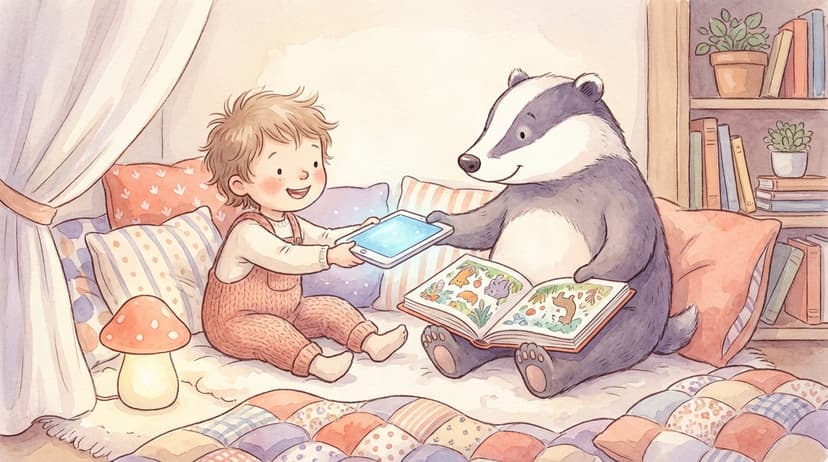
3. Replace One Screen Moment With a Story Moment
You don't need to ban screens. You need to displace them. Choose one daily moment where a screen currently fills the gap — after school, before dinner, at bedtime — and replace it with shared reading.
This single swap has outsized effects. Research shows that shared reading builds vocabulary, strengthens the parent-child bond, and calms the nervous system — the exact opposite of what passive screen time does.
37%
of U.S. fourth graders scored below the basic reading level in 2022, the lowest in decades
Source: National Assessment of Educational Progress (NAEP), 2022
4. Be Present, Not Productive
Slow parenting asks you to redefine what "doing something" looks like. Sitting on the floor while your child builds with blocks — without checking your phone — is doing something. Walking to the park without a podcast in your ears is doing something. Reading a bedtime story together without rushing through the pages is doing something.
Presence is the core practice. Everything else flows from it.
5. Say No to One Thing This Week
Look at your family's upcoming week. Find one commitment — one birthday party, one practice, one errand — that you can skip without consequence. Replace it with nothing. An open afternoon. A slow morning.
Notice how it feels. Notice how your child fills the space.
6. Let Them Struggle (a Little)
Slow parenting means resisting the urge to smooth every path. When your child struggles with a puzzle, a friendship, a zipper — pause before jumping in. Struggle is where competence grows. A child who is never allowed to fail is a child who never learns they can recover.
7. Build One Slow Ritual
Choose one daily moment to anchor your slow parenting practice. It could be a screen-free dinner, a bedtime reading ritual, a morning walk, or ten minutes of unstructured play together. Make it consistent. Make it unhurried.
The ritual becomes the container. Over time, it expands — not because you added more structure, but because you and your child discovered what fills the space when you stop rushing through it.
📖 A book that slows everything down
Sherly's personalized storybooks are built for the slow parenting philosophy. A hardcover book with your child's face on every page, read together at bedtime, with no notifications and no autoplay. Just you, your child, and a story where they're the hero. It's the kind of slow, present, meaningful moment that becomes a childhood memory — for both of you.
Ready to create your child's story?
Turn your child into the hero of a 30-page illustrated hardcover book. Upload a photo and see the magic.
What Does a Slow Parenting Day Actually Look Like?
It doesn't look like a productivity hack. There's no optimized morning routine pinned to the fridge.
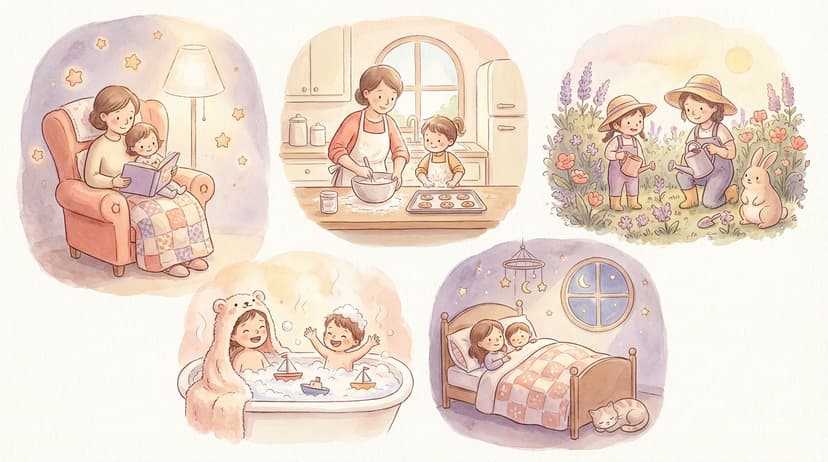
A slow parenting morning might mean waking up without a rush, eating breakfast together, and leaving ten minutes of buffer before school — not for an extra activity, but for whatever happens. A conversation. A silly game. A moment to notice the sky.
A slow parenting afternoon might mean coming home from school to a snack and an open hour. No lessons. No screens. Maybe the child reads. Maybe they play outside. Maybe they lie on the floor and stare at the ceiling. All of it counts.
A slow parenting evening might mean dinner without devices, a bedtime reading ritual that doesn't get cut short, and a few quiet minutes together before lights out.
The pattern is simple: fewer transitions, more depth. Fewer inputs, more presence.
We've confused a busy childhood with a rich childhood. They are not the same thing. A rich childhood has long afternoons with nothing to do. It has parents who aren't perpetually distracted. It has stories read slowly, games played fully, and silences that aren't immediately filled.
Will My Child Fall Behind If We Slow Down?
This is the fear that keeps parents on the treadmill. If we drop soccer, will they miss a scholarship? If we skip the coding camp, will they fall behind peers?
The research says no. A 2023 study from Stanford's Center on Adolescence found that children with fewer structured activities but more free play showed equal or higher academic achievement by middle school compared to overscheduled peers. They also showed lower rates of burnout and higher intrinsic motivation — meaning they wanted to learn, not just perform.
The children who fall behind aren't the ones with open afternoons. They're the ones who never learned to direct their own attention, tolerate frustration, or find meaning outside of external validation. Those skills are built in unstructured time — the exact thing slow parenting protects.
Frequently Asked Questions
Sherly Team
Children's Reading Specialists