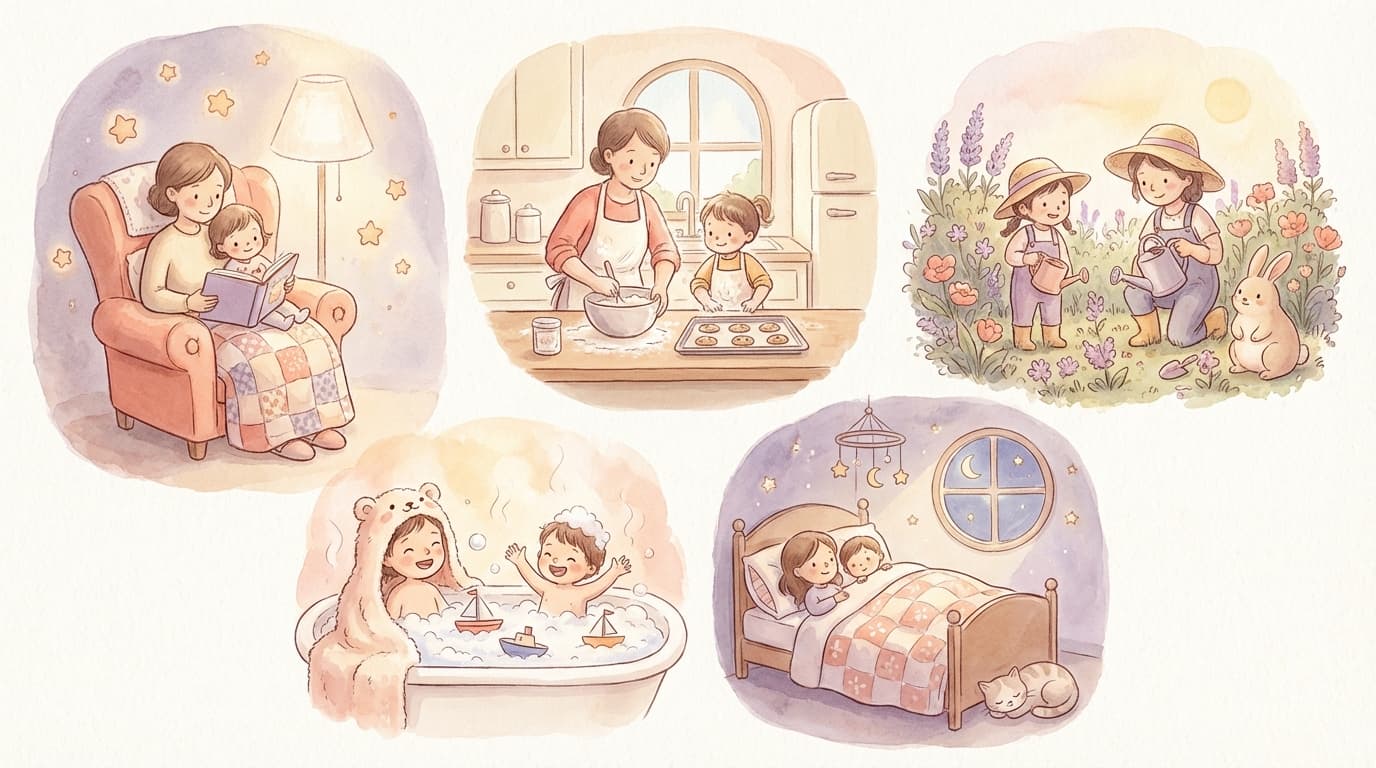
The daily rituals that make kids feel most loved are surprisingly simple: a warm greeting, focused one-on-one time, a bedtime story, physical affection, and a consistent "I love you" moment. Research from Harvard's Center on the Developing Child shows that these small, repeated interactions — not grand gestures or expensive gifts — are what build secure attachment, the single strongest predictor of a child's long-term emotional health.
A 2024 longitudinal study from the University of Minnesota found that children whose families maintained at least three consistent daily connection rituals showed 42% higher scores on measures of emotional security and were significantly less likely to develop anxiety or behavioral problems through adolescence. The rituals themselves don't need to be elaborate. They need to be consistent, warm, and present.
Why Do Rituals Matter More Than Big Moments?
Children's sense of being loved is built through repetition, not intensity. A surprise trip to a theme park is exciting but fades quickly. A nightly bedtime story, repeated for years, becomes woven into a child's identity and attachment system.
The neuroscience explains why. Repeated positive interactions strengthen neural pathways in the attachment circuitry — the orbitofrontal cortex, the vagus nerve, the oxytocin system. These pathways grow stronger with each repetition, like a trail that becomes a road that becomes a highway.
Children don't need perfect parents. They need present parents with predictable patterns of warmth. A daily ritual of connection — even just 10 minutes — communicates safety, love, and belonging more powerfully than any single event ever could.
A single act of kindness produces a spike of oxytocin. A daily ritual produces a sustained, elevated baseline of oxytocin, serotonin, and endorphins that shapes the child's developing nervous system. This is why consistency trumps intensity every time.
42%
higher emotional security scores in children whose families maintained at least three consistent daily connection rituals
Source: University of Minnesota Institute of Child Development, 2024
Ritual 1: The Warm Greeting — How Does Reconnection Affect Children?
The first ritual is the simplest: how you greet your child after a separation. Whether it's morning wake-up, school pickup, or coming home from work, the first 30 seconds set the emotional tone.
Research from the Gottman Institute found that the quality of the reunion moment after separation is one of the strongest predictors of attachment security. Children whose parents showed genuine warmth at reunion — eye contact, a smile, physical touch, a few words of connection — had 26% higher attachment security scores.
How to do it:
- •Stop what you're doing. Put down the phone, close the laptop, turn away from the counter.
- •Get on their level. Kneel, squat, or sit so you're face-to-face.
- •Make eye contact and smile. Before you say anything.
- •Say something specific. Not just "How was your day?" but "I've been thinking about you! Tell me one thing that happened."
- •Physical touch. A hug, a hand on the shoulder, whatever is natural.
This takes 30-60 seconds. The return on investment is enormous.
A 2023 study from the University of Virginia found that children who received a consistent warm greeting from their primary caregiver showed lower baseline cortisol levels throughout the day — meaning their nervous system was calmer overall, not just during the greeting.
Ritual 2: One-on-One Time — Why Does Focused Attention Build Security?
Dedicated one-on-one time — even just 10-15 minutes per day — is one of the most powerful gifts a parent can give. This isn't time in the same room while multitasking. It's time when the child has the parent's undivided attention.
10-15 minutes
of daily one-on-one focused attention is the minimum needed to maintain strong attachment security, according to attachment researchers
Source: Attachment and Human Development Journal, 2024
The concept, popularized by child therapist Dr. Garry Landreth, is called "special time" — and the research behind it is compelling. A 2024 study from the University of Denver found that children who received just 15 minutes of daily special time showed:
- •33% reduction in attention-seeking behavior
- •28% reduction in power struggles
- •41% increase in cooperative behavior
The mechanism is straightforward: when children know they'll get focused attention every day, they stop needing to seek it through misbehavior. Their attachment need is pre-emptively met.
How to do it:
- •Let the child lead. They choose the activity — play, drawing, conversation, reading
- •No phones, no screens, no siblings. Just you and them
- •Follow their interest. Don't redirect, teach, or correct
- •Name it. "This is our special time" — giving it a name makes it a ritual the child can anticipate and count on
- •Be consistent. Same time every day if possible
Children spell love T-I-M-E. Not quality time in the abstract, but specific, predictable, child-led time where the parent is fully present. When this becomes a daily ritual, it fundamentally changes the child's sense of security.
Ritual 3: Bedtime Reading — Why Is This the Most Powerful Ritual?
Of all daily rituals, bedtime reading stands alone in its breadth of benefits. It simultaneously strengthens attachment, builds literacy, develops emotional intelligence, provides a transition to sleep, and creates the most cherished childhood memories.
A 2024 report from the American Academy of Pediatrics described bedtime reading as a "multi-benefit intervention" that addresses physical health (sleep quality), mental health (anxiety reduction), cognitive development (vocabulary, comprehension), and relational health (attachment security) in a single daily practice.
78%
of adults who recall a strong parent-child bond cite bedtime reading as their most vivid positive childhood memory
Source: Scholastic Kids and Family Reading Report, 2024
What makes bedtime reading uniquely powerful:
- •Physical closeness — Cuddling while reading triggers oxytocin in both parent and child
- •Focused attention — Screens are off, the world is quiet, and the child has their parent's full presence
- •Emotional processing — The day's events can be processed through the lens of the story
- •Sleep quality — Reading calms the nervous system and signals the brain that sleep is approaching
- •Identity building — Especially with personalized books, bedtime reading reinforces the child's sense of self as they drift toward sleep
📖 Make bedtime the best moment of the day
Sherly's personalized hardcover storybooks turn bedtime reading into something extraordinary. When your child sees themselves as the hero across 30 illustrated pages, the ritual becomes deeply personal. The combination of physical closeness, a familiar story, and seeing themselves as brave and beloved creates the kind of memory — and attachment — that lasts a lifetime.
The timing matters too. Research from the University of Colorado found that stories heard at bedtime are processed during sleep consolidation, meaning the positive messages and emotional content are literally woven into long-term memory overnight.
Ready to create your child's story?
Turn your child into the hero of a 30-page illustrated hardcover book. Upload a photo and see the magic.
Ritual 4: Physical Affection — How Does Touch Build Emotional Security?
Physical affection — hugs, cuddles, a hand on the back, a gentle hair ruffle — is the oldest and most fundamental way humans communicate love. And for children, it's not optional for healthy development.
Research from the Touch Research Institute at the University of Miami has consistently shown that children who receive regular positive physical affection from caregivers show:
- •Lower cortisol levels (less stress)
- •Higher oxytocin levels (more bonding and trust)
- •Better immune function
- •Stronger emotional regulation
- •Higher self-esteem
Touch is the first language of love. Before a child understands words, they understand being held. Making physical affection a deliberate daily practice — not just reactive but proactive — tells the child they are loved in the language their body understands best.
The key is proactive, not reactive affection. Don't wait for your child to seek a hug. Offer affection throughout the day: a good-morning hug, a hand on the shoulder while they eat breakfast, a cuddle during reading, a kiss goodnight.
A 2023 study from the University of Notre Dame found that children who received an average of 8-12 positive touches per day from their primary caregiver showed optimal attachment security scores. The type of touch mattered less than the consistency and warmth.
For children who are less physically affectionate, respect their boundaries while finding alternatives: a special handshake, sitting close during reading, a high-five, or a gentle hand on the back. The child should always feel that physical affection is available but never forced.
Ritual 5: The "I Love You" Moment — Does Saying It Every Day Really Matter?
Yes — and the research is unambiguous. Children who hear "I love you" daily from a parent show higher self-esteem, lower anxiety, and stronger attachment security than children who are loved but hear it less frequently.
A 2024 study from the University of Arizona found that the simple phrase "I love you," said with eye contact and warmth, produced a measurable cortisol reduction in children aged 3-10. The effect was strongest when it was part of a consistent ritual — not random, but predictable.
Measurable cortisol reduction
in children who heard 'I love you' with eye contact and warmth as part of a daily ritual
Source: University of Arizona Department of Psychology, 2024
The most effective "I love you" rituals:
- •Specific and unconditional — "I love you no matter what happened today"
- •Connected to identity — "I love who you are"
- •At a transition point — Before school, at bedtime, or during a separation
- •With eye contact — The visual connection amplifies the emotional impact
- •Combined with touch — A hug + "I love you" is more powerful than either alone
Some parents worry about saying it too often. Research has found no upper limit where "I love you" loses its impact — as long as it remains genuine rather than mechanical. The key is sincerity, not frequency.
How Do You Build Rituals That Last?
Starting rituals is easy. Maintaining them through busy schedules, travel, illness, and the chaos of family life is the challenge. Here's what the research says about sustainable rituals:
Attach to existing anchors. The most durable rituals attach to moments that already happen every day: waking up, meals, school transitions, bathtime, bedtime.
Start with one. Don't try to add five rituals at once. Choose the one that feels most natural and build it for two weeks before adding another.
Make it specific. "We'll spend more quality time" fails. "Every night at 7:30 we read one book together on the couch" succeeds.
Protect it fiercely. A ritual that gets skipped "just this once" becomes a ritual that gets skipped often. Consistency is the active ingredient.
Involve the child. Let them have input — choosing the bedtime book, deciding the special time activity, creating a secret handshake for the greeting ritual. Ownership builds investment.
A 2023 study from Brigham Young University found that families who maintained connection rituals for at least 21 consecutive days had an 89% continuation rate at six months. The 21-day threshold appears to be the point where the ritual shifts from deliberate practice to automatic habit.
What If You've Missed Years of Rituals?
It's never too late. The brain remains plastic throughout childhood, and even into adolescence, new rituals can strengthen attachment and connection.
A 2024 study from the University of Minnesota found that families who introduced daily connection rituals after the child's sixth birthday still showed significant improvements in attachment security within three months.
The approach for starting later:
- •Don't force it. Older children may be initially resistant to rituals that feel sudden or unfamiliar
- •Explain the why. "I want us to have a special time together every day because you matter to me"
- •Start with what works for your child. A tween who won't sit for a picture book might welcome a card game, a walk, or a cooking session
- •Be patient. The child may test whether you'll keep showing up. Keep showing up.
The most important thing isn't which rituals you choose — it's that you choose them consciously, maintain them consistently, and bring genuine warmth to each one. Five minutes of fully present connection, repeated daily, builds a foundation that lasts a lifetime.
Frequently Asked Questions
Sherly Team
Children's Reading Specialists