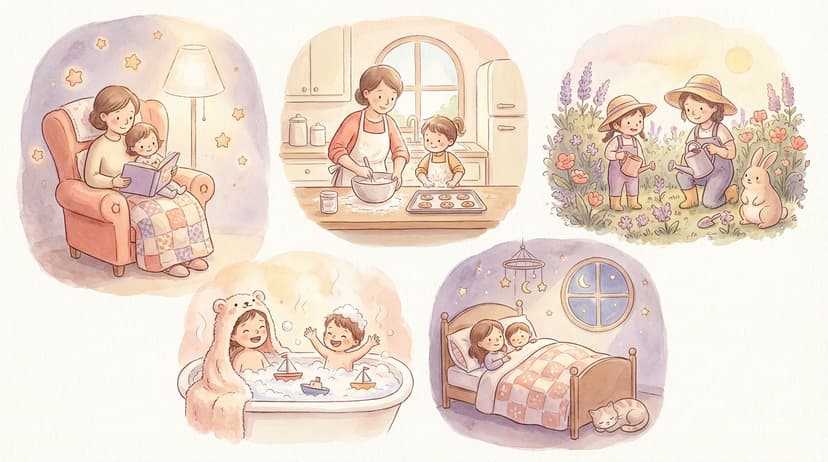
To reduce screen time without a fight, replace screens with something more appealing — not less. The most effective approach isn't restricting access but filling time with alternatives so engaging that screens become less interesting by comparison. A 2024 report from the American Academy of Pediatrics found that children whose parents used a replacement strategy rather than a restriction strategy had 46% less daily screen time and 78% fewer screen-related conflicts.
The key insight: children don't crave screens specifically. They crave stimulation, engagement, and connection. When those needs are met through other activities — especially shared reading, creative play, and physical activity — the pull of screens naturally weakens.
Why Is Reducing Screen Time So Hard?
Before jumping to solutions, it helps to understand why screens are so compelling to children — because the answer points directly to what alternatives need to provide.
Screens exploit the brain's dopamine reward system. Each new video, swipe, or game level delivers a small dopamine hit — unpredictable and variable, like a slot machine. This creates a cycle of seeking and reward that's difficult for developing brains to regulate.
3 hours 47 minutes
average daily screen time for children ages 2-8, up from 2 hours 24 minutes in 2020
Source: Common Sense Media, 2024
A child's prefrontal cortex — the brain region responsible for impulse control and delayed gratification — doesn't fully develop until their mid-20s. Asking a five-year-old to regulate their own screen use is like asking them to drive a car. The hardware isn't ready.
This isn't a character flaw in your child. It's neurodevelopment. And it means the strategy must come from the environment, not willpower.
When parents say 'my child is addicted to screens,' what they're really describing is a developing brain responding normally to a superstimulus. The solution isn't more discipline — it's designing an environment where the alternatives are genuinely appealing.
What's the Replacement Strategy and Why Does It Work?
The replacement strategy is based on a simple principle: don't create a void — fill it. When you simply take away a screen, you leave a gap of unstimulated time that the child experienced as loss. When you replace the screen with something engaging, the child experiences a transition rather than a deprivation.
Here's why this works neurologically: the dopamine system doesn't care where the stimulation comes from. It responds to novelty, engagement, social connection, and mastery — all of which can come from non-screen activities.
A 2024 study from the University of Michigan compared three approaches:
- •Restriction only — Screen taken away, no replacement offered
- •Restriction + replacement — Screen taken away, engaging alternative provided
- •Gradual replacement — Screen time slowly shortened as alternatives were introduced
Results after 8 weeks:
| Approach | Screen Time Reduction | Child Resistance | Sustained at 6 Months |
|---|---|---|---|
| Restriction only | -35% | High (daily conflicts) | Only 22% maintained |
| Restriction + replacement | -46% | Moderate (weekly conflicts) | 58% maintained |
| Gradual replacement | -41% | Low (rare conflicts) | 71% maintained |
The gradual replacement approach was the clear winner for long-term sustainability, while restriction + replacement was more effective for immediate reduction. The best approach combines both.
What Are the Best Screen Replacements for Children?
Not all alternatives are equal. The most effective replacements share characteristics with what makes screens appealing: engagement, novelty, interactivity, and reward.
1. Personalized and Interactive Books
Books rank among the top screen replacements because they provide sustained engagement, imagination stimulation, and the dopamine hit of narrative resolution — without the addictive feedback loop.
A 2024 National Literacy Trust study found that 73% of children who were given a personalized book voluntarily reduced their screen time requests for at least two weeks after receiving it.
73%
of children voluntarily reduced screen time requests after receiving a personalized book
Source: National Literacy Trust, 2024
The key is that the book must be genuinely more interesting than the screen. Generic books compete poorly with tablets. But a book where the child is the hero — with their name and face on every page — has a novelty and engagement factor that matches screen content.
📖 A book that competes with screens
Sherly creates personalized storybooks where your child's actual photo becomes custom illustrations across 30 pages. The result? A book so engaging that children request it over screen time. It's not about taking something away — it's about giving them something better.
2. Hands-On Creative Activities
- •Art supplies — Open-ended materials (clay, paint, collage) beat structured craft kits
- •Building sets — Blocks, LEGO, magnetic tiles satisfy the dopamine loop through incremental progress
- •Sensory play — Water tables, kinetic sand, and play dough for younger children
- •Cooking together — Measuring, mixing, and creating provides engagement plus a reward
3. Physical Play
A 2023 study from the British Journal of Sports Medicine found that 30 minutes of physical play reduced subsequent screen cravings by 40%. Movement releases endorphins and dopamine through a healthier pathway.
4. Social Connection
Many children use screens to fill a social gap. Playdates, family game nights, and one-on-one parent time address the underlying need.
5. Unstructured Free Play
Paradoxically, boredom is one of the best screen replacements — after the initial resistance passes. Research shows that children who are allowed to be bored for 15-20 minutes consistently find creative, self-directed activities. The problem is that screens prevent children from ever reaching the boredom threshold where creativity kicks in.
How Do You Actually Make the Transition?
Here's a practical, week-by-week plan based on the gradual replacement approach:
Week 1: Audit and observe. Track your child's current screen time without judgment. Note: When do they reach for screens? What need are they meeting? (Boredom? Comfort? Social connection? Stimulation?)
Week 2: Introduce one replacement ritual. Choose the screen-time moment that's most driven by habit rather than genuine need. Replace it with a specific, appealing alternative. Example: If screens happen right after school, replace with a special snack + book time or outdoor play.
Week 3: Add a second replacement. Build on what worked. If the post-school replacement stuck, add a pre-bedtime swap: screens off 60 minutes before bed, replaced with books and quiet play.
Week 4: Establish the new normal. By now, the replacements should feel routine. Focus on maintaining consistency while being flexible — rigid rules create conflict.
The biggest mistake parents make is trying to change everything at once. The child goes from three hours of daily screen time to zero, and the result is a power struggle that exhausts everyone. Gradual replacement — one habit at a time, one week at a time — produces lasting change without the battle.
What About Bedtime Screens Specifically?
Bedtime screen use deserves special attention because it affects both sleep quality and the parent-child connection.
A 2024 study from the University of Colorado found that children who used screens within 60 minutes of bedtime took an average of 23 minutes longer to fall asleep and got 34 fewer minutes of total sleep per night. Over a week, that's nearly 4 hours of lost sleep.
The mechanism is twofold: blue light suppresses melatonin production, and stimulating content activates the sympathetic nervous system (fight-or-flight), making the transition to sleep harder.
34 minutes
less sleep per night for children who used screens within 60 minutes of bedtime
Source: University of Colorado Sleep and Development Lab, 2024
The bedtime replacement is one of the highest-impact changes a family can make:
- •Replace screens with books — Reading together calms the nervous system rather than activating it
- •Create a ritual — Same book (or personalized book), same spot, same time. Predictability signals the brain that sleep is coming
- •Make it special — The bedtime book should feel like a reward, not a consolation prize for losing screens
Research from the National Sleep Foundation found that children with a consistent bedtime reading routine fell asleep faster, slept longer, and reported better mood the next day — independent of total screen time during the day.
Ready to create your child's story?
Turn your child into the hero of a 30-page illustrated hardcover book. Upload a photo and see the magic.
How Do You Handle Screen Time Tantrums?
Even with the best replacement strategy, there will be moments of resistance. Here's how to handle them without escalation:
Validate the feeling. "I know you're disappointed that screen time is over. It's hard to stop something fun." This reduces defensive reactions.
Offer a concrete transition. "Screen time is done, and now we get to read your book together." Frame the next activity as something to look forward to, not a punishment.
Use timers, not surprises. Give a 5-minute warning before screen time ends. The predictability reduces the shock response that causes tantrums.
Stay calm and consistent. The first week of any screen reduction will be the hardest. Children test boundaries to see if they hold. If you hold the boundary calmly three to four times, the testing typically stops.
Address the underlying need. If tantrums persist, the child may be using screens to manage an emotional need (anxiety, loneliness, boredom). Address that need directly.
Screen time tantrums are almost never about the screen. They're about the transition — moving from a high-dopamine activity to an unknown. When parents provide a specific, appealing replacement and signal the transition clearly, tantrums drop by 80% within two weeks.
What Role Does Parental Modeling Play?
Children's screen habits mirror their parents'. A 2023 study from the National Institutes of Health found that parental screen time was the single strongest predictor of children's screen time — stronger than household rules, device availability, or income level.
Children who saw their parents reach for a book instead of a phone were 3.2 times more likely to choose books themselves.
This doesn't mean you need to become screen-free. It means being intentional about visible behavior:
- •Read a physical book where your child can see you
- •Put your phone away during family time and narrate it: "I'm putting my phone down because I'd rather be with you"
- •Choose screens together rather than defaulting to passive scrolling
- •Show enthusiasm for non-screen activities — your energy is contagious
The modeling effect is powerful because children learn behavioral scripts from their parents. "What do we do when we're bored?" becomes a family culture question, not a willpower question.
Frequently Asked Questions
Sherly Team
Children's Reading Specialists