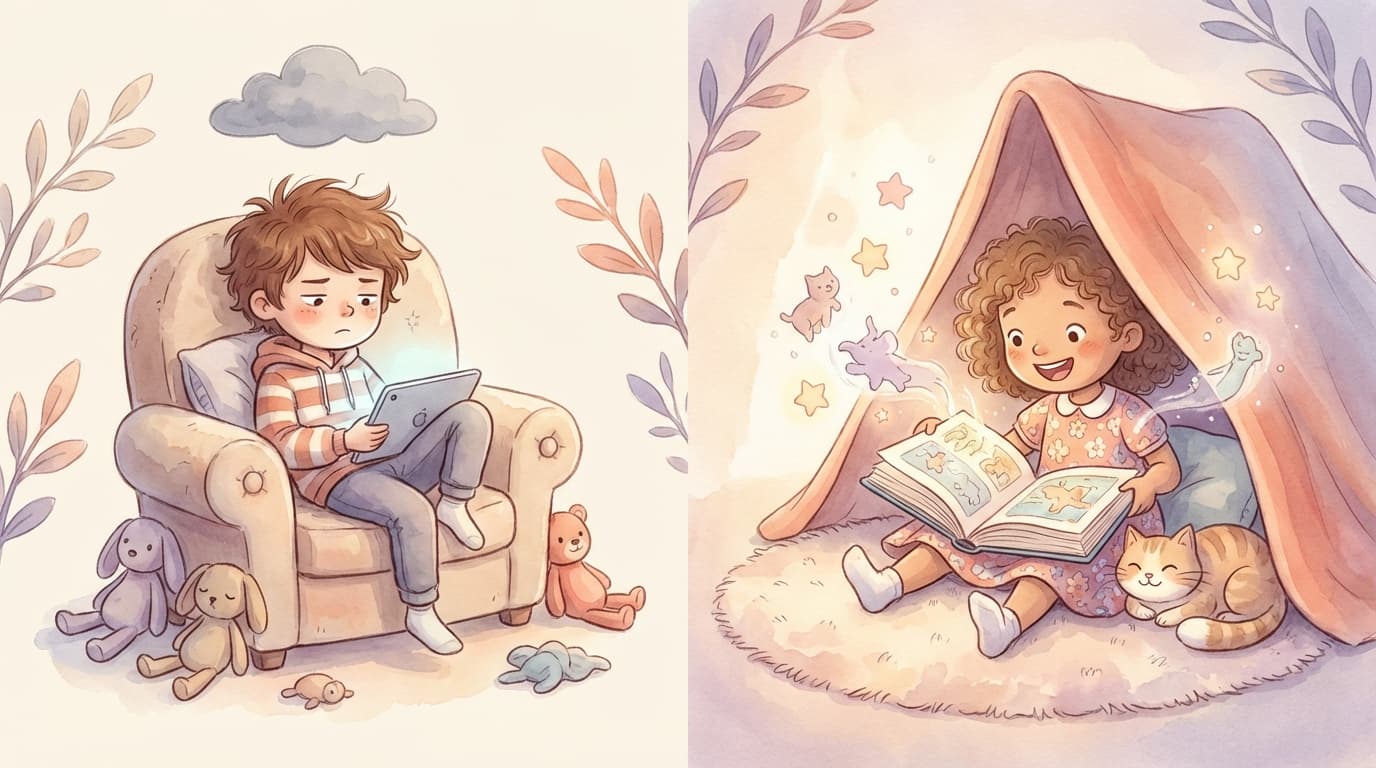
Screen time vs reading is not an all-or-nothing choice, but the research is clear: when it comes to language development, comprehension, and brain architecture, reading — especially shared reading with a parent — significantly outperforms passive screen consumption. The key is understanding what each medium does to a developing brain and making informed choices.
According to a 2023 report from Common Sense Media, children ages 8-12 spend an average of 5 hours and 33 minutes per day on entertainment screen media, while average time spent reading has declined to approximately 26 minutes. This imbalance has measurable consequences for literacy and cognitive development.
What Does Screen Time Do to a Child's Brain Differently Than Reading?
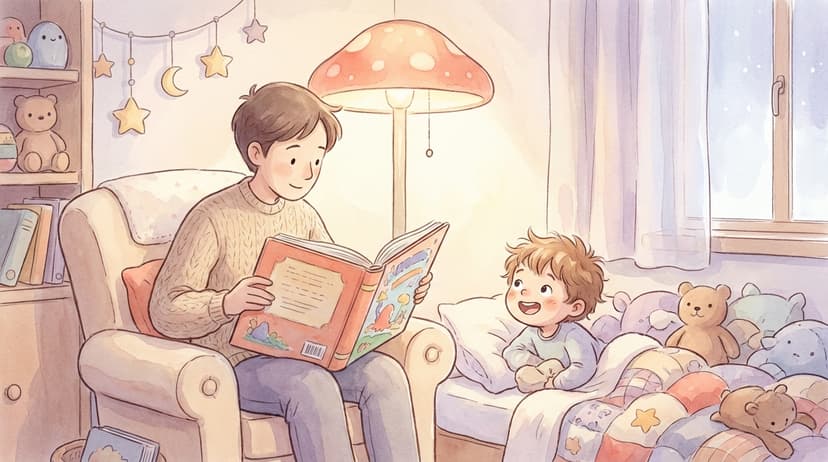
The fundamental difference is active versus passive processing. Reading — whether being read to or reading independently — requires the brain to generate its own images, predict outcomes, and construct meaning from abstract symbols. Screen content delivers pre-made images and rapid stimulation that the brain receives passively.
A 2020 neuroimaging study from Cincinnati Children's Hospital found that preschool-age children with higher screen use showed less structural integrity in white matter tracts supporting language and literacy — the same tracts that strengthen with regular reading exposure.
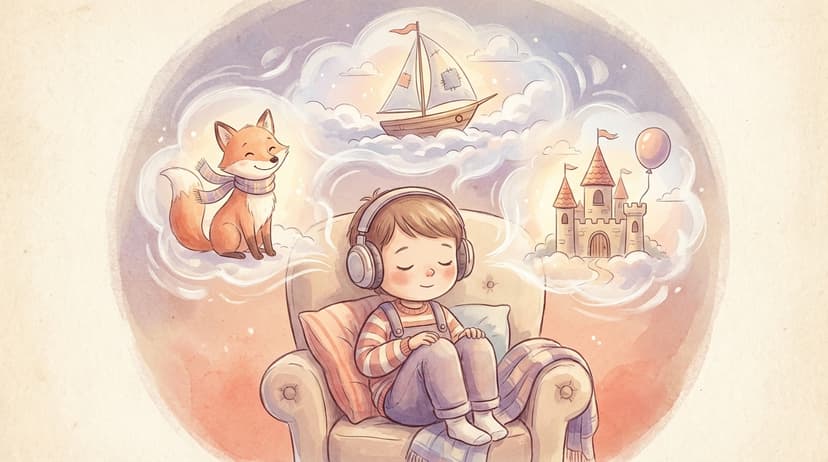
The brain is a use-it-or-lose-it organ. When a child watches a video, the visual cortex is fed ready-made images. When they hear a story, the brain must generate those images itself. That generation process builds the neural architecture for imagination, comprehension, and abstract thinking.
This doesn't mean all screen content is equal. Educational interactive content (where the child makes choices, solves problems, or creates) activates more brain regions than passive video consumption. But even the best interactive apps don't replicate the cognitive demands of sustained reading.
5h 33m
average daily entertainment screen time for children ages 8-12
Source: Common Sense Media, 2023
Does Screen Time Directly Harm Reading Ability?
The research suggests a displacement effect rather than a direct harm. Every hour spent on screens is an hour not spent reading, being read to, or engaging in the kind of rich conversation that builds literacy. Over time, this displacement compounds.
A 2019 study published in JAMA Pediatrics followed over 2,400 children and found that higher screen time at ages 24 and 36 months was associated with poorer performance on developmental screening at 36 and 60 months, respectively. The relationship was dose-dependent — more screen time correlated with lower scores.
However, context matters enormously:
- •Video calls with relatives — social, interactive, minimal harm
- •Co-viewed educational content with parent discussion — moderate benefit
- •Solo passive video consumption — largest negative association
- •Interactive reading apps — mixed results, depends on design quality
It's not that screens are inherently toxic. It's that they're incredibly efficient at displacing the activities we know build brains — conversation, play, reading, and exploration. The question isn't 'are screens bad?' It's 'what is your child not doing because they're on a screen?'
What Are the Benefits of Reading That Screens Can't Replace?
Several cognitive benefits are unique to reading or significantly stronger during reading compared to screen use:
1. Vocabulary development Children's books contain 50% more rare words than prime-time television or college-educated adult conversations, according to research by Hayes and Ahrens (1988). This finding has been replicated multiple times. The language of even simple picture books is richer than most spoken language children encounter.
2. Sustained attention Reading requires maintaining focus on a single stream of information without the novelty-driven interruptions that characterize digital media. A 2022 study from the University of Alberta found that children who read for 20+ minutes daily showed significantly better sustained attention scores than non-readers, regardless of screen time.
3. Theory of mind Understanding other people's thoughts and feelings develops more strongly through narrative fiction than through video content. A 2013 study published in Science found that reading literary fiction temporarily enhanced theory of mind in adults — and subsequent research suggests the effect is even stronger in developing children.
50%
more rare words in children's books than in prime-time TV dialogue
Source: Hayes & Ahrens, 1988 (replicated 2019)
4. Sleep quality Screen use before bed suppresses melatonin production through blue light exposure. Reading does the opposite — it activates the parasympathetic nervous system and reduces cortisol. The American Academy of Pediatrics recommends replacing screens with reading for at least 30-60 minutes before bedtime.
What's a Realistic Balance Between Screens and Books?
Rather than aiming for zero screen time (unrealistic for most families), focus on protecting reading time and managing the quality and timing of screen use.
Ready to create your child's story?
Turn your child into the hero of a 30-page illustrated hardcover book. Upload a photo and see the magic.
Evidence-based guidelines from the AAP:
- •Under 18 months: No screen media other than video calls
- •18-24 months: High-quality programming only, co-viewed with a parent
- •2-5 years: Maximum 1 hour/day of high-quality content
- •6+: Consistent limits that ensure screens don't displace sleep, physical activity, or reading
Practical strategies for protecting reading time:
- •Reading first, screens second — establish reading as the default before allowing screen access
- •No screens in the bedroom — this single rule improves both sleep quality and reading habits
- •Match screen time to reading time — for every 30 minutes of screens, 30 minutes of reading
- •Create "reading pockets" — car rides, waiting rooms, the 30 minutes before bed
- •Model the behavior — children whose parents read are significantly more likely to read themselves
💡 The 'one book before one screen' rule
Many families find success with a simple rule: one book before any screen time. This establishes reading as a normal, non-negotiable part of the day without framing screens as the enemy. Over time, children often start reaching for books voluntarily.
Are Reading Apps and E-Books as Good as Physical Books?
The answer is nuanced. E-books on dedicated readers (Kindle, etc.) provide similar comprehension benefits to print books, with some studies showing slight advantages for print in younger children due to the tactile experience.
However, reading apps with interactive features (animations, games, sound effects) tend to produce lower comprehension than either print or plain e-books. A 2019 meta-analysis from the University of Valencia found that interactive digital features actually distracted children from the narrative, leading to better recall of multimedia elements but poorer recall of story content.
The bells and whistles in reading apps are designed to keep children engaged, but they often keep them engaged with the wrong things. A child tapping hotspots on a page is playing a game, not reading a story. The simpler the digital reading experience, the closer it gets to the benefits of print.
Key findings on digital vs. print reading:
- •Print books produce slightly better comprehension in children under 6
- •Plain e-books (no interactive features) are comparable to print for children 6+
- •Interactive reading apps reduce comprehension compared to both print and plain e-books
- •Physical books promote more parent-child interaction during shared reading
- •The physicality of turning pages aids sequential memory and spatial understanding of narratives
📖 The best of both worlds
Sherly books come as premium hardcover editions with digital and audiobook versions included. Your child gets the tactile benefits of a real 30-page hardcover book — where they're the hero through custom illustrations — plus a digital version for travel and an audiobook they can listen to independently.
What Does the Latest Research Say About Long-Term Outcomes?
The longest-running studies on reading versus screen exposure are now showing results, and the findings are consistent.
A 2024 longitudinal study from the National Institute of Child Health and Human Development (NICHD) tracked children from age 3 to age 15 and found that early reading habits were a stronger predictor of academic success at age 15 than early screen habits were a predictor of academic difficulty. In other words, the presence of reading mattered more than the absence of screens.
This is encouraging for parents who worry about their child's screen consumption: adding reading to your child's routine may be more impactful than reducing screen time. Both matter, but reading is the stronger lever.
A 2023 study from the University of Michigan found that children who maintained regular reading habits alongside moderate screen use performed comparably to children with low screen use — but children with high screen use and no reading habit performed significantly worse. Reading appears to be protective, buffering the potential negative effects of screen time.
Frequently Asked Questions
Sherly Team
Children's Reading Specialists