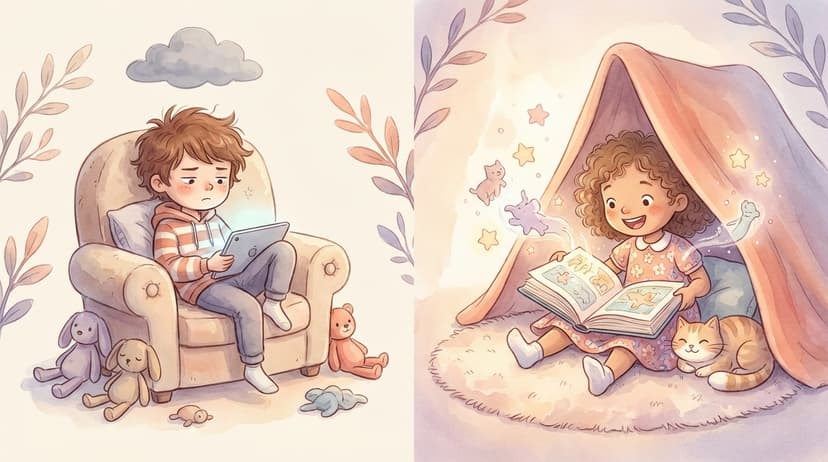
The Anxious Generation by Jonathan Haidt argues that childhood shifted from play-based to phone-based around 2010-2015 — and that this single shift is the primary driver behind the surge in teen anxiety, depression, and self-harm. The book lays out four foundational harms of a phone-based childhood, proposes four collective norms to reverse them, and backs it all with data that's hard to ignore.
If you haven't read it yet, here's what you need to know — and what you can start doing today.
Why Did This Book Become a Cultural Phenomenon?
Jonathan Haidt, a social psychologist at NYU's Stern School of Business, published The Anxious Generation in March 2024. It hit the New York Times bestseller list within a week and stayed there for months. School boards cited it. Legislators referenced it. Parent groups organized around it.
The reason is simple: it named what millions of parents already felt.
Something changed. Kids are more anxious, more depressed, more fragile than a generation ago. And the timing lines up almost perfectly with the arrival of smartphones and social media in children's lives.
7.1% to 10.6%
increase in childhood anxiety diagnoses from 2016 to 2022 among U.S. children ages 3-17
Source: CDC National Survey of Children's Health, 2022
Haidt doesn't just point at screens and shout. He builds a careful, evidence-rich argument about how the phone-based childhood harms kids — and what replaces what was lost. That structure is what makes the book so useful for parents.
What Is the "Great Rewiring of Childhood"?
Haidt describes a historic shift that happened in two phases.
Phase one (1980s-2000s): The decline of play-based childhood. Parents, driven by fear of abduction and liability culture, began restricting unsupervised outdoor play. Kids moved indoors. Free-range childhood shrank.
Phase two (2010-2015): The rise of phone-based childhood. Smartphones became standard. Social media platforms lowered age restrictions. The average age a child received their first smartphone dropped to 10-12. By 2015, a majority of American teens had both a smartphone and at least one social media account.
The combination was devastating. Children lost the real-world experiences that build resilience — free play, face-to-face conflict resolution, boredom, physical risk-taking — and replaced them with algorithmically curated content designed to maximize engagement, not wellbeing.
We have overprotected children in the real world while underprotecting them in the virtual world. We got it exactly backwards.
This isn't nostalgia. Haidt presents data showing that childhood mental health was relatively stable from the 1990s through 2010 — and then declined sharply. The timing doesn't match economic recessions, school shootings, or climate anxiety. It matches smartphones.
What Are the Four Foundational Harms?
Haidt identifies four specific mechanisms through which a phone-based childhood damages mental health. Understanding these helps you see beyond "screens are bad" and toward why they're harmful and what to protect.
1. Social Deprivation
Children need face-to-face interaction to develop social skills, empathy, and secure attachment. When socializing moves to screens — texting, DMs, social media comments — the richness evaporates. No eye contact. No tone of voice. No physical play.
A 2023 study from the American Journal of Preventive Medicine found that teens who spent more than three hours daily on social media had double the risk of depression and anxiety symptoms. But it's not just the screen time itself — it's what the screen time displaces.
Every hour on a phone is an hour not spent building a fort, arguing over game rules, or sitting in comfortable silence with a friend. Those unglamorous experiences build emotional muscle.
2. Sleep Deprivation
Smartphones in bedrooms destroy sleep. The blue light suppresses melatonin. The social anxiety of unanswered messages keeps the mind racing. The infinite scroll has no natural stopping point.
The National Sleep Foundation reports that 72% of teens bring their phone to bed. Among those who do, average sleep duration drops by 30-45 minutes per night. Chronic sleep loss in adolescence is directly linked to anxiety, depression, impaired learning, and emotional dysregulation.
3. Attention Fragmentation
The developing brain needs sustained focus to build deep thinking skills. Smartphones fragment attention into tiny slivers — a notification here, a scroll there, a video that autoplays into another video.
Haidt cites research showing that the mere presence of a smartphone on a desk reduces cognitive capacity, even when the phone is face-down and silenced. The brain allocates resources to not checking it. For a child whose executive function is still developing, this tax is even higher.
4. Addiction
Social media platforms are engineered for compulsive use. Variable reward schedules (like a slot machine), social comparison metrics (likes, followers), and infinite scroll are not accidents. They're design choices optimized for engagement.
Haidt argues that calling this "addiction" is not hyperbole. The behavioral patterns — compulsive checking, withdrawal symptoms, continued use despite negative consequences — mirror substance addiction. And children's brains, with their still-developing prefrontal cortex, are especially vulnerable.
3x
increase in teen depression since 2012, coinciding with widespread smartphone and social media adoption
Source: Monitoring the Future Survey / CDC YRBS, 2012-2023
What Are Haidt's Four Recommended Norms?
This is where the book moves from diagnosis to prescription. Haidt argues that individual family rules aren't enough — we need collective action. One family banning smartphones doesn't work when every other child has one. He proposes four norms:
Norm 1: No Smartphones Before High School
Give children a basic phone (calls and texts only) until age 14. Smartphones — with app stores, browsers, and social media access — should wait until ninth grade. This isn't about distrust. It's about brain readiness.
Norm 2: No Social Media Before 16
Social media platforms are designed for adults. The social comparison, public performance, and algorithmic amplification of extreme content are harmful to developing minds. Age 16 allows for more developed executive function and identity formation.
Norm 3: Phone-Free Schools
Schools should require phones to be stored in lockers or phone pouches (like Yondr pouches) during the entire school day. Not silenced. Not in backpacks. Physically inaccessible. Schools that have implemented this report improved focus, better social interaction, and reduced bullying.
Norm 4: More Unsupervised Play and Independence
Children need age-appropriate freedom to explore, take risks, and resolve conflicts without adult intervention. This means allowing walk-to-school independence, unsupervised backyard play, and neighborhood exploration based on the child's maturity — not based on fear.
Children cannot learn to manage risk if they never encounter it. They cannot develop social competence if every interaction is mediated by adults. Free play is not a luxury. It is a developmental necessity.
What Can You Do Right Now?
Haidt's norms require collective action, but you don't have to wait for society to catch up. Here are steps you can take today:
Delay the smartphone. If your child is under 14, a basic phone handles safety needs without the risks. If they already have a smartphone, consider strict parental controls that remove browsers and social media.
Protect sleep. All devices charge outside the bedroom. No exceptions. Buy a $10 alarm clock. This single change improves sleep by an average of 30 minutes per night.
Create phone-free zones. Meals, car rides, and the first and last hour of the day should be screen-free. These become natural pockets for conversation, reading, and the kind of unstructured downtime children's brains need.
Reclaim boredom. Boredom is not a problem to solve — it's the spark of creativity. When your child says "I'm bored," resist the urge to hand them a screen. Give them time. They'll find something.
Replace screen time with story time. This isn't about punishment or restriction. It's about offering something better. A physical book that features your child as the hero provides exactly the kind of experience the phone-based childhood erodes — sustained attention, narrative imagination, emotional processing, and deep connection with you.
Build a coalition. Talk to other parents. Haidt's research shows that norms work when groups adopt them together. If four or five families in your child's friend group agree to delay smartphones, the social pressure disappears.
📖 The antidote to the phone-based childhood
Haidt's research points to what children need more of: real-world experiences that build imagination, connection, and identity. A Sherly book delivers all three. Your child sees themselves as the hero across 30 custom-illustrated pages — a tangible, screen-free experience that builds the narrative identity and sustained attention that phone-based childhood erodes. It's not a replacement for free play and friendships. But it's a powerful daily ritual that pulls in the right direction.
How Does Reading Fit Into the Solution?
Haidt doesn't prescribe reading specifically, but his framework makes the case for it clearly. Each of his four harms has a reading-based antidote:
- •Social deprivation — Shared reading is a deeply social act. When you read with your child, you make eye contact, discuss the story, laugh together, and sit in physical closeness. It strengthens attachment.
- •Sleep deprivation — A bedtime reading routine replaces screens before bed with an activity that activates the parasympathetic nervous system and reduces cortisol.
- •Attention fragmentation — Reading demands sustained focus on a single narrative. It trains the brain to hold attention, build mental images, and resist distraction. A child who reads 20 minutes a day is practicing deep focus.
- •Addiction — Books don't have algorithms. They don't send notifications. They don't hijack dopamine with variable reward schedules. A book ends. A child closes it and goes to sleep. That's by design.
A 2024 study from the National Literacy Trust found that children who read daily for pleasure were three times more likely to report high life satisfaction and significantly less likely to report feelings of anxiety compared to non-readers. Reading isn't just the absence of screens. It's an active protective factor.
The research on how stories shape a child's identity adds another layer. When children engage with narrative — especially stories where they see themselves reflected — they build what psychologists call a "narrative identity." This internal story of who they are becomes a buffer against the identity threats that social media amplifies.
Reading is an act of resistance against the attention economy. Every time a child sits with a book, they are practicing the exact cognitive skills that smartphones erode — sustained attention, imagination, and the ability to sit with complexity.
Is Haidt Right About Everything?
Honest answer: the book has critics, and some of their points are worth hearing.
Some researchers argue Haidt overstates the causal link between smartphones and teen mental health, noting that correlation does not prove causation and that effect sizes in some studies are small. Dr. Candice Odgers at UC Irvine has pointed out that many large-scale studies find only modest associations between screen time and wellbeing.
Others note that the book focuses primarily on American and Anglophone data, and that the mental health trends vary by country and culture.
Haidt's response — and the response of many clinicians — is that even modest average effects translate to enormous population-level harm when billions of children are exposed. And that the timing, the dose-response relationship, and the convergence across multiple data sources make a compelling circumstantial case even without a smoking-gun experiment.
For parents, the practical takeaway remains the same regardless of where you land on the academic debate: more free play, more face-to-face connection, more reading, and less phone-based living is good for your child. That's not controversial. It's common sense backed by decades of developmental research.
Ready to create your child's story?
Turn your child into the hero of a 30-page illustrated hardcover book. Upload a photo and see the magic.
Frequently Asked Questions
Sherly Team
Children's Reading Specialists