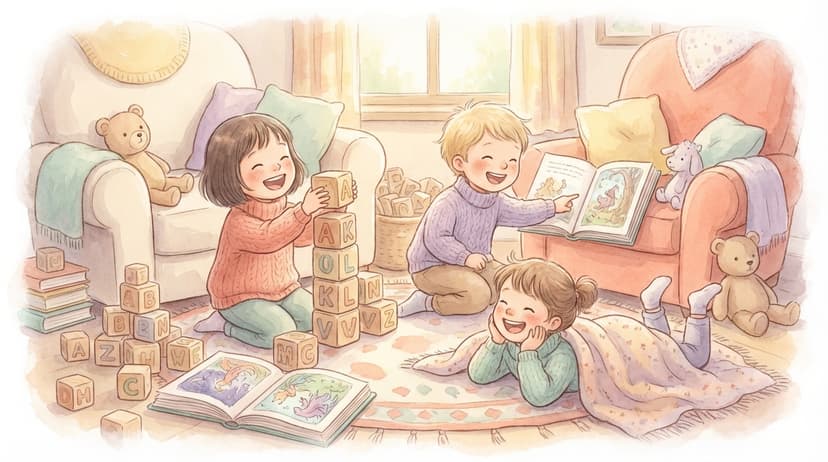
Unstructured play is not wasted time. It is the single most powerful engine for childhood development — more effective than enrichment classes, tutoring sessions, or structured activities at building the skills children need most: executive function, creativity, emotional regulation, and social competence. If your child's schedule is packed and you feel guilty about the one empty afternoon, flip that guilt. The empty afternoon is doing the heaviest lifting.
The American Academy of Pediatrics (AAP) issued a clinical report in 2018 calling play "essential to development" and urging pediatricians to write prescriptions for play at every well-child visit. Not structured play. Not educational games. Play — the messy, child-directed, no-adult-agenda kind. The kind that looks like nothing and builds everything.
What Counts as "Unstructured Play"?
Unstructured play is any activity where the child decides what to do, how to do it, and when to stop. No instructions. No curriculum. No coach. The child is the architect.
It looks like this:
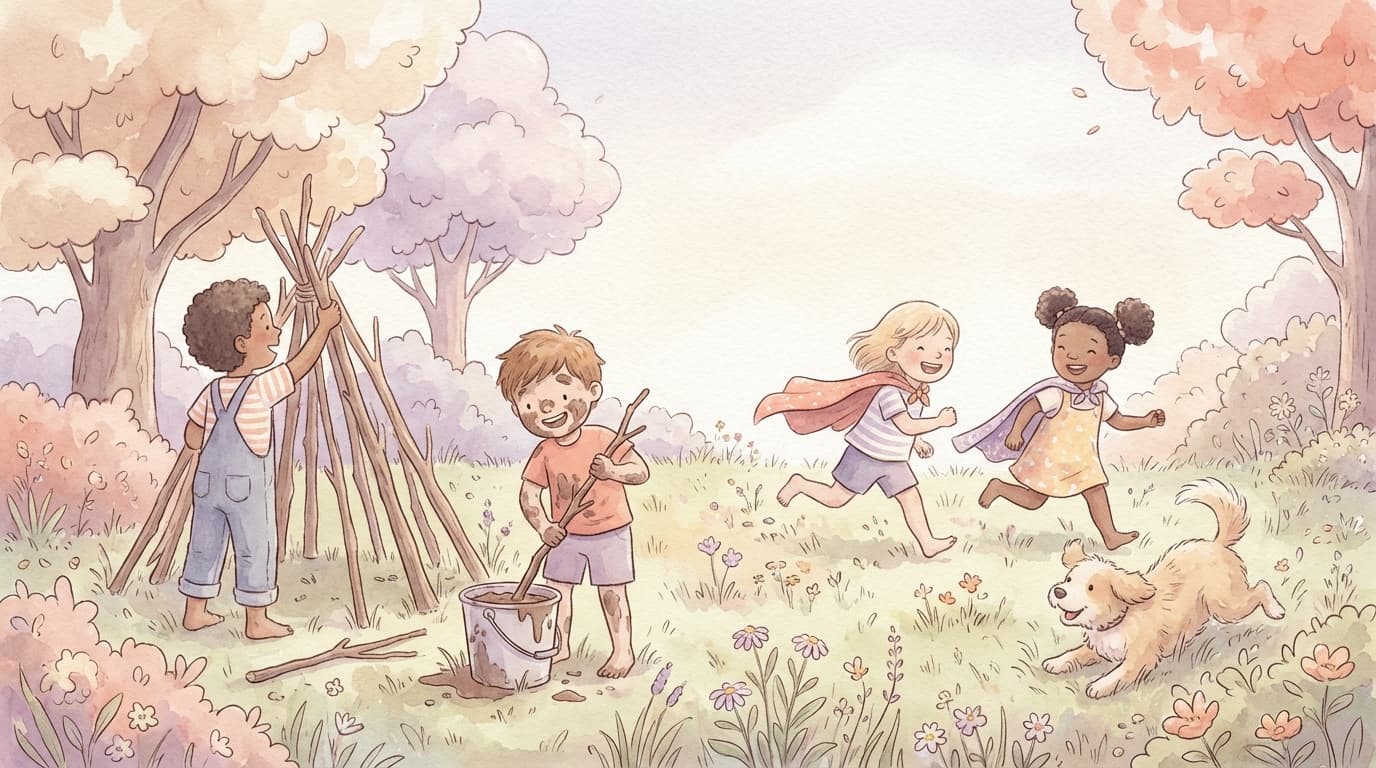
- •Building a blanket fort and deciding it's a spaceship
- •Digging in the dirt with no goal beyond digging
- •Drawing whatever comes to mind — not a coloring sheet
- •Running around the backyard inventing games with siblings
- •Sorting rocks by color, then by size, then stacking them into a tower
- •Playing pretend — restaurant, doctor, explorer, dragon tamer
It does not include organized sports, music lessons, tutoring, educational apps, or any activity where an adult sets the structure. Those activities have value. But they exercise different muscles than free play does.
The distinction matters because the benefits of unstructured play come specifically from the child's autonomy — from making decisions, solving problems, negotiating rules, and managing frustration without adult scaffolding. Remove the autonomy and you remove the mechanism.
How Much Free Play Have Children Lost?
A lot. And fast.
8 fewer hours per week
of free play for the average American child compared to 1981
Source: University of Michigan Institute for Social Research, 2019
Between 1981 and 2019, children lost an average of eight hours of free play per week. That time shifted into structured activities, screen time, and academics. A study from the University of Michigan's Institute for Social Research tracked this decline across four decades and found that the sharpest drops occurred in two categories: outdoor play and unstructured indoor play.
Where did the time go? Homework increased by 145% for children aged 6-8. Organized activities doubled. Screen time filled the remaining gaps. The net result: a generation of children who are busier than ever but playing less than any generation in recorded history.
Children today are the subjects of a vast, uncontrolled experiment. We have systematically eliminated the activity that is most essential to their healthy development — free play — and replaced it with adult-directed activities that serve adult anxieties about achievement. The results are not encouraging.
This isn't nostalgia. It's epidemiology. The decline in play correlates with measurable rises in childhood anxiety, depression, and attention disorders. Correlation isn't causation — but the mechanisms are well understood, and the pattern is consistent across cultures wherever play has been displaced by structured activity.
What Does Unstructured Play Build in the Brain?
Free play develops four capacities that structured activities struggle to reach.
1. Executive function. This is the brain's air traffic control system — the ability to plan, focus, remember instructions, and juggle multiple tasks. A 2014 study from the University of Colorado found that children who spent more time in less-structured activities (free play, family outings, unscheduled reading) had significantly stronger self-directed executive function than children who spent more time in structured activities.
The reason: in free play, the child must self-regulate. Nobody tells them what to do next. They set their own goals, manage their own frustration, and sequence their own actions. That repeated practice strengthens the prefrontal cortex — the brain region responsible for executive function — in ways that following an adult's instructions cannot.
2. Creativity and divergent thinking. When a stick becomes a sword, then a fishing rod, then a magic wand, the child practices cognitive flexibility — the ability to see multiple possibilities in a single object or situation. A 2020 study published in Developmental Psychology found that preschoolers who engaged in more pretend play scored significantly higher on measures of creative divergent thinking than peers with less pretend play time. Enrichment classes, by definition, teach convergent thinking — one right answer, one correct technique.
3. Emotional regulation. Play is where children practice feeling frustrated, disappointed, excited, and scared — in a context where the stakes are low. A child whose block tower falls can cry, breathe, and rebuild. That cycle — emotional arousal, coping, recovery — is the training ground for emotional resilience. Without it, children encounter strong emotions for the first time in high-stakes situations (school, social conflict) with no practice handling them.
4. Social competence. Unstructured play with other children requires constant negotiation. Who goes first? What are the rules? What happens when someone cheats? These micro-negotiations build skills that no social-emotional learning curriculum can replicate, because the motivation is intrinsic — the child negotiates because they want the game to continue, not because an adult told them to "use their words."
Play is the foundational experience through which children learn to regulate emotions, delay gratification, and negotiate with others. These are not soft skills. They are the core capacities that predict academic success, relationship quality, and mental health across the lifespan.
What Happens When Children Don't Get Enough Play?
The research on play deprivation is sobering.
8x increase
in childhood depression and anxiety diagnoses since the mid-1950s, correlating with the decline in children's free play
Source: American Journal of Play, Dr. Peter Gray, 2011
Dr. Peter Gray's landmark 2011 analysis in the American Journal of Play traced five decades of data and found a strong inverse relationship between the decline in children's play and the rise in childhood psychopathology. As play went down, anxiety and depression went up — by a factor of five to eight, depending on the measure.
The mechanism is straightforward. Play builds an internal locus of control — the belief that you can affect outcomes through your own actions. Structured environments build an external locus of control — the belief that outcomes depend on following others' directions. Research consistently links external locus of control with higher rates of anxiety and depression.
Animal research supports this. Juvenile rats deprived of play develop anxiety-like behaviors, impaired social skills, and reduced prefrontal cortex development. When allowed to play again, some — but not all — deficits reverse. The window matters.
None of this means enrichment classes cause depression. But it does mean that replacing all free time with structured activities removes the primary mechanism through which children build psychological resilience.
Is It Okay to Skip the Enrichment Classes?
Yes. With a caveat.
Enrichment activities — sports, music, art classes, language lessons — offer real benefits. They build discipline, expose children to skills they wouldn't discover on their own, and provide social connections. The problem isn't enrichment. The problem is enrichment that displaces all unstructured play.
The AAP's recommendation is clear: children need at least 60 minutes of unstructured free play daily, and ideally more. If your child's schedule leaves no room for an afternoon of doing nothing, something needs to give — and the research says it shouldn't be the free time.
A useful framework: one structured activity per season for young children (ages 3-6), and no more than two to three for school-age children (ages 7-12). Leave at least one weekday and one weekend day completely unscheduled.
The guilt many parents feel about unscheduled time comes from a cultural myth: that every hour must be optimized for development. But development doesn't work like a factory. It works like a garden. You provide the conditions — space, time, safety, freedom — and growth happens on its own schedule.
How Can Reading Together Be a Form of Unhurried Play?
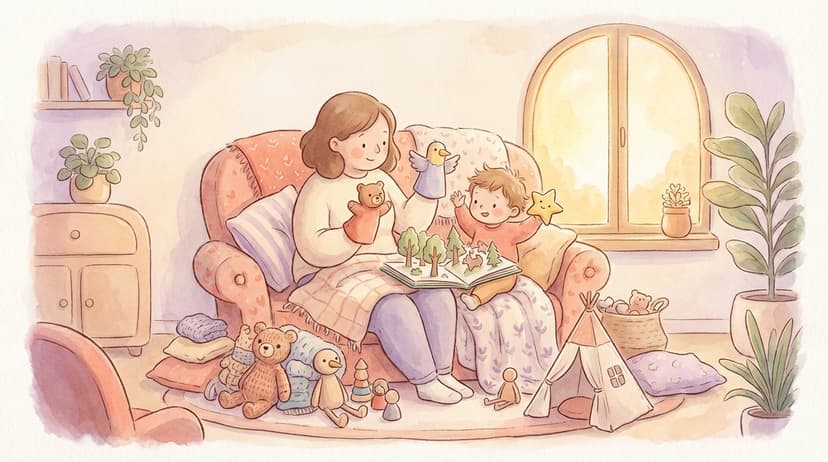
Not all reading is structured. When you curl up with your child and a book with no agenda — no comprehension questions, no lesson plan, no timer — that's an act of unhurried connection that shares DNA with free play.
The best reading moments happen when the child leads. They pick the book. They decide to linger on one page for three minutes because the picture fascinates them. They interrupt to tell you a story about their day. They ask you to read the same page four times. You follow their lead.
This kind of reading builds the same capacities as unstructured play: autonomy (the child chooses), emotional regulation (stories process big feelings in safe contexts), creativity (imagination fills the gaps between pictures), and social connection (shared attention between parent and child).
When we read with children in an unhurried, child-led way — following their curiosity, answering their questions, letting them set the pace — we create a form of guided play. The story provides a scaffold, but the child's mind is free to wander, wonder, and make meaning on their own terms.
A 2023 study from the National Literacy Trust found that children who described reading as a leisure activity (something they chose to do for fun) had stronger vocabulary, comprehension, and emotional well-being than children who described it as a task — regardless of how much time each group spent reading. The framing mattered more than the minutes.
This is why pressuring children to read backfires. And why making books feel like play — choosing together, reading without a goal, letting the child steer — succeeds.
📖 When the book is their world
Sherly books turn reading into something that feels like play. When your child opens a book and sees themselves as the hero — illustrated from their own photo across 30 pages — they don't experience it as "reading time." They experience it as their adventure. They flip back to favorite pages. They narrate what happens next. They bring it to friends. That's not a lesson. That's play with a story at the center.
What Can Parents Do Right Now?
You don't need a program. You need less of one.
1. Protect empty time. Block unscheduled hours on the family calendar and defend them the way you'd defend a doctor's appointment. Boredom is not an emergency — it's a launchpad.
2. Tolerate the "I'm bored" phase. When children first encounter unstructured time, they may complain. This is normal. The discomfort passes — usually within 10-15 minutes — and what follows is the creative, self-directed play that builds executive function. Resist the urge to fix boredom with a screen or a suggestion.
3. Provide materials, not instructions. Cardboard boxes. Art supplies. Sticks. Sand. Water. Blocks. Loose parts that can become anything. The less a toy dictates how it should be used, the more it builds.
4. Go outside. Outdoor free play is the gold standard. Nature provides infinite open-ended stimulation — mud, trees, insects, puddles — that manufactured environments cannot replicate. A 2019 study from Aarhus University found that children who grew up with more green space had up to 55% lower risk of developing mental health disorders later in life.
5. Read together without an agenda. Pick a book. Curl up. Let your child lead the experience. Don't quiz them afterward. Let the story be the point. If they want to talk about it, wonderful. If they want to sit in silence, that's wonderful too.
6. Audit the schedule. Count the structured activities. Count the free hours. If the ratio tips heavily toward structure, consider dropping one class — at least for a season — and watching what fills the space.
60+ minutes daily
of unstructured free play recommended for all children
Source: American Academy of Pediatrics, 2018
Ready to create your child's story?
Turn your child into the hero of a 30-page illustrated hardcover book. Upload a photo and see the magic.
Frequently Asked Questions
Sherly Team
Children's Reading Specialists