You can teach kids to love reading most effectively by removing the word "teach" entirely. Play-based literacy works because it wraps reading skills inside activities children already enjoy — games, pretend play, art, movement, and exploration. The child builds phonological awareness, vocabulary, and narrative comprehension without ever sitting down for a "lesson."
According to a 2022 position statement by the National Association for the Education of Young Children (NAEYC), play is the primary vehicle through which children develop literacy skills from birth through age eight. Research from the University of Cambridge confirms that children in play-based learning environments develop reading skills at the same rate or faster than children in formal instruction settings — with significantly higher motivation and lower anxiety.
Why Does Play Build Reading Skills Better Than Drills?
The answer lies in how the brain learns. Literacy development requires the formation of neural connections across multiple brain regions — language, visual processing, motor control, and executive function. Play activates all of these regions simultaneously, while worksheets and drills typically activate only one or two.
A 2019 study from MIT's Early Childhood Cognition Lab found that children engaged in playful learning activities showed 23% greater retention of new vocabulary words compared to children who learned the same words through direct instruction. The emotional engagement of play creates stronger memory encoding.
Play is not the opposite of learning — it is the mechanism of learning. When a child sets up a pretend restaurant and writes a menu, they are practicing letter formation, phonics, vocabulary, and narrative simultaneously. No worksheet can replicate that integration.
23%
greater vocabulary retention from playful learning vs. direct instruction
Source: MIT Early Childhood Cognition Lab, 2019
The key difference: Direct instruction builds skills through extrinsic motivation (following instructions, earning rewards, avoiding failure). Play builds skills through intrinsic motivation (curiosity, fun, social connection). Research on motivation consistently shows that intrinsically motivated learning produces deeper understanding, stronger retention, and — crucially for literacy — a positive emotional association with reading.
What Are the Best Literacy Games for Preschoolers (Ages 3-5)?
At this age, play-based literacy focuses on phonological awareness (hearing and manipulating sounds), print awareness (understanding that written words carry meaning), and vocabulary building. No formal reading instruction needed.
Rhyming games:
- •Rhyme basket: Fill a basket with small objects (cat/hat, star/car, bug/mug). Children match rhyming pairs. Builds phonological awareness — one of the strongest predictors of later reading success.
- •Silly rhyme walk: On a walk, pick a word and take turns making rhymes (even nonsense ones). "Tree — free — blee — plee!" Laughter reinforces learning.
- •Song modification: Take a familiar song and change the words. "Twinkle twinkle little CAR, how I wonder what you ARE" builds awareness of word endings.
Letter play:
- •Letter hunt: Hide magnetic letters around the house. "Can you find the letter that makes the /s/ sound?" Combines movement with phonics.
- •Name play: Write your child's name in large letters. Let them trace with fingers, paint over it, fill it with stickers. Their name is the most motivating word in their vocabulary.
- •Environmental print walk: Point out letters on signs, cereal boxes, and stores during errands. "Look, that word starts with the same letter as your name!" Builds print awareness naturally.
The most powerful literacy intervention for a preschooler is not a workbook or an app. It's a parent who plays with language — who makes word games part of everyday life, who reads with joy, who lets the child see that words are fun, not just functional.
What Literacy Play Works for Early Readers (Ages 5-7)?
Once children begin decoding, play-based approaches reinforce skills without the pressure of formal practice. The goal is making reading practice feel like fun.
Word games:
- •Sight word scavenger hunt: Write sight words on index cards and hide them around the house. Finding and reading each word builds automatic recognition.
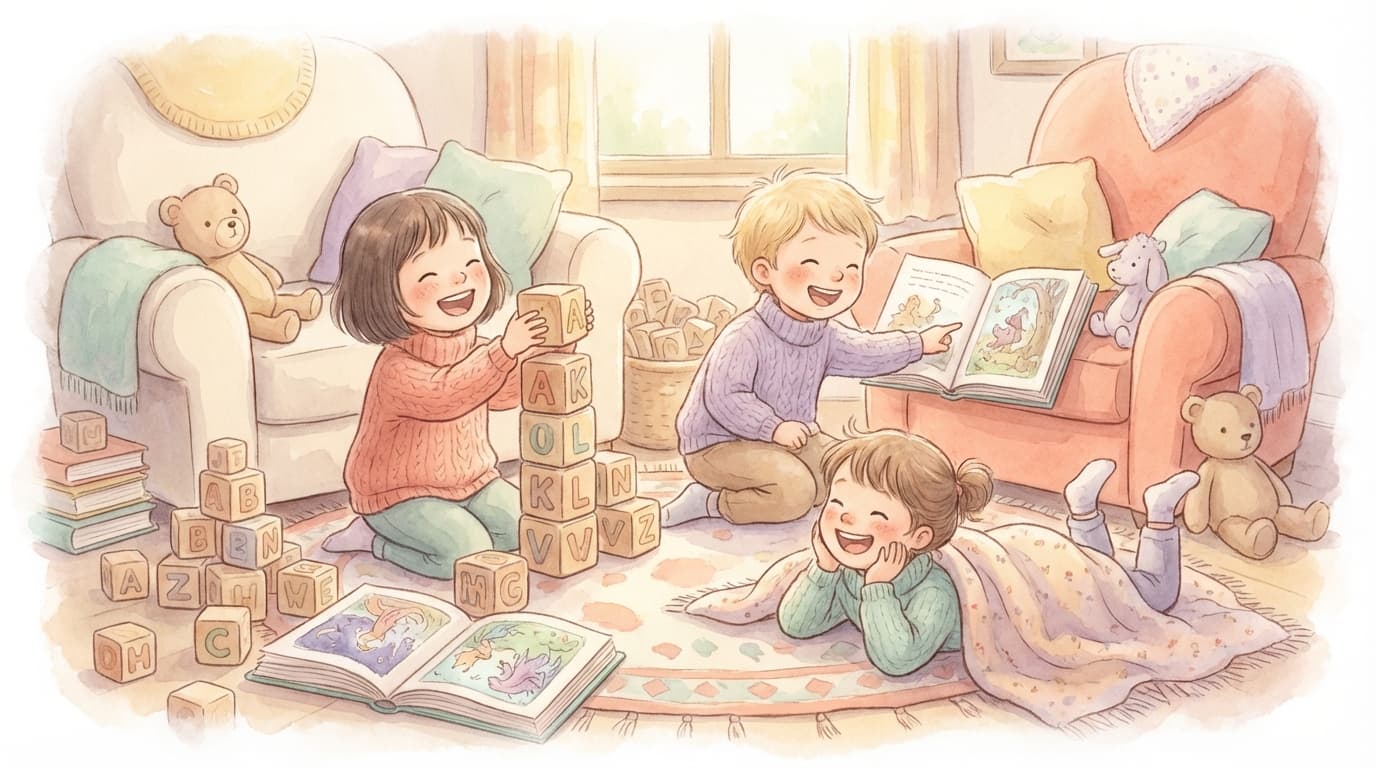
- •Word building with magnetic letters: Give them a pile of letters and challenge them to build as many words as they can in 5 minutes. Make it a friendly competition.
- •Label everything: Give your child sticky notes and a marker. Their job is to label everything in a room (BED, LAMP, DOOR, RUG). This builds spelling, vocabulary, and a sense that words are everywhere.
Ready to create your child's story?
Turn your child into the hero of a 30-page illustrated hardcover book. Upload a photo and see the magic.
Story play:
- •Act it out: After reading a book, act out the story. Assign roles, use props, improvise new endings. This dramatically improves comprehension and narrative skills.
- •Story stones: Paint or draw simple images on stones (house, tree, cat, moon, car). Pull out 3-5 stones and make up a story together using those elements. Builds narrative structure naturally.
- •Comic strip creation: Fold paper into panels. Your child draws a story in pictures, then adds speech bubbles. This is writing and reading practice disguised as art.
Same rate or faster
reading development in play-based environments vs. formal instruction
Source: University of Cambridge, 2022
Reading motivation play:
- •Blanket fort reading: Build a fort, get a flashlight, bring books. The context transforms reading from a chore into an adventure.
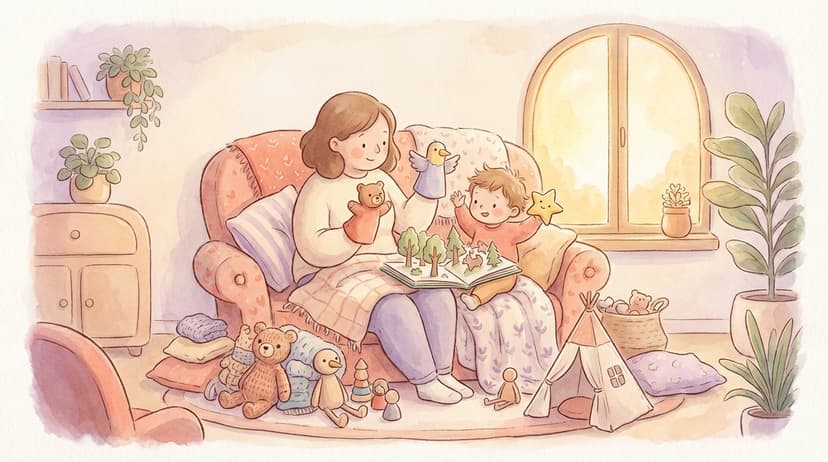
- •Stuffed animal reading: The child "reads" to their stuffed animals. Even if they're making up the words based on pictures, they're practicing narrative skills and building reader identity.
- •Book picnic: Pack books with lunch, find a spot outside, and read together. Associating reading with positive experiences rewires the emotional connection.
📖 Play meets personalization
Sherly's personalized books become natural springboards for play-based literacy. When your child is the hero of the story — with custom illustrations made from their actual photo — they naturally want to act out scenes, retell the adventure to friends, and "read" their book to stuffed animals. The personal connection turns passive reading into active, imaginative play.
How Can Pretend Play Build Reading Comprehension?
Pretend play (dramatic play, make-believe) is one of the most underrated literacy tools. When children engage in pretend play, they practice the exact cognitive skills required for reading comprehension: creating narratives, understanding character perspectives, sequencing events, and using language to construct meaning.
A 2020 study from the University of Denver found that preschool children who engaged in more frequent pretend play showed significantly stronger narrative comprehension skills by first grade — even after controlling for vocabulary, IQ, and home literacy environment.
Setting up literacy-rich pretend play:
- •Restaurant: Menus to read, orders to write, signs to make. Literacy is embedded in the play naturally.
- •Post office: Write letters to family members, address envelopes, create stamps. Real-world purpose for writing.
- •Veterinarian's office: Write patient charts for stuffed animals, read "prescriptions," create appointment schedules.
- •Bookstore/library: Organize real books, create "staff picks" signs, check books in and out with a log.
- •News reporter: "Report" on family events by writing headlines and presenting stories. Combines writing, reading, and oral language.
When a five-year-old plays 'restaurant' and scribbles a menu, they are demonstrating one of the most important literacy insights: that written marks carry meaning. This understanding — that writing communicates — is the cognitive foundation everything else is built on.
What About Digital and Board Games That Build Literacy?
Select digital and physical games can build literacy skills, but quality varies enormously. The best options involve active decision-making, language use, and social interaction rather than passive consumption.
Board games that build literacy:
- •Scrabble Junior (age 5+) — Letter recognition, word building, and vocabulary
- •Zingo (age 4+) — Sight word recognition in a bingo-style format
- •Boggle Junior (age 3+) — Matching letters to pictures builds letter-sound connections
- •Apples to Apples Junior (age 9+) — Vocabulary building and creative language use
- •Dixit (age 8+) — Storytelling based on abstract images; builds narrative skills
Quality digital options:
- •Epic! Reading App — Curated library with reading-level matching
- •Khan Academy Kids — Free, research-backed literacy activities
- •Teach Your Monster to Read — Phonics game designed by reading researchers
- •Starfall — Interactive phonics and early reading activities
💡 The 'together' rule for digital literacy games
Digital literacy games are most effective when played with a parent or sibling, not alone. The conversation around the game — "What sound does that letter make?" "What word can you build?" — provides the interactive element that turns screen time into learning time. A 2021 study from Vanderbilt University found that co-played educational apps produced 35% greater learning gains than solo play.
How Do I Balance Play-Based and Formal Literacy Activities?
Both have a place. The optimal balance shifts with age and your child's needs.
Ages 3-5: Play-based literacy should dominate. Formal instruction (if any) should be brief, child-led, and embedded in play. The NAEYC recommends that 90% of literacy activity at this age be play-based.
Ages 5-7: School introduces formal phonics instruction, which is necessary for decoding. At home, play-based activities complement and reinforce what school teaches. Think of play as the "practice field" for school-taught skills.
Ages 7-10: Children can handle more structured reading. Play-based activities shift from building basic skills to maintaining motivation and enjoyment — book clubs with friends, creative writing for fun, reading-related art projects.
The consistent rule across all ages: if reading feels like a chore, add more play. If skills are developing well, the balance is working.
A 2018 longitudinal study from the University of Virginia tracked children from preschool through third grade and found that children who experienced more play-based literacy instruction in preschool had equal academic outcomes and significantly more positive attitudes toward reading by third grade compared to children in formal-instruction-heavy programs. Same skills, better feelings.
Frequently Asked Questions
Sherly Team
Children's Reading Specialists