Story time for toddlers works best when you stop trying to "read" and start playing with the book. Toddlers aged 1-3 are wired for movement, interaction, and sensory experience — not passive listening. The most engaging story time techniques use voices, gestures, props, and physical participation to turn a book into a whole-body experience.
According to a 2020 study from the University of Waterloo, toddlers whose parents used interactive reading techniques (questions, gestures, voices) during shared book reading showed vocabulary gains 40% greater than toddlers whose parents read the text straight through. The interaction is what builds language — not the words on the page alone.
Why Won't My Toddler Sit Still for a Story?
Because they're not supposed to. Toddlers are in the sensorimotor and pre-operational stages of development (Piaget), meaning they learn primarily through physical interaction with their environment — not by sitting and absorbing information.
A toddler who wanders away during reading, grabs pages, or flips to random spots is not misbehaving. They are interacting with the book in a developmentally appropriate way. Expecting a 18-month-old to sit through a 15-minute picture book is like expecting an adult to focus on a lecture in a language they barely understand.
The biggest mistake parents make with toddler story time is expecting it to look like adult reading. It shouldn't. A successful story time with a two-year-old might last three minutes, involve a lot of pointing and animal sounds, and end with the book being thrown on the floor. That's learning.
Developmentally realistic expectations by age:
- •12-18 months: 2-5 minutes. They may just turn pages and point. This is perfect.
- •18-24 months: 5-8 minutes. They can follow simple stories with one sentence per page.
- •24-36 months: 8-15 minutes. They can engage with narrative, predict what comes next, and answer simple questions.
40%
greater vocabulary gains from interactive reading vs. straight-through reading
Source: University of Waterloo, 2020
What Are the Best Voices and Sound Effects for Toddler Story Time?
Voices are the single most powerful tool for toddler engagement. Research from the University of London found that children as young as 12 months show heightened attention and pleasure responses when adults use exaggerated prosody (varied pitch, rhythm, and volume) during reading.
Voice techniques that work:
- •Animal sounds — Every animal in the book gets its own sound. Don't just say "the cow" — say "the cow goes MOOOOO!" Pause and let them join in.
- •Character voices — Give the bear a deep, grumbly voice. Give the mouse a tiny, squeaky voice. Toddlers remember characters by voice before they understand plot.
- •Whisper moments — Lower your voice dramatically. Toddlers lean in. It creates anticipation and focus.
- •Loud moments — A sudden "ROAR!" or "SPLASH!" snaps attention back. Use sparingly for maximum effect.
- •Rhythm and sing-song — Rhyming text should be read with exaggerated rhythm. Toddlers learn language patterns through musicality.
Parents worry about sounding silly. That's exactly the point. The more dramatically you perform a book, the more deeply a toddler engages. Their mirror neurons fire when they see exaggerated emotion, and that builds both language and social-emotional development.
The power of repetition: If your toddler wants the same book with the same voices every night for three weeks, celebrate. A 2011 study from the University of Sussex found that toddlers who heard the same story repeatedly learned new vocabulary words significantly faster than those hearing different stories each time. Your fifth reading of "Brown Bear, Brown Bear" is doing important brain work.
How Can I Use Props and Movement During Story Time?
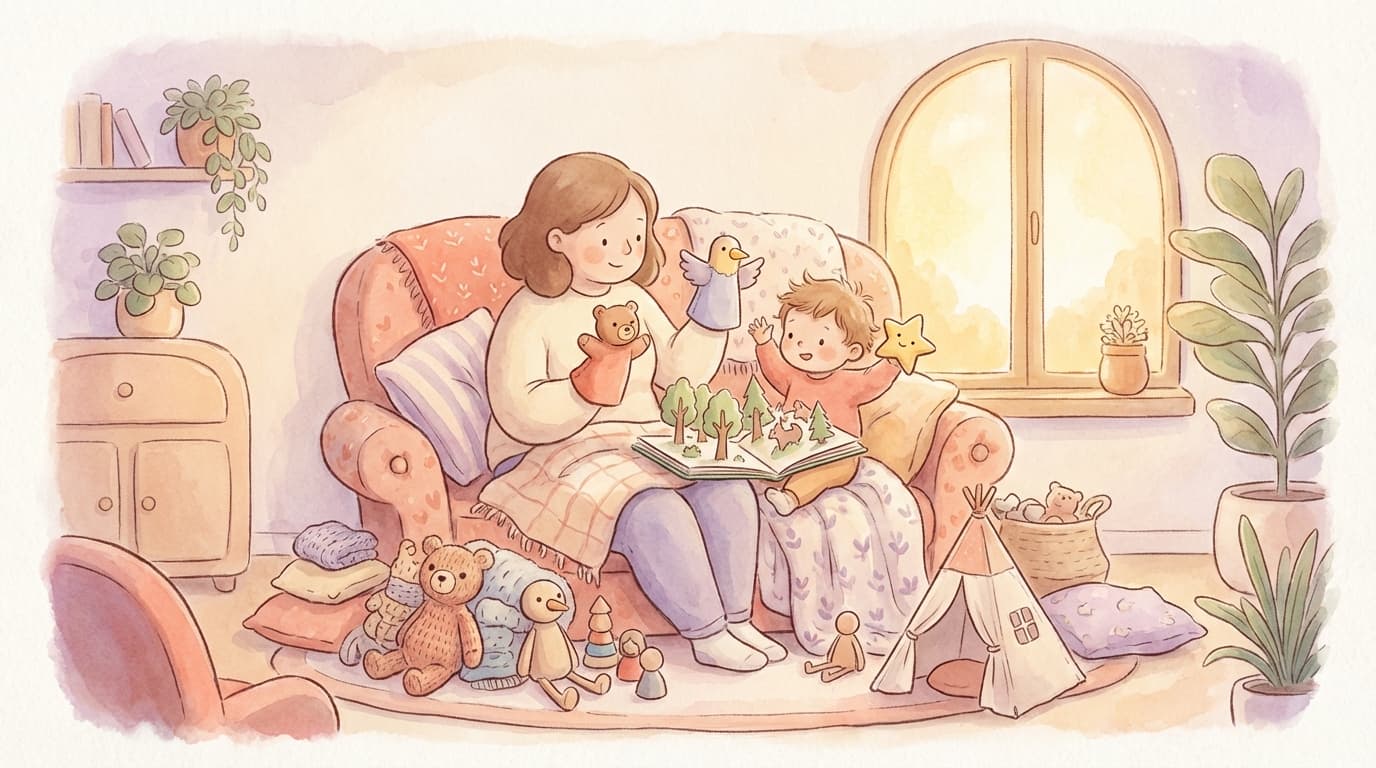
Props transform reading from a visual-auditory experience into a multi-sensory one. For toddlers, more senses means more learning.
Simple prop ideas:
- •Stuffed animals — Read a book about a bear with a stuffed bear present. Let the toddler hold it, make it "listen" to the story.
- •Blanket play — Use a blanket to hide under when the story gets "scary" or to wrap up characters.
- •Food tie-ins — Reading "The Very Hungry Caterpillar"? Have real fruit available. Eating an apple while reading about eating an apple builds connections.
- •Finger puppets — Simple finger puppets for key characters let toddlers participate in the narration.
- •Sound props — A wooden spoon on a pot for thunder. A spray bottle for rain. Crinkled paper for fire. Toddlers are riveted by real sounds that match the story.
💡 The prop basket
Keep a small basket of versatile props near your reading spot: a flashlight (for nighttime scenes), a small bell (for arrival or excitement), a soft scarf (for wind, water, or hiding). You don't need prop-specific items for every book — versatile objects that can represent different things work best.
Movement techniques:
- •Action mimicry — Characters jump? You and the toddler jump. Characters sleep? Lie down together. Characters eat? Pretend to eat.
- •Page-turn power — Let the toddler turn every page. The physical act of controlling the book increases ownership and engagement.
- •Point and find — "Can you find the red bird?" turns passive listening into active searching.
- •Body movement — "The bear walked slowly" (walk your fingers slowly up their arm). "The rabbit hopped fast!" (bounce them gently).
What Books Work Best for Interactive Toddler Story Time?
The best toddler books are designed for interaction, not just reading. Look for:
Ready to create your child's story?
Turn your child into the hero of a 30-page illustrated hardcover book. Upload a photo and see the magic.
- •Lift-the-flap books — "Where's Spot?" by Eric Hill is the classic. The physical act of lifting builds fine motor skills and creates anticipation.
- •Touch-and-feel books — "That's Not My..." series by Usborne. Sensory feedback keeps fingers and brain engaged.
- •Call-and-response books — "Brown Bear, Brown Bear, What Do You See?" by Bill Martin Jr. The repetitive structure invites participation.
- •Interactive instruction books — "Press Here" by Herve Tullet. The book gives the child commands.
- •Sound books — "The Very Noisy Bear" by Nick Bland. Built-in sound effects trigger excitement.
- •Simple narrative books — "Goodnight Moon" by Margaret Wise Brown. Ritual, rhythm, and the satisfaction of naming familiar objects.
📖 When they are the character
The most engaging book for any toddler is one that features them. Sherly's personalized books transform your child's photo into custom illustrations across 30 pages — they see themselves as the hero on every spread. Toddlers point to themselves, say their own name, and request re-readings with an enthusiasm that generic books rarely match.
How Do I Handle a Toddler Who Wants to Skip Pages or Read Backwards?
Let them. This is one of the most important shifts in thinking for parents. Toddler story time is not about getting through the book from front to back. It's about engaging with the book in whatever way the child finds interesting.
A 2018 study from the University of Virginia found that child-directed book interactions — where the toddler controls pacing, page selection, and focus — produced equal or greater language gains compared to adult-directed linear reading. Following the child's lead isn't permissive — it's strategic.
Equal or greater
language gains from child-directed vs. adult-directed reading in toddlers
Source: University of Virginia, 2018
Practical approaches:
- •If they flip to the last page first, describe what you see on that page
- •If they want to spend three minutes on one illustration, narrate everything in it
- •If they close the book mid-story, respect it — three good minutes beats fifteen forced ones
- •If they bring you a different book mid-read, switch without comment
- •If they want to chew the book (at 12 months), give them a board book designed for exactly that
When we follow a toddler's lead during reading, we're doing something profoundly important: we're teaching them that books respond to their interest. That their curiosity matters. That reading is something they control, not something done to them. This sense of agency is the seed of lifelong reading motivation.
When Should Story Time Happen — and How Often?
Daily is ideal, but any reading is better than no reading. The timing should fit your family's natural rhythms rather than an imposed schedule.
Best times for toddler story time:
- •After meals — toddlers are calm and content
- •Before naps and bedtime — the routine signals sleep is coming
- •During transitions — a book can bridge the gap between activities
- •When they bring you a book — this is the single most important time to read. A toddler handing you a book is saying "I want this." Always say yes.
According to the AAP, reading to your child for just 15 minutes a day results in hearing approximately 1 million words per year. Over five years, that's a 5-million-word exposure advantage before kindergarten even begins.
If you can only do one thing: Read to them at the same time every day, even for five minutes. The routine matters more than the duration. A child who expects story time builds anticipation, and anticipation builds engagement.
Frequently Asked Questions
Sherly Team
Children's Reading Specialists