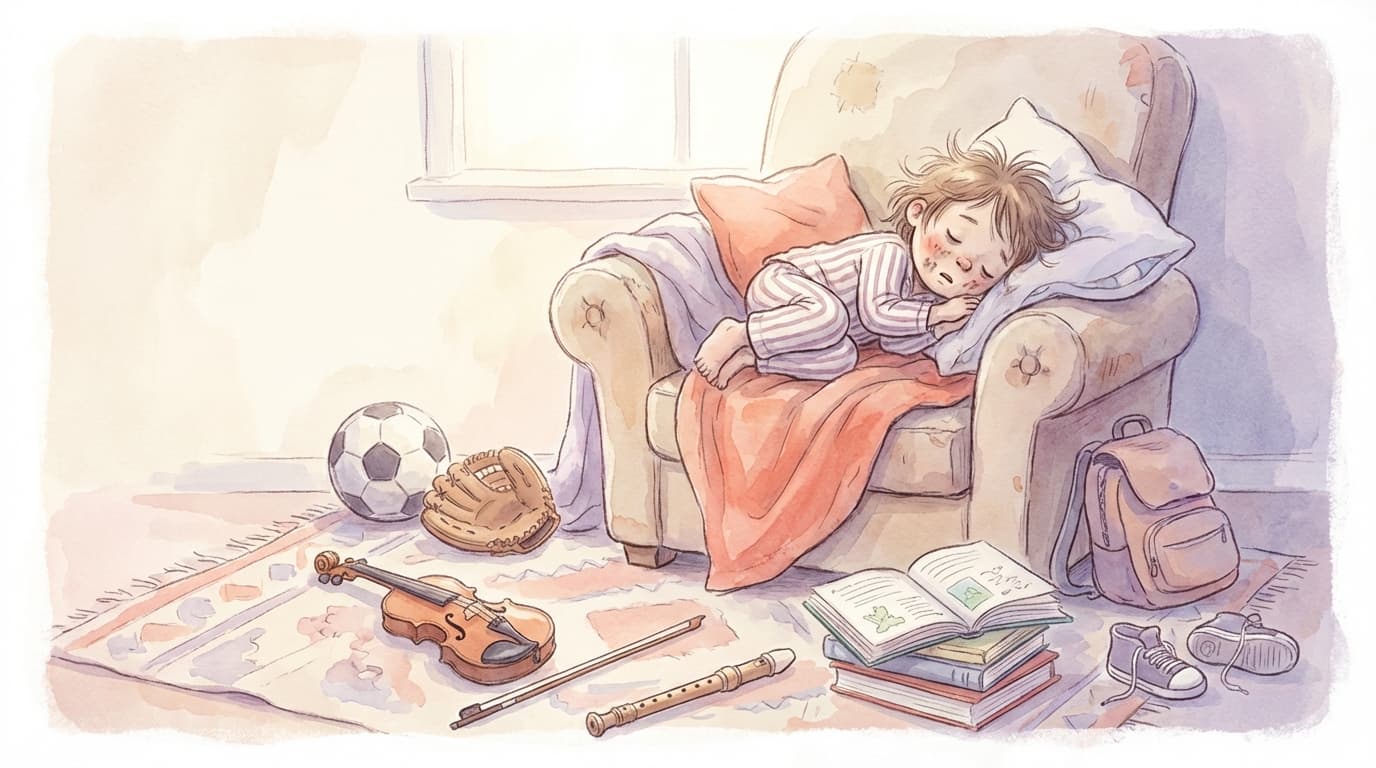
If your child is irritable, exhausted, resisting activities they once loved, or has stopped playing on their own, they may be overscheduled. The fix isn't another enrichment program. It's less. A 2025 survey from the American Psychological Association found that 61% of children ages 6-12 reported feeling stressed by their weekly schedule — and their parents had no idea.
Overscheduling sneaks up on families. Each activity seems reasonable on its own. Piano builds discipline. Soccer builds teamwork. Coding camp prepares them for the future. But stacked together, they steal something children need more than any skill: unstructured time to simply be a kid.
How Do You Know If Your Child Is Overscheduled?
The signs don't arrive as a single alarm. They creep in. You explain them away — growth spurts, a bad week, a phase. But if several of these show up together, your child's schedule is the likely culprit.
1. Chronic irritability. Not occasional bad moods. A persistent, low-grade crankiness that wasn't there before. Overscheduled children live in a state of low-level stress, and irritability is the first signal their nervous system sends.
2. Sleep problems. Difficulty falling asleep, waking at night, or dragging in the morning. A 2024 study from the National Sleep Foundation found that children with four or more weekly extracurricular activities were twice as likely to report sleep disturbances as children with two or fewer.
3. Resistance to activities they used to enjoy. When your child begs not to go to the class they once loved, listen. This isn't laziness. It's a stressed brain protecting itself.
61%
of children ages 6-12 reported feeling stressed by their weekly schedule, according to their own self-reports
Source: American Psychological Association, 2025
4. Frequent physical complaints. Stomachaches and headaches with no medical explanation are classic stress signals in children. Their bodies speak what their words can't.
5. Loss of imaginative play. This is the canary in the coal mine. When a child stops inventing games, building worlds out of couch cushions, or narrating adventures to their stuffed animals, it often means they've lost the mental space that imagination requires. Creativity needs boredom as fuel. An overscheduled child never reaches the boredom threshold where creative play ignites.
6. Social withdrawal. Pulling away from family or friends. Wanting to be alone — not for play, but for collapse. The child has spent every ounce of social energy on structured interactions and has nothing left for the people who matter most.
7. Declining performance across activities. Paradoxically, doing more leads to doing everything worse. Attention fragments. Motivation drains. A 2023 study in Pediatrics found that children enrolled in more than three structured activities simultaneously showed 27% lower engagement scores across all activities compared to peers in two or fewer.
An overscheduled child doesn't look busy and thriving. They look busy and brittle. The distinction matters. Thriving children have energy left at the end of the day for play, curiosity, and connection. Brittle children are running on empty and one bad day from falling apart.
Why Do Parents Overschedule — And Why Is It So Hard to Stop?
No parent sets out to exhaust their child. Overscheduling is driven by love — and fear. The fear that if your child doesn't start violin by age five, they'll fall behind. The fear that empty afternoons mean wasted potential. The fear that other parents are doing more.
The cultural pressure is enormous. A 2024 Pew Research survey found that 75% of parents felt pressure to enroll their children in extracurriculars to keep pace with peers. The average American child ages 6-12 now spends 7.5 hours per week in organized activities outside of school — nearly double the figure from 2005.
This pressure creates a kind of arms race. One family signs up for travel soccer. Another adds robotics club. Soon, an empty Saturday feels like neglect rather than what it actually is: a gift.
75%
of parents felt pressure from other families to enroll their children in more extracurricular activities
Source: Pew Research Center, 2024
There's also the proxy achievement trap. When a child's schedule is packed, it can feel like proof that the parent is doing a good job. The busy schedule becomes a security blanket — for the parent, not the child. Scaling back feels like giving up.
But here's what the research says with uncomfortable clarity: the parents doing the most aren't raising the happiest kids. A 2025 longitudinal study from the University of Maryland found that children's life satisfaction peaked at two structured activities per week and declined steadily after three.
We've confused enrichment with accumulation. A rich childhood isn't one filled with the most activities — it's one with enough space for a child to discover who they are when no one is telling them what to do.
What Happens to Children Who Get Enough Unstructured Time?
The research on free play and unstructured time is striking — and it runs directly counter to the instinct to fill every hour.
Creativity depends on it. A landmark 2024 study from the University of Cambridge found that children who had at least one hour of daily unstructured free time scored 40% higher on measures of creative thinking than peers whose time was entirely structured. The researchers concluded that boredom acts as a "cognitive incubator" — the brain, left without instructions, begins to generate its own content.
Emotional regulation grows in the gaps. When children play freely, they encounter frustration, negotiation, disappointment, and triumph — all without an adult directing the outcome. This builds internal coping skills that structured activities, with their adult-managed rules and adult-resolved conflicts, simply cannot provide.
40%
higher creative thinking scores in children with at least one hour of daily unstructured free time
Source: University of Cambridge Faculty of Education, 2024
Self-identity forms in silence. Overscheduled children know what they can do — play piano, score goals, solve equations. But they may not know who they are. Free time is where children discover their own interests, preferences, and inner voice. It's where they learn to tolerate being alone with themselves — a skill that will matter enormously in adolescence and beyond.
Physical health improves. A 2023 report from the American Academy of Pediatrics noted that children with more unstructured outdoor time had lower cortisol levels, better sleep quality, and fewer stress-related physical complaints than heavily scheduled peers — even when total physical activity was similar.
The message from decades of developmental research is clear: children need margins. Time that belongs to no curriculum, no coach, no instructor. Time that belongs to them.
How Do You Pare Back Without Guilt?
Knowing your child is overscheduled and actually reducing the load are two very different challenges. Here's a practical framework.
Step 1: Audit the week honestly. Write down every committed hour — school, homework, activities, travel time between activities, meals, sleep. Then look at what's left. If there isn't at least one hour per day of truly unstructured time, the schedule is too full.
Step 2: Apply the two-activity rule. Research from the University of Maryland suggests that two structured extracurriculars per week is the sweet spot for most children ages 5-12. This provides enrichment without crowding out free time, family connection, and rest.
Step 3: Let your child choose. If you're scaling from four activities to two, let the child pick which two stay. This preserves their sense of autonomy and ensures the remaining activities are driven by genuine interest, not parental ambition.
Step 4: Protect empty time like an appointment. Block "nothing" on the family calendar. Treat it as sacred. When another parent mentions a new program, you have a ready answer: "That time is already committed." It is — to your child's wellbeing.
Step 5: Redefine what counts as productive. A child lying on the floor staring at the ceiling isn't wasting time. They might be daydreaming, processing their day, or letting an idea form. A 2024 study from the University of East Anglia found that children who daydreamed regularly showed stronger working memory and problem-solving skills. The "doing nothing" is doing something essential.
💡 The Saturday test
Try one fully unscheduled Saturday. No activities, no playdates, no screens. Just the family, the house, the backyard. Watch what happens after the initial "I'm bored" passes. Most parents are surprised by the creativity, calm, and connection that emerge when there's nowhere to be.
The greatest gift you can give an overscheduled child is a canceled activity and an afternoon with nothing planned. It feels counterintuitive. It feels like you're shortchanging them. But you're giving them back something priceless — the chance to play, to dream, to just be little.
What Should Replace the Activities You Cut?
Nothing. That's the point.
But if "nothing" feels too radical, here's what research shows children gravitate toward when the schedule clears:
- •Free play — Building forts, inventing games, exploring the yard. The activities children create are more developmentally valuable than most adult-designed programs.
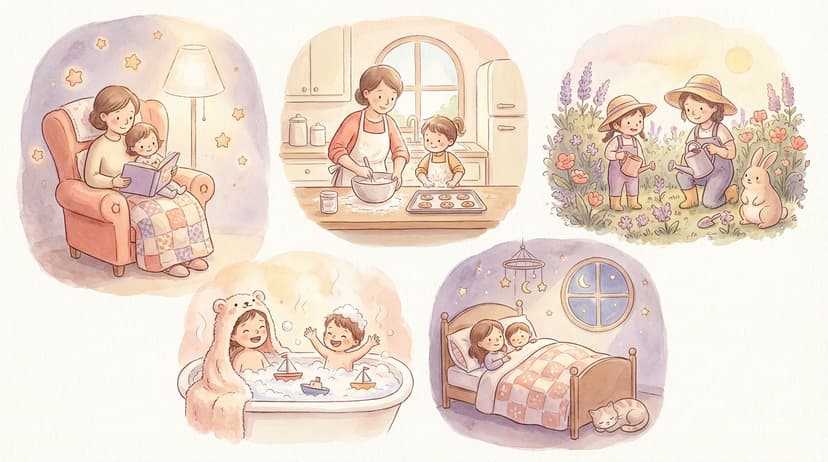
- •Reading together — Not as a task, but as a shared pleasure. Curling up on the couch with a story is the antithesis of the rushed, performance-oriented overscheduled day.
- •Nature time — Unstructured outdoor exploration. A 2024 meta-analysis in Frontiers in Psychology found that just 20 minutes in a natural setting reduced stress markers in children by 28%.
- •Boredom — Yes, boredom itself. It's the doorway to self-directed play, creativity, and the deep inner work of childhood.
The irony is beautiful: by doing less, your child develops more. More creativity. More resilience. More self-knowledge. More calm.
Ready to create your child's story?
Turn your child into the hero of a 30-page illustrated hardcover book. Upload a photo and see the magic.
Why Is a Quiet Evening Together the Best Antidote?
After a day of school and whatever activities remain, the evening is where repair happens. Not through another structured experience, but through presence.
A consistent bedtime reading ritual does something no extracurricular can: it tells your child that the rushing is over, that they are enough as they are, and that the most important person in their world has time — unhurried, undistracted time — just for them.
78%
of adults who recall a strong parent-child bond cite bedtime reading as their most vivid positive childhood memory
Source: Scholastic Kids and Family Reading Report, 2024
This is the opposite of the overscheduled day. No performance. No evaluation. No competition. Just a parent, a child, and a story. Research from the Scholastic Kids and Family Reading Report found that 78% of adults with strong parent-child bonds cited bedtime reading as their most vivid childhood memory — not the trophies, not the recitals, not the camps.
When the story is personalized — when your child sees themselves as the hero — the effect deepens. After a day of being measured, evaluated, and coached, a child hears a story where they are brave, kind, and capable simply because of who they are. Not because of what they accomplished. That distinction matters more than most parents realize.
📖 The antidote to the overscheduled day
Sherly's personalized storybooks turn the quiet evening into the highlight of the day. Your child sees themselves illustrated across 30 pages — not performing, not competing, just being the hero of their own adventure. After a long day of structured activities, there's something deeply restorative about curling up together with a story that says: you are enough, exactly as you are.
How Do You Handle Pressure From Other Parents?
This is the part no one talks about. You can be fully convinced that your child needs less — and still feel a knot in your stomach when another parent mentions their child's five-activity weekly lineup.
A few reframes that help:
"Busy" is not a parenting badge. The family with the fullest calendar is not the family doing the best job. Research on children's self-esteem consistently shows that connection and autonomy — not achievement — predict long-term wellbeing.
Your child is not falling behind. The skills built through free play — creativity, emotional regulation, independent thinking — are the skills that matter most in adulthood. No employer has ever said, "Tell me about your travel soccer record at age seven."
You are modeling a healthy relationship with time. When your child sees you choosing rest and connection over relentless productivity, you teach them that their worth isn't measured in busyness. That lesson will serve them for decades.
You don't owe anyone an explanation. "We're keeping our schedule light this season" is a complete sentence.
Frequently Asked Questions
Sherly Team
Children's Reading Specialists