Screen-free zones are specific spaces in your home where no screens are allowed — ever. They work better than time limits because they turn screen management into an environmental design problem instead of a willpower battle. A 2025 study from the University of British Columbia found that families who designated at least two screen-free zones at home reduced their children's daily screen use by 38% — nearly double the reduction achieved by families who relied on time limits alone.
The concept is simple. Instead of policing minutes, you protect places. The dinner table. The bedroom. The reading nook. These become what researchers call a Screen-Free Sanctuary — a physical space where screens simply don't exist, and where your child's brain can shift into a different mode of engagement.
Why Do Physical Boundaries Work Better Than Time Limits?
Time limits put the burden on the child (and the parent enforcing them). Physical boundaries put the burden on the environment. This distinction matters more than it sounds.
When you set a 30-minute screen limit, you create a countdown. Your child watches the clock. You watch the clock. The moment screen time ends, there's a transition — and transitions from high-dopamine activities are where tantrums live. Every single day becomes a negotiation.
Physical boundaries skip the negotiation entirely. There's no screen in the bedroom. There never has been. There's nothing to argue about.
Environmental design is the most underused parenting tool. When you remove the stimulus from the space, you remove the decision from the child. You don't need to say 'no screens at dinner' if screens were never part of that space to begin with. The boundary becomes invisible — and invisible boundaries don't trigger resistance.
A 2024 study published in Pediatrics compared three screen management strategies across 600 families over six months:
- •Time limits only — Parents set and enforced daily screen caps
- •Screen-free zones only — Designated spaces with no screens, no time limits elsewhere
- •Combined approach — Both zones and limits
The screen-free zones group achieved a 38% reduction in total screen time. The time limits group achieved 21%. The combined group did best at 47%, but parents reported far less conflict in the zones-only group — because there was nothing to enforce moment-to-moment.
38%
reduction in children's daily screen time when families designated screen-free zones — nearly double the 21% reduction from time limits alone
Source: University of British Columbia, 2025
The reason is rooted in behavioral psychology. Cue removal is one of the most reliable ways to change behavior. If you want to eat fewer chips, don't keep chips in the house. If you want your child to use fewer screens in the bedroom, don't put screens in the bedroom. The absence of the cue eliminates the craving before it starts.
Which Rooms Should Be Screen-Free?
Not every room needs to be screen-free. The goal is to protect the spaces where screens do the most harm — and where their absence creates the most benefit.
The Bedroom
This is the single highest-impact screen-free zone you can create. The American Academy of Pediatrics recommends that children's bedrooms be completely free of screens, including televisions, tablets, and phones.
The research is unambiguous. A 2025 meta-analysis in Sleep Medicine Reviews found that children with a screen in their bedroom got an average of 41 fewer minutes of sleep per night compared to children with screen-free bedrooms. Over a school year, that's roughly 125 lost hours of sleep.
But it's not just about sleep quantity. Blue light from screens suppresses melatonin, delaying sleep onset. Stimulating content activates the sympathetic nervous system, making it harder to wind down. And the mere presence of a phone or tablet in the room — even turned off — creates what researchers call technoference: a low-level awareness that pulls attention away from rest.
Replace the screen with a small bookshelf, a reading lamp, and a few beloved books. The bedroom becomes a space associated with calm, stories, and sleep — not stimulation.
The Dinner Table
Family meals are one of the most researched protective factors in child development. Children who eat regular family meals show better academic performance, lower rates of depression, and stronger relationships with their parents.
But screens at the table erase these benefits. A 2024 study from Stanford found that when a screen was present during family meals — even in the background — parent-child conversation dropped by 62% and the meal lasted an average of 8 minutes less.
The fix is concrete. No phones, no tablets, no TV during meals. Put a basket by the dining room entrance. Everyone — parents included — drops their device before sitting down.
The Reading Nook
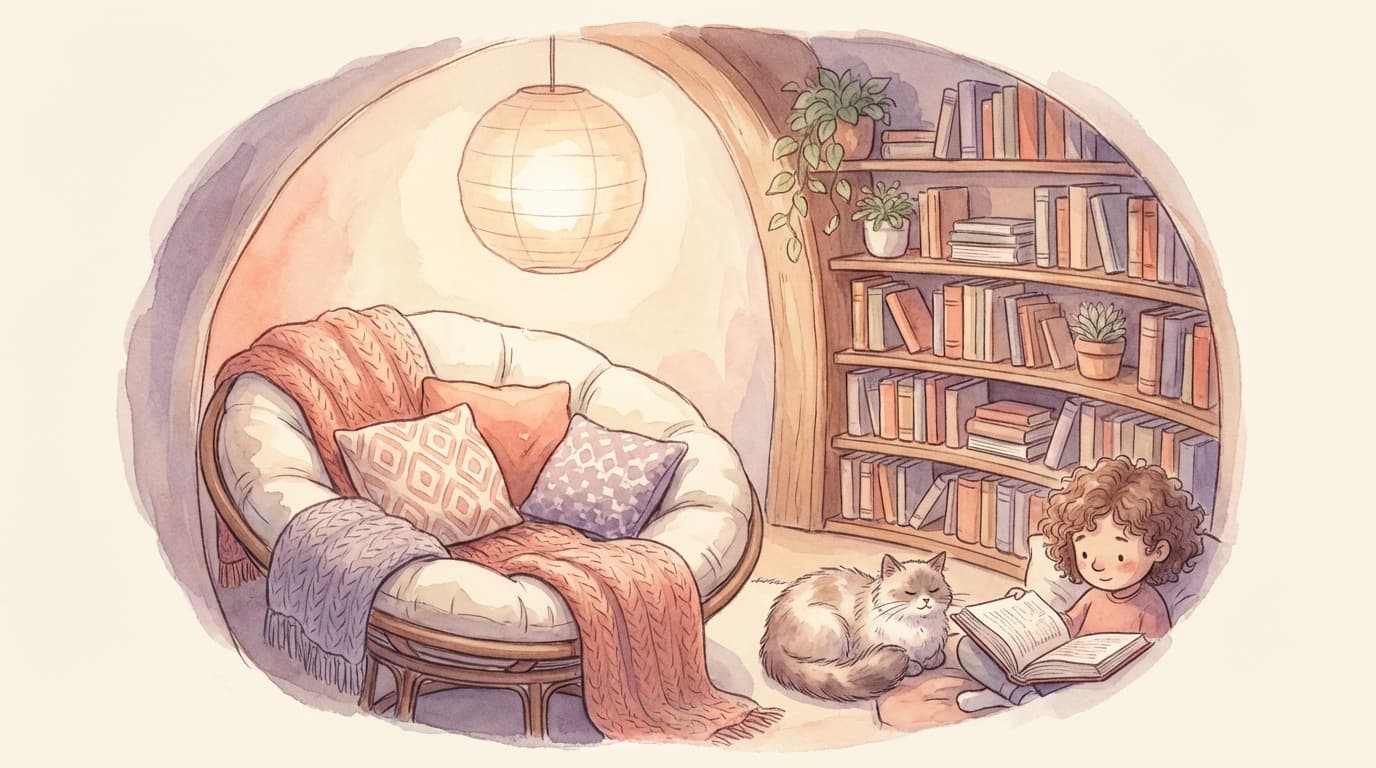
This is where the Screen-Free Sanctuary concept comes alive. A reading nook doesn't need to be fancy. A corner with a beanbag, good light, and a basket of books is enough. What matters is that it's designated, consistent, and completely screen-free.
The reading nook serves a specific purpose: it gives your child a place to go when they're bored, restless, or winding down — a place where the only option is a book, a drawing pad, or their own imagination. Over time, the space becomes associated with that mode of thinking.
Children need what I call 'analog anchors' — physical spaces in the home that are defined by non-digital activity. A reading nook, a craft table, a garden corner. These spaces train the brain to shift gears. When a child sits in their reading nook, their nervous system begins to downregulate before they even open a book. The space itself becomes a cue for calm.
What Does the Research Say About Screen Time and Anxiety?
The urgency behind screen-free zones isn't just about better sleep or more reading. The mental health data has become impossible to ignore.
A 2026 study published in Nature followed over 10,000 children ages 6-12 across five countries and found that children with four or more hours of daily screen time faced a 45% higher risk of clinically significant anxiety symptoms compared to children with under two hours. The relationship held after controlling for family income, parental mental health, physical activity, and sleep duration.
45%
higher anxiety risk for children with 4+ hours of daily screen time compared to children with under 2 hours
Source: Nature, 2026
The mechanism isn't fully understood, but researchers point to several factors: social comparison (especially on social media), displacement of physical play and face-to-face interaction, disrupted sleep, and the constant low-grade stimulation that prevents the nervous system from learning to self-regulate.
Screen-free zones don't solve all of this. But they create pockets of the day where your child's brain gets a break — where the nervous system can downshift, where boredom can spark creativity, and where connection happens without a device mediating it.
This is why the reading nook matters so much. It's not just a screen-free space. It's a screen-free ritual. And rituals build the kind of security that buffers against anxiety.
How Do You Set Up Screen-Free Zones by Age?
The approach shifts as your child grows. What works for a toddler won't work for a ten-year-old.
Ages 0-2: The Whole Home (Almost)
The AAP recommends no screen media for children under 18 months, except video calls. For this age group, the entire home is essentially a screen-free zone. The practical challenge is managing your own screen use around the baby, since parental screen distraction is associated with fewer verbal interactions and weaker attachment cues.
Ages 2-5: Bedroom + Meals + Reading Nook
Start with three clear zones. The bedroom is screen-free at all times. Meals are screen-free. And designate one cozy corner as the reading nook — a place your child learns to associate with books and quiet play. At this age, the zones feel natural because you're establishing them before habits form.
Ages 6-9: Add the Car and Homework Space
School-age children face more screen pull. Add the car (audiobooks and conversation replace tablets on drives) and the homework area. The homework space is critical — research shows that children who do homework near a screen take 50% longer to complete assignments, even when the screen isn't in use.
Ages 10-12: Negotiate, Don't Dictate
Preteens push back against unilateral rules. Involve them in designing the zones. "Which spaces do you think should be screen-free?" gives them ownership. Most children this age will agree that the bedroom and dinner table make sense — especially if you model it by keeping your own phone out of those spaces.
The key across all ages: parents follow the same rules. A screen-free dinner table where Dad scrolls his phone teaches children that rules are for kids, not for the family. More on this below.
How Do You Get Family Buy-In Without a Fight?
This is where most families stumble. Announcing "new screen rules" feels like a punishment. Here's how to make it feel like a family project instead.
Step 1: Name the problem together. Instead of lecturing, ask: "Do you notice we spend a lot of time on screens? How does that feel?" Children as young as five can articulate that too much screen time makes them feel "bored" or "bleh." Let them arrive at the problem.
Step 2: Design the zones as a team. Get a simple floor plan of your home (or draw one together). Let your child color in the screen-free zones. Let them choose which corner becomes the reading nook. Let them pick the books that go there. Ownership kills resistance.
Step 3: Make screen-free spaces better, not emptier. The reading nook should feel like the best spot in the house — a place your child wants to be. Soft pillows. A cozy blanket. A reading lamp. Their favorite books. A book where they're the hero. The goal is replacement, not removal.
Step 4: Model relentlessly. Put your own phone in the basket at dinner. Read a physical book on the couch. Let your child see you choosing analog over digital. A 2023 NIH study found that parental screen habits were the strongest single predictor of children's screen habits — stronger than rules, access, or income.
Step 5: Start small and expand. Begin with one zone (dinner table is easiest). Once it's normal — usually two to three weeks — add the bedroom. Then the reading nook. Gradual change sticks. Sudden overhauls collapse.
📖 The reading nook's secret weapon
The hardest part of a screen-free zone is filling it with something your child actually reaches for. A Sherly book — where your child sees themselves as the hero on every page, with custom illustrations created from their own photo — turns the reading nook into the most magnetic spot in the house. When the book stars them, they don't ask for the tablet.
What If It's Not Working?
Some common sticking points and how to handle them:
"My child throws a fit when screens aren't available." This is normal for the first one to two weeks. The tantrum isn't about the screen — it's about the transition. Stay calm. Validate the feeling ("I know it's frustrating"). Offer a specific alternative ("Let's read your adventure book together"). The tantrums fade once the new normal sets in.
"My partner won't follow the rules." This is the most common sabotage. Have the conversation privately, not in front of the children. Frame it around the research, not blame: "Kids with screen-free bedrooms get 41 more minutes of sleep per night. Can we try it for a month?"
"My child needs a screen for homework." Separate the homework screen from entertainment screens. A laptop for schoolwork in a shared space (kitchen counter, living room desk) is different from a tablet in the bedroom. The zone isn't "no technology" — it's "no entertainment screens."
"We live in a small space." You don't need a whole room. A corner of the living room with a curtain divider, a reading cushion, and a book basket creates a psychological boundary even without a physical wall. The boundary is about intention, not square footage.
41 minutes
more sleep per night for children with screen-free bedrooms compared to children with a screen in their room
Source: Sleep Medicine Reviews, 2025
The Reading Nook: Heart of the Screen-Free Home
If you take one thing from this guide, let it be this: create a reading nook and protect it.
The reading nook is where the screen-free concept becomes something positive rather than restrictive. It's not a place where screens are banned. It's a place where stories live. Where your child curls up with a book and disappears into a world built by their own imagination. Where you sit together at the end of the day and read.
Research consistently shows that a dedicated reading space at home is one of the strongest predictors of whether a child becomes a reader. A 2024 study from the National Literacy Trust found that children with a designated reading spot at home read for pleasure twice as often as children without one.
The nook doesn't need to cost anything. A pile of cushions in a quiet corner. A shelf with ten beloved books. A lamp. That's it.
What matters is that it's always there. Always screen-free. Always inviting. A sanctuary — not from screens, but for something better.
Ready to create your child's story?
Turn your child into the hero of a 30-page illustrated hardcover book. Upload a photo and see the magic.
Frequently Asked Questions
Sherly Team
Children's Reading Specialists