Building a home library your kids actually use starts with one shift: stop thinking like a collector and start thinking like a curator. The goal isn't rows of perfect spines on a shelf. It's a small, intentional collection your child reaches for without being asked. Research backs this up — a 2018 study of 160,000 households across 31 countries found that children who grew up with books at home scored significantly higher on literacy, numeracy, and technology tests as adults.
But here's the part most parents miss: the number of books matters less than how those books are presented, rotated, and woven into your child's daily life. A shelf of 30 well-chosen, face-out books beats a wall of 200 dusty spines every time.
Why Do Home Libraries Matter So Much?
The research is striking. That same 2018 study, published in Social Science Research by researchers at the Australian National University, found that growing up with 80 or more books in the home correlated with significantly higher literacy — an effect comparable to having university-educated parents.
80+
books in the home correlates with significantly higher literacy scores — equivalent to the impact of parental university education
Source: Social Science Research, 2018 (Australian National University)
This isn't about wealth. It's about access and proximity. Children who see books around them absorb a simple message: reading is what people in this house do. The books become part of the environment, not an event.
The mere presence of books in the home is one of the strongest predictors of academic achievement. It signals to the child that reading is valued — and children absorb that signal long before they can read a word.
You don't need to hit 80 books overnight. You build toward it. And the books you choose — and how you display them — matter far more than hitting a number.
How Should You Display Books So Kids Actually Pick Them Up?
Here's a fact that changes everything: young children choose books by their covers, not their spines. Walk into any children's library or bookstore and notice what faces outward. That's intentional. Kids are drawn to images, colors, and characters they recognize.
A traditional bookshelf with spines facing out is designed for adults who can read titles sideways. For a child under eight, a wall of spines is a wall of nothing.
Front-facing display is the single highest-impact change you can make. Options range from simple to elaborate:
- •Wall-mounted ledge shelves — IKEA picture ledges work perfectly and cost under $10 each
- •Rain gutter shelves — a popular DIY option for under $20 total
- •Forward-facing bookcases — designed for children's rooms, with sling-style fabric shelves
- •A low basket or crate — placed where your child plays, with covers visible
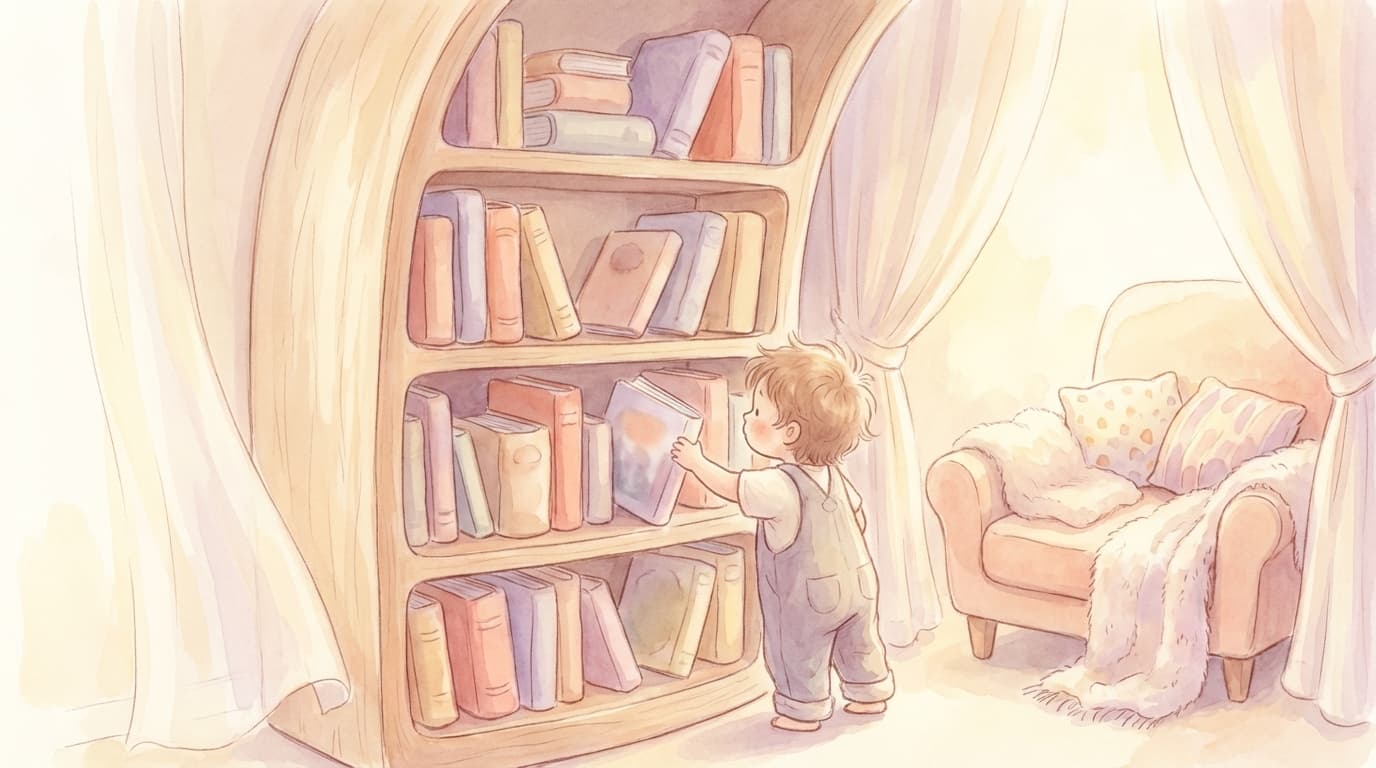
The key principle: books at eye level, covers facing out, within arm's reach. When a three-year-old can see a dinosaur on a book cover and grab it without asking for help, that book gets read. When it's spine-out on a high shelf, it doesn't.
💡 The 20-book front-face rule
You don't need to display your entire collection face-out. Pick 15-20 books and rotate them monthly. Store the rest in a bin or on a traditional shelf. This keeps the display fresh and prevents visual overload — which, for young children, can be just as discouraging as having no books at all.
How Many Books Does a Home Library Actually Need?
The research points to 80 as a meaningful threshold, but don't let that number paralyze you. Quality and curation matter more than volume.
Think of your home library in three tiers:
Tier 1: The Anchor Books (5-10 books) These are the books your child returns to again and again. The ones with worn covers and memorized pages. Every child has them — the stories that feel like theirs. These never rotate off the shelf.
Tier 2: The Active Collection (15-25 books) These are the books currently in rotation. A mix of fiction and nonfiction, familiar and new, matched to your child's current interests and reading level. Swap these out every few weeks.
Tier 3: The Reserve (30-50+ books) Books your child has outgrown, books waiting to be introduced, seasonal titles, and books saved for later. Store these out of sight — in a closet, under the bed, in labeled bins — and pull from them when it's time to refresh the active collection.
This system means you're always working with a manageable, curated display while building toward a deeper collection over time.
What Books Should You Include at Each Age?
Curation by age prevents the common mistake of keeping toddler board books on display for a seven-year-old. Your library should grow with your child.
Ages 0-2: Sensory and Rhythm
- •Board books with high-contrast images
- •Touch-and-feel books
- •Simple rhyming text (anything by Sandra Boynton)
- •Books with faces — babies are drawn to eyes
Ages 2-4: Story and Repetition
- •Picture books with repetitive refrains ("Brown Bear, Brown Bear")
- •Books about daily routines (bedtime, meals, getting dressed)
- •Lift-the-flap and interactive books
- •Stories featuring animals or vehicles — whatever obsession your child currently has
Ages 4-6: Narrative and Identity
- •Longer picture books with real story arcs
- •Books that reflect your child's experiences and world
- •Early readers for children beginning to decode
- •Books that hold attention through humor, surprise, or emotional resonance
Ages 6-9: Independence and Range
- •Early chapter books and graphic novels
- •Nonfiction about current passions (space, dinosaurs, animals, sports)
- •Series books — once hooked, children build stamina by chasing the next volume
- •Books for reluctant readers if your child resists independent reading
A child's home library should be a living thing — not a static display. The books on the shelf today should reflect who your child is right now: their questions, their fears, their obsessions. Next month, it should look a little different.
Why Should You Rotate Books Instead of Displaying Everything?
Rotation solves two problems at once. It prevents visual overwhelm — too many choices can freeze a young child the same way a screen full of streaming options freezes an adult. And it creates novelty without spending — a book pulled from storage after three months feels brand new.
A simple rotation schedule:
- •Weekly: Move 2-3 books from active display to reserve, pull 2-3 from reserve
- •Monthly: Do a bigger swap of 8-10 books, aligning with your child's shifting interests
- •Seasonally: Introduce seasonal or holiday-themed books; retire them after
One powerful trick: let your child help choose which books rotate in. Autonomy drives engagement. When a child selects the books on their shelf, those books get read.
80%
of children in homes with books read for pleasure — compared to far lower rates in bookless homes
Source: National Literacy Trust, 2023
How Do You Create a Reading Nook That Pulls Kids In?
A reading nook doesn't need to be elaborate. It needs to feel separate, cozy, and claimed. The goal is a space your child associates with one activity: reading. Not screens, not homework, not discipline. Just books.
The essentials:
- •Soft seating — a floor cushion, beanbag, or pile of pillows. It should feel different from sitting at a desk or table.
- •Good light — natural light during the day, a warm reading lamp for evenings. Overhead fluorescents kill the mood.
- •Proximity to books — the nook should be within arm's reach of the front-facing shelf or basket. Friction kills habits.
- •A boundary — even a small rug or canopy defines the space as "theirs." Children respond to territory.
You can build a reading nook in a closet, a corner, under a loft bed, or beside a window seat. Some parents hang a simple fabric canopy from the ceiling over a cushion. Others repurpose a large cardboard box. The investment can be $0 or $200 — the effect is the same.
The critical rule: the reading nook is sacred space. No timeouts happen there. No screens live there. It's the one spot in the house that belongs to books and imagination. Protect that association and your child will protect it too.
How Do You Build a Library on a Budget?
You don't need to spend $15-20 per new book to build an 80-book collection. The most well-stocked home libraries are built through resourcefulness, not retail.
- •Library book sales — Most public libraries hold annual or quarterly sales. Hardcovers go for $1-2, paperbacks for $0.25-0.50. Arrive early for the best selection.
- •Little Free Libraries — the take-a-book, leave-a-book boxes in neighborhoods. Free.
- •Book swaps — organize one with other parents. Your child's outgrown books become another child's new favorites.
- •Thrift stores — Goodwill, Salvation Army, and local thrift shops stock children's books for $0.50-2.00.
- •Buy Nothing groups — Facebook and Nextdoor groups where parents give away books their children have outgrown.
- •Scholastic Book Club flyers — sent home from school, these offer books at steep discounts and earn free books for the classroom.
- •Birthday and holiday requests — when relatives ask what to buy, say books. Be specific: share a wishlist.
A family spending $5-10 a month through these channels can build a solid 80-book library within two years. The library itself — your public library — fills every gap in the meantime. Borrow widely, buy the ones your child asks to keep.
What Are "Anchor Books" and Why Do They Matter?
Every child has a handful of books they return to obsessively. The ones they ask for at bedtime five nights in a row. The ones with cracked spines and food stains. These are anchor books — and they are the foundation of a home library that gets used.
Anchor books share one quality: deep personal connection. The child sees something of themselves in the story. Maybe the character shares their fear of the dark, their love of dogs, or their experience of starting a new school. The story resonates at a level that transcends "good writing" or "nice illustrations."
This is exactly why personalized books become anchor books so consistently. When a child opens a book and sees their own face illustrated into every page — their name in the text, their appearance in the art, their world reflected in the story — that book earns a permanent spot on the shelf.
📖 The anchor book your child never outgrows
Sherly books are designed to become anchor books. Your child's photo is transformed into custom illustrations across 30 pages of a premium hardcover. They don't just read the story — they live inside it. Parents tell us these are the books their children pull off the shelf first, read on repeat, and refuse to lend out. Because when the hero looks like you, the story belongs to you.
Anchor books don't rotate. They stay. Build your library around them and fill in the rest with a rotating cast of borrowed, swapped, and discovered titles.
A Simple Plan to Start This Week
You don't need to overhaul your child's room. Start with these five steps:
- •Choose a spot — a corner, a wall, a shelf. Dedicate it to books and nothing else.
- •Go front-facing — mount a ledge shelf or set out a low basket with covers visible. Display 15-20 books.
- •Audit what you have — remove books your child has outgrown or never liked. Store them for a younger sibling or donate them.
- •Add one anchor book — a personalized book, a beloved favorite, or a title that reflects your child's current world. This book stays.
- •Visit the library this weekend — borrow five books your child picks. Watch which ones they reach for at home. Those genres and styles guide your next purchases.
The library you build doesn't need to be Instagram-worthy. It needs to be used. Creased covers, missing dust jackets, pages with crayon marks — those are signs of a library doing its job. A pristine shelf is a warning sign. A messy one is a victory.
Ready to create your child's story?
Turn your child into the hero of a 30-page illustrated hardcover book. Upload a photo and see the magic.
Frequently Asked Questions
Sherly Team
Children's Reading Specialists