Reading to your child every night physically changes the structure of their developing brain. MRI studies show that children who are read to regularly have significantly more activity in the regions responsible for language comprehension, visual imagery, and narrative understanding. This isn't metaphor — it's measurable neuroscience.
A landmark 2015 study from Cincinnati Children's Hospital, published in Pediatrics, found that children exposed to regular home reading showed significantly greater activation in the left-sided parietal-temporal-occipital association cortex — a brain region critical for mental imagery and narrative comprehension. The more reading at home, the stronger the signal.
What Happens in a Child's Brain During Storytime?
When you read aloud to your child, you activate far more than just their auditory cortex. The brain lights up across multiple regions simultaneously, creating a rich network of neural connections.
The left parietal-temporal cortex processes language structure. The visual association cortex generates mental images of characters and settings. The prefrontal cortex engages with prediction and emotional understanding. All of these regions fire together, strengthening the connections between them through a process neuroscientists call myelination — the insulation of neural pathways that makes information travel faster.
When a child is read to, the brain doesn't just passively receive words. It's actively constructing meaning, generating images, and building connections that form the architecture of literacy.
According to the American Academy of Pediatrics, children who are read to from infancy show measurably larger vocabularies by age two — an average of 300 more words than peers who are not read to regularly. That vocabulary gap widens with every passing year.
How Many Minutes of Reading Actually Makes a Difference?
You don't need hour-long reading marathons. Research suggests that 15-20 minutes of nightly reading is the sweet spot for young children. This amount provides enough exposure to build neural pathways without overwhelming developing attention spans.
A 2019 study from Ohio State University calculated that children who are read five books a day enter kindergarten having heard approximately 1.4 million more words than children who were never read to. Even one book a day resulted in a 290,000-word advantage over five years.
1.4M
more words heard by kindergarten for children read 5 books daily
Source: Ohio State University, 2019
The consistency matters more than the duration. A child read to for 10 minutes every single night benefits more than one read to for an hour on weekends. The brain builds pathways through repetition and routine, not intensity.
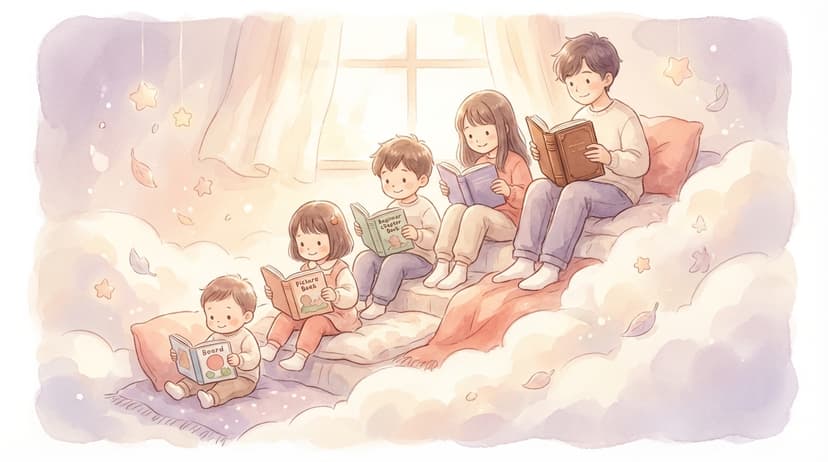
- •Birth to 12 months — 5-10 minutes of board books with high-contrast images
- •1-3 years — 10-15 minutes of picture books with simple narratives
- •3-5 years — 15-20 minutes of longer stories with richer vocabulary
- •5-8 years — 20-30 minutes of chapter books, even after they start reading independently
Does It Matter Who Reads to the Child?
Yes — and not in the way you might think. Research from Harvard's Graduate School of Education found that dialogic reading — where the adult asks questions, pauses for responses, and connects the story to the child's life — produces significantly greater language gains than straight read-throughs.
The adult's role is not just narrator. You are the child's co-pilot through meaning-making. When you pause and ask "What do you think happens next?" or "How do you think she feels?", you activate the child's prefrontal cortex — the seat of critical thinking and emotional intelligence.
The magic isn't in the book itself. It's in the interaction between the reader and the child. That's where language, empathy, and cognitive skills are built.
Different readers also bring different benefits. A 2020 study published in Developmental Psychology found that fathers tend to use more abstract and challenging language during storytime, while mothers tend to provide more emotional scaffolding. Children who are read to by multiple caregivers get the broadest language benefit.
Why Does Nightly Reading Build Stronger Readers Than Occasional Reading?
The brain's learning mechanisms rely heavily on spaced repetition. When a child encounters vocabulary, story structures, and phonological patterns night after night, those neural pathways strengthen through a process called long-term potentiation — the biological basis of memory formation.
According to the National Institute of Child Health and Human Development (NICHD), children who are read to daily from ages one through five perform significantly better on reading assessments in third grade than children read to only occasionally — even after controlling for socioeconomic factors.
📖 Making storytime personal
Children engage most deeply with stories where they see themselves reflected. Sherly creates personalized books where your child's actual photo becomes custom illustrations — making them the hero of every page. When children see themselves in the story, the brain's engagement response is even stronger.
This effect compounds over time. Reading researcher Anne Cunningham at UC Berkeley found that the amount of reading a child does by age nine predicts their vocabulary at age 15 more accurately than any other single factor, including IQ. The foundation is laid in those nightly reading sessions.
What About Kids Who Squirm and Won't Sit Still?
A wiggly child is still a listening child. Research from the University of Virginia shows that young children can process auditory information even when physically active. You don't need a perfectly still child perched on your lap to get the brain benefits of reading aloud.
Some practical strategies for active listeners:
- •Let them hold a toy while you read — tactile stimulation can actually aid focus
- •Choose books with interactive elements — flaps, textures, or questions for the child to answer
- •Read during bath time with waterproof books for toddlers
- •Start with shorter sessions and gradually increase duration as attention builds
- •Follow their interest — if they want to flip back to a previous page, let them
Ready to create your child's story?
Turn your child into the hero of a 30-page illustrated hardcover book. Upload a photo and see the magic.
According to a 2023 report from the National Literacy Trust in the UK, children who enjoy reading are five times more likely to read above the expected level for their age. The goal of nightly reading isn't compliance — it's cultivating enjoyment.
Does Reading Aloud Still Help After Children Learn to Read Themselves?
Absolutely. The American Academy of Pediatrics recommends reading aloud to children well past the age they can read independently. A child's listening comprehension exceeds their reading comprehension until approximately age 13.
This means a seven-year-old who can independently read at a second-grade level can listen to and understand stories at a fourth- or fifth-grade level. Read-alouds expose them to more complex vocabulary, sentence structures, and narrative ideas than they could access on their own.
13
age at which reading comprehension catches up to listening comprehension
Source: American Academy of Pediatrics
Reading aloud to older children also maintains the emotional bonding aspect that makes storytime so powerful. In an age of increasing screen time, those 15-20 minutes of shared narrative remain one of the most effective ways to stay connected to your child's inner world.
Reading aloud to older children isn't remedial — it's enrichment. You're exposing them to language and ideas they can't yet access independently, while maintaining one of the most important bonding rituals in family life.
How to Build a Nightly Reading Habit That Sticks
The neuroscience is clear: consistency is everything. Here's how to make nightly reading non-negotiable without making it feel like a chore.
- •Anchor it to an existing routine — right after brushing teeth, right before lights out
- •Keep books accessible — a small shelf or basket next to the bed removes friction
- •Let the child choose — autonomy increases engagement and builds intrinsic motivation
- •Don't make it conditional — reading should never be a reward that can be taken away
- •Rotate and refresh — introduce new books regularly alongside beloved favorites
Children who re-read favorite books aren't being lazy. Repetition is exactly how the brain consolidates learning. A 2011 study from the University of Sussex found that children who heard the same story repeatedly learned new vocabulary words faster than children exposed to multiple different stories.
Frequently Asked Questions
Sherly Team
Children's Reading Specialists