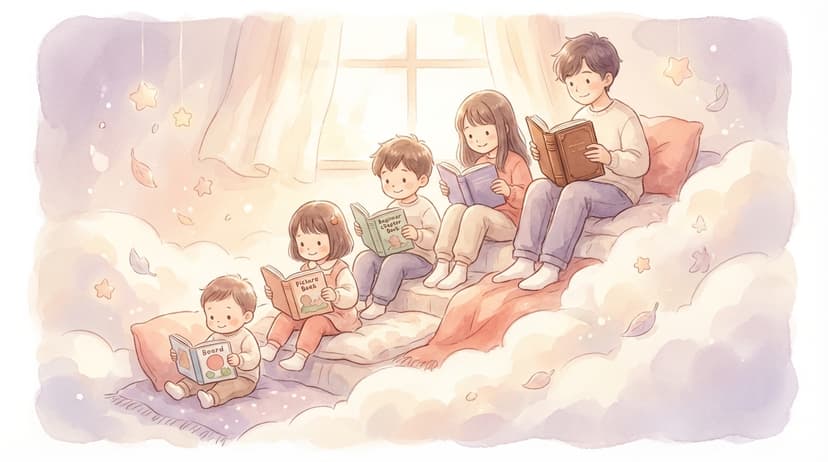
To choose a book for your child's reading level, use the five-finger rule: have them read a page and hold up a finger for each unknown word. Zero to one finger means the book is too easy for learning (but fine for enjoyment). Two to three fingers is the ideal instructional level. Four to five fingers means it's too hard for independent reading — save it for a read-aloud.
According to the International Literacy Association, reading at the right level is critical because books that are too difficult create frustration and avoidance, while books that are too easy don't build new skills. The sweet spot — called the "zone of proximal development" — is where growth happens.
What Are the Main Reading Level Systems and How Do They Work?
Multiple systems exist to categorize children's reading levels, and they don't always align. Understanding the major systems helps you navigate bookstores, libraries, and school recommendations.
Lexile Framework (most widely used in the US):
- •Measures both reader ability and text difficulty on the same scale
- •Range: Below 200L (beginning readers) to 1600L+ (advanced adult)
- •Your child may receive a Lexile score from school assessments (MAP, SRI, STAR)
- •Books display Lexile measures on the back cover or online
Guided Reading Levels (Fountas & Pinnell):
- •Letters A through Z, used primarily in schools for K-5
- •Considers not just vocabulary but also sentence complexity, content, and book length
- •Level A = beginning reader; Level Z = advanced middle school
DRA (Developmental Reading Assessment):
- •Numbered scale from 1 to 80
- •Used in many school districts for progress monitoring
- •Often paired with Guided Reading levels
Reading level systems are tools, not sentences. A child's Lexile score tells you where they can read independently, but it says nothing about where they can read with support, what they should read for enjoyment, or what they can understand through listening. Use levels as a starting point, not a ceiling.
| Grade Level | Lexile Range | Guided Reading | DRA |
|---|---|---|---|
| Kindergarten | BR-300L | A-D | 1-6 |
| 1st Grade | 190L-530L | D-J | 6-18 |
| 2nd Grade | 420L-650L | J-M | 18-28 |
| 3rd Grade | 520L-820L | M-P | 28-38 |
| 4th Grade | 740L-940L | P-T | 38-44 |
| 5th Grade | 830L-1010L | T-V | 44-50 |
5-finger
rule: the simplest and most reliable way parents can assess reading level match
Source: International Literacy Association
How Do I Use the Five-Finger Rule at a Bookstore?
The five-finger rule works anywhere — bookstores, libraries, even browsing at home. It takes about 60 seconds and requires no knowledge of formal reading levels.
Step by step:
- •Have your child open the book to any full page of text
- •Ask them to read the page aloud (or silently for older children)
- •For each word they cannot read or don't understand, they hold up one finger
Interpreting the result:
- •0-1 fingers = "Easy read" — Great for independent reading, building fluency, and enjoyment. Not ideal for growth, but excellent for confidence.
- •2-3 fingers = "Just right" — The goldilocks zone. Challenging enough to build skills but not so hard that comprehension breaks down. Ideal for instructional reading.
- •4-5 fingers = "Too hard" — Will cause frustration if read independently. Perfect for read-alouds, audiobooks, or reading together with support.
💡 Both 'easy' and 'hard' books have a place
Children should have access to all three levels. Easy books build fluency and confidence. Just-right books build skills. Hard books (as read-alouds) expose them to advanced vocabulary and complex stories. A balanced reading diet includes all three.
Common mistake: Parents often push children exclusively toward "just right" books, thinking easy books are a waste of time. Research from Timothy Rasinski at Kent State University shows that high-volume easy reading is one of the most effective fluency-building strategies. Let your child enjoy easy books guilt-free.
Should My Child Always Read at Their Exact Level?
No — and this is where many parents and schools get it wrong. A child's reading level describes their independent instructional zone, but children also need to read above and below this zone for different purposes.
If we only ever gave children texts at their exact level, we'd be denying them both the confidence that comes from easy reading and the excitement that comes from reaching for something just beyond their grasp. Reading level is a diagnostic tool, not a prison.
When to read below level:
- •Building fluency and automaticity
- •Reading for pure pleasure (bedtime, vacation)
- •Rebuilding confidence after a frustrating experience
- •Re-reading favorites (builds speed and comprehension)
When to read at level:
- •School assignments and guided reading
- •Building new vocabulary and comprehension skills
- •Independent reading for growth
When to read above level:
- •Read-alouds with a parent (listening comprehension exceeds reading comprehension)
- •Audiobooks
- •Paired reading with a more fluent reader
- •High-interest topics where motivation compensates for difficulty
Ready to create your child's story?
Turn your child into the hero of a 30-page illustrated hardcover book. Upload a photo and see the magic.
How Do I Know if a Book Is Age-Appropriate Beyond Reading Level?
Reading level measures text difficulty — not content appropriateness. A precocious six-year-old reader might decode a young adult novel, but that doesn't mean the content is suitable. Similarly, a struggling 10-year-old reader needs age-appropriate themes even in simpler texts.
Factors beyond reading level:
- •Emotional maturity — Can your child handle the themes? (death, fear, conflict, romance)
- •Background knowledge — Does the book assume knowledge your child doesn't have?
- •Social context — Will the content lead to questions you're prepared to discuss?
- •Interest alignment — A perfectly leveled book on an uninteresting topic is still a bad match
Resources for content appropriateness:
- •Common Sense Media — Detailed age-appropriateness reviews for thousands of children's books
- •Goodreads parent reviews — Real parents flagging content concerns
- •Your librarian — Children's librarians are trained to match books to individual children on both level and content
Until age 13
children's listening comprehension exceeds their reading comprehension
Source: American Academy of Pediatrics
What If My Child Insists on Books That Are Too Easy or Too Hard?
Too easy: Let them. Children gravitate toward easy books for valid developmental reasons — building fluency, enjoying mastery, finding comfort. As long as they're also occasionally encountering just-right and above-level text (through read-alouds, school, or audiobooks), easy-reading binges are healthy and productive.
Too hard: This usually indicates high interest in the topic or characters. Don't take the book away — instead, offer support:
- •Read it aloud to them
- •Listen to the audiobook version together
- •Take turns reading pages
- •Talk through difficult vocabulary as you encounter it
- •Revisit the book in six months when their level has grown
📖 Books that grow with your child
Sherly's personalized books are designed with rich vocabulary and engaging narrative across 30 illustrated pages. Because the story features your child as the hero with custom illustrations from their photo, the personal connection means children engage with the text regardless of whether it's slightly above their independent level. They are motivated to "read about themselves" — and that motivation bridges skill gaps naturally.
A child reaching for a book 'above their level' is showing you their aspiration. That should be celebrated, not corrected. Find a way to make the book accessible — read it together, use the audiobook, discuss it — rather than steering them back to something 'appropriate.'
How Often Should I Reassess My Child's Reading Level?
Formal reading levels should be reassessed every 3-6 months during the elementary years, as children's abilities can change significantly in a single semester. Your child's school likely conducts these assessments through programs like STAR, MAP, or running records.
Between formal assessments, use the five-finger rule as a quick check whenever your child seems to be struggling with or breezing through their current reading material. If a just-right book from three months ago now feels easy, that's growth — time to move up.
Signs your child has outleveled their current books:
- •Reading aloud is smooth and expressive (not labored)
- •They finish books much faster than before
- •They can retell plot, character motivations, and themes accurately
- •They say books are "boring" (often means too easy, not actually uninteresting)
Signs they need easier material:
- •Frequent word-guessing or skipping
- •Can read the words but can't summarize what happened
- •Avoidance or resistance toward reading
- •Visible frustration during independent reading
Frequently Asked Questions
Sherly Team
Children's Reading Specialists