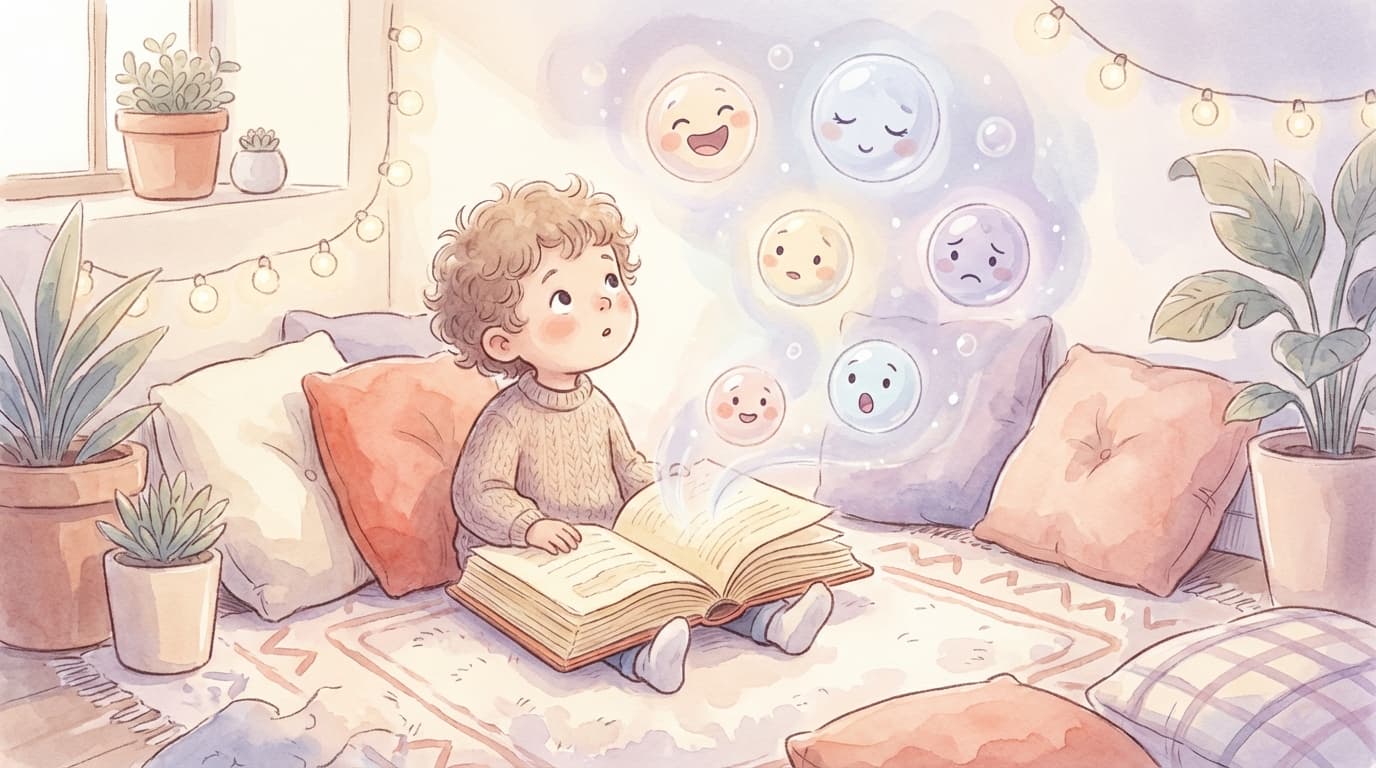
Storytelling builds emotional intelligence in children by giving them a safe space to experience, label, and process complex emotions before they encounter them in real life. Research from York University found that children who were read to regularly scored 36% higher on measures of emotional understanding and showed significantly greater empathy than peers with less story exposure. Stories are, effectively, an emotional flight simulator.
Emotional intelligence — the ability to recognize, understand, manage, and effectively express emotions — is one of the strongest predictors of life success. A 2023 meta-analysis published in Psychological Bulletin found that childhood emotional intelligence predicted academic achievement, relationship quality, and mental health outcomes 20 years later, even after controlling for IQ.
What Is Emotional Intelligence and Why Does It Matter for Children?
Emotional intelligence (EQ) encompasses four core skills:
- •Self-awareness — Recognizing your own emotions as they happen
- •Self-regulation — Managing emotions without being overwhelmed
- •Social awareness — Understanding what others are feeling (empathy)
- •Relationship management — Navigating social interactions effectively
These aren't soft skills — they're foundational. A 2024 report from the World Economic Forum listed emotional intelligence among the top 10 skills needed for the future workforce. And unlike IQ, which is relatively fixed, EQ is highly trainable — especially during childhood.
Emotional intelligence is the strongest predictor of performance in the workplace, the biggest driver of leadership and personal excellence, and the foundation of quality relationships. The good news is it's learnable. The best news is it's most learnable in childhood. And the simplest tool we have for teaching it is storytelling.
The challenge: you can't teach emotions through lectures. A child who is told "You should be empathetic" doesn't become empathetic. But a child who experiences empathy through a story — who feels what a character feels — develops that capacity naturally.
36%
higher scores on emotional understanding measures among children who were read to regularly versus those with less story exposure
Source: York University, 2023
How Do Stories Develop Empathy in Children?
Empathy — the ability to understand and share another person's feelings — develops through a process called theory of mind. This is the cognitive ability to understand that other people have thoughts, feelings, and perspectives different from your own. It typically emerges between ages 3-5.
Stories accelerate theory of mind development because they give children access to other people's inner worlds. In real life, you can observe someone's behavior but not their thoughts. In a story, you get both — the narrator reveals what the character thinks, feels, fears, and hopes.
A 2024 study from the University of Toronto found that children aged 4-6 who were read stories with rich emotional content showed theory of mind development that was 6-12 months ahead of their peers who were read primarily factual or simple narrative content.
The mechanism works in three stages:
- •Exposure — The child encounters an emotion in a character ("The little boy felt lonely")
- •Resonance — Through narrative transportation, the child feels that emotion vicariously
- •Reflection — After the story, the child processes what happened and can apply the understanding to real situations
Reading fiction is the closest thing we have to a telepathy device. It lets children literally inhabit another person's mind. Every time a child reads a story and thinks 'How does the character feel?' they're doing a push-up for their empathy muscles.
This is why the type of story matters. Stories with complex characters who have clear internal emotional lives do far more for empathy than stories focused primarily on action or plot.
How Does Storytelling Build Emotional Vocabulary?
Children can only manage emotions they can name. A child who feels a swirl of frustration, disappointment, and jealousy but can only label it as "mad" is at a disadvantage. Emotional granularity — the ability to make fine-grained distinctions between emotions — is a key component of emotional intelligence.
Stories naturally expand emotional vocabulary. Every time a character feels "determined" instead of "trying," "embarrassed" instead of "bad," or "relieved" instead of "happy," the child's emotional lexicon grows.
40%
larger emotional vocabulary in children who were read to for 20+ minutes daily, compared to children with less than 5 minutes of daily reading
Source: Harvard Graduate School of Education, 2024
A 2024 study from the Harvard Graduate School of Education found that children aged 3-7 who were read to for 20+ minutes daily had a 40% larger emotional vocabulary than children with less than 5 minutes of daily reading. The researchers noted that this vocabulary difference predicted real-world emotional regulation skills.
Why does naming matter? Neuroscience research from UCLA shows that labeling an emotion — saying "I feel frustrated" rather than just feeling it — activates the prefrontal cortex and reduces amygdala activity. In other words, naming an emotion literally calms the brain's stress response.
Stories teach children to name emotions in a low-stakes context. When a character in a book is "overwhelmed," the child learns that word without being overwhelmed themselves. Then, when they experience that feeling in real life, they have a word for it — and that word gives them a measure of control.
Can Personalized Stories Enhance Emotional Learning?
When a child is the protagonist of the story, the emotional learning intensifies. Here's why: narrative transportation — the degree to which a reader is absorbed in a story — determines how strongly they experience the character's emotions. And identification with the protagonist is the primary driver of narrative transportation.
A 2024 study from the National Literacy Trust found that children reading personalized stories showed 47% stronger emotional engagement compared to children reading non-personalized versions of the same stories.
📖 Emotional intelligence, personalized
When your child sees themselves navigating emotions in a Sherly book — feeling scared and being brave anyway, feeling different and discovering that's a strength — the emotional lessons land deeper. Every Sherly book features your child as the hero across 30 illustrated pages, turning abstract emotional concepts into personal, felt experiences.
When the hero who feels brave, kind, or determined literally is the child, the emotional experience isn't observed — it's owned. The child doesn't learn "bravery is good." They learn "I am brave." That's the difference between knowing about emotional intelligence and having it.
What Storytelling Techniques Build EQ at Home?
You don't need special training to use stories for emotional intelligence. These simple techniques, backed by research, make any reading session an EQ-building opportunity:
1. Pause and ask emotional questions. "How do you think the character is feeling right now?" This builds the habit of reading emotional cues.
2. Name the emotions explicitly. "The character looks frustrated. Frustrated means you're trying but things aren't working." This builds vocabulary.
3. Connect to the child's experience. "Have you ever felt like that?" This bridges fictional emotions to real emotional awareness.
4. Explore multiple perspectives. "How do you think the other character feels about this?" This develops theory of mind.
5. Discuss emotional choices. "What could the character do with those big feelings?" This builds self-regulation awareness.
The difference between reading a story and using a story for emotional learning is just two or three questions. 'How does the character feel?' 'Have you felt like that?' 'What would you do?' Those three questions, asked consistently, transform any picture book into an emotional intelligence curriculum.
A 2023 study from the University of Cambridge found that parents who used dialogic reading techniques (asking questions, connecting to experience, discussing emotions) during story time produced children with 52% higher emotional intelligence scores than parents who read without interaction.
52%
higher emotional intelligence scores in children whose parents used dialogic reading techniques during story time
Source: University of Cambridge Faculty of Education, 2023
Ready to create your child's story?
Turn your child into the hero of a 30-page illustrated hardcover book. Upload a photo and see the magic.
How Does Storytelling Help with Emotional Self-Regulation?
Self-regulation — the ability to manage intense emotions without being overwhelmed — is often the hardest EQ skill for children. Stories help through three mechanisms:
1. Emotional rehearsal. When a child experiences frustration, fear, or sadness through a story character, they're practicing the emotion in a safe context. The brain processes this as a low-stakes trial run, building capacity for handling the emotion in real life.
2. Narrative scaffolding. Stories provide scripts for emotional management: "When the character felt angry, they took three deep breaths." Children absorb these scripts and apply them when they face similar feelings.
3. Co-regulation. When a parent reads a story about big emotions while the child is safe in their lap, the child experiences the emotion while being regulated by the parent's calm presence. Over time, this external regulation becomes internal.
A 2024 study from the Child Mind Institute found that children who engaged in regular story-based emotional learning showed 34% fewer emotional outbursts at six-month follow-up compared to a control group. The researchers noted that the children had developed "narrative self-regulation" — the ability to construct a story about their own emotional experience in the moment: "I'm feeling angry right now. In my book, the character took a break when they felt this way."
At What Age Does Story-Based EQ Development Start?
Emotional intelligence development through storytelling begins earlier than most parents realize:
- •0-12 months — Infants respond to the emotional tone of a parent's voice during reading. Warm, varied vocal expression during reading helps them begin recognizing emotional states.
- •12-24 months — Toddlers begin pointing at faces in books and mimicking expressions. Board books with clear emotional faces ("happy," "sad," "surprised") lay groundwork.
- •2-3 years — Children start labeling basic emotions in stories. "He's sad!" This is the beginning of emotional vocabulary.
- •3-5 years — The critical window. Theory of mind emerges. Children can now understand that characters have feelings different from their own. Complex emotional content in stories has maximum impact.
- •5-7 years — Children begin understanding mixed emotions ("happy and scared at the same time") and can discuss emotional motivations.
- •7+ — Children can engage with more nuanced emotional narratives, including moral dilemmas and conflicting emotions.
The earlier you begin, the larger the advantage. But it's never too late. Emotional intelligence remains highly trainable throughout childhood and beyond.
Frequently Asked Questions
Sherly Team
Children's Reading Specialists