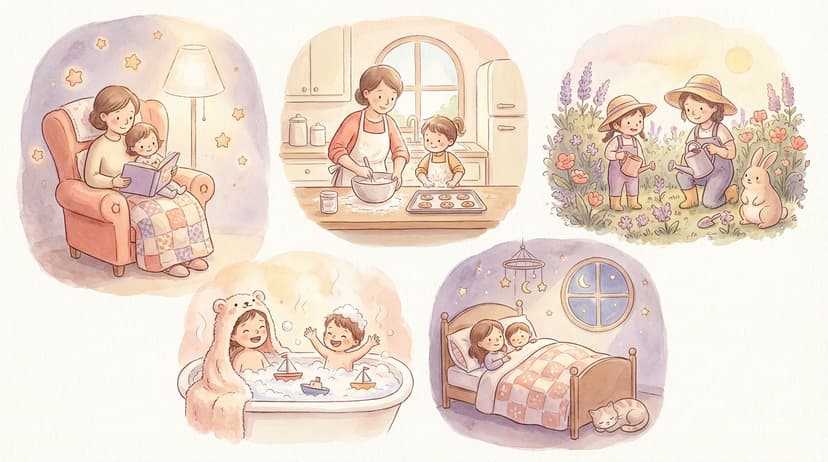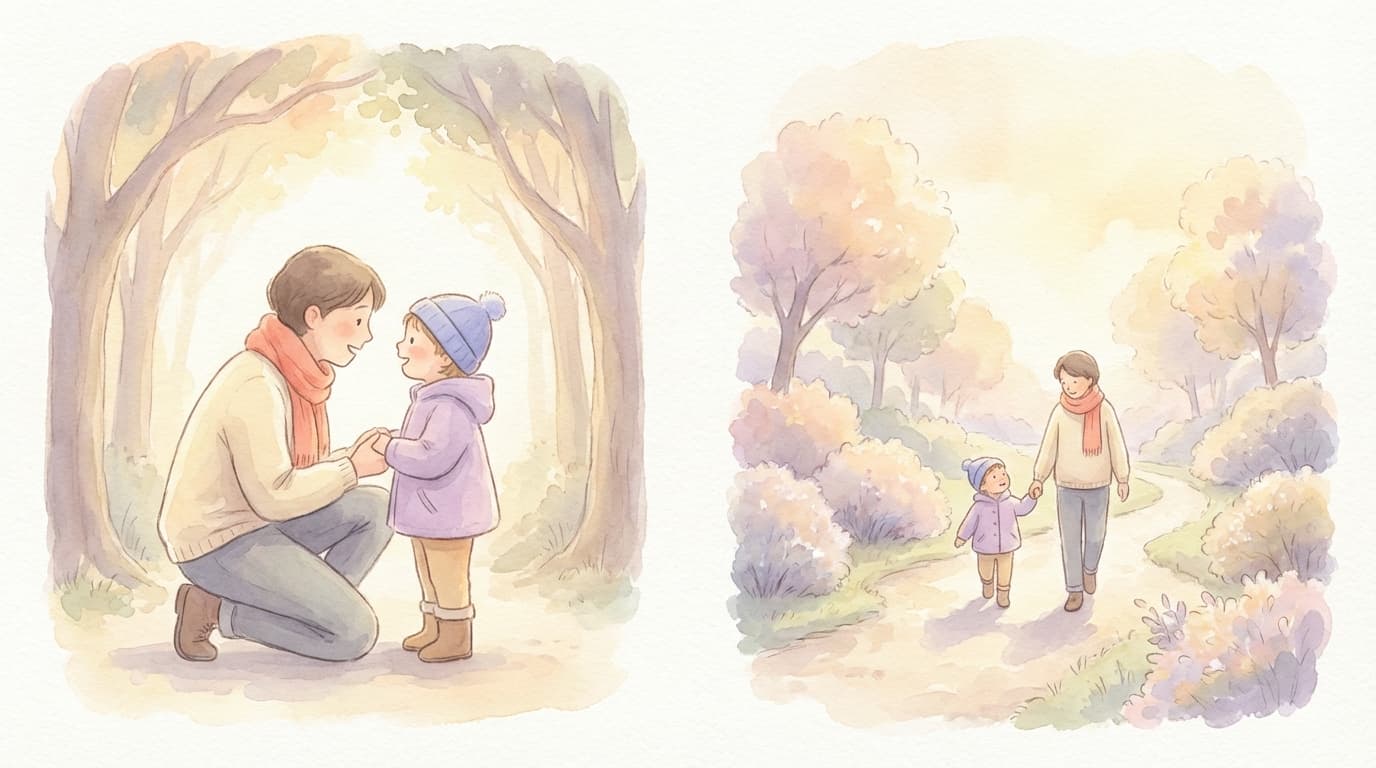
Gentle parenting and slow parenting are related but different philosophies. Gentle parenting is about how you interact with your child — empathy, firm boundaries, no punishment. Slow parenting is about the pace of childhood — less scheduling, more free play, presence over productivity. They share a foundation of respect and intentionality, but they solve different problems. And combining them creates something stronger than either one alone.
Both movements emerged as responses to modern parenting pressures, yet they target different symptoms. A 2024 survey from the Pew Research Center found that 62% of parents feel overwhelmed by conflicting parenting advice, and many confuse these two approaches or assume they're the same thing. Understanding the distinction helps you take what works from each — without the guilt of trying to follow a rigid philosophy.
What Is Gentle Parenting, Exactly?
Gentle parenting is a relationship-first approach built on four pillars: empathy, respect, understanding, and boundaries. It was popularized by parenting educator Sarah Ockwell-Smith and has roots in attachment theory and child development research.
The core idea: children behave better when they feel understood, not controlled.
This doesn't mean permissive parenting. That's the most common misconception. Gentle parenting holds firm limits — it just enforces them without yelling, shaming, time-outs, or punitive consequences. The boundary stays. The method of enforcing it changes.
What gentle parenting looks like in practice:
- •Instead of: "Stop crying or I'll give you something to cry about" → Try: "You're upset that we have to leave the park. That makes sense. It's hard to stop doing something fun. We're still leaving."
- •Instead of: Time-out in a chair → Try: Time-in with the parent, co-regulating the emotion
- •Instead of: "Because I said so" → Try: "The rule is no hitting. Hitting hurts. You can stomp your feet or squeeze this pillow instead."
Gentle parenting is not about being soft. It's about being strong enough to hold a boundary while also holding your child's emotions. It requires more self-regulation from the parent than any authoritarian approach ever did.
A 2023 meta-analysis published in Developmental Psychology reviewed 58 studies on gentle and positive parenting approaches. Children raised with empathy-based discipline showed 31% fewer behavioral problems and 27% stronger emotional regulation skills compared to children raised with punitive discipline — with no loss in compliance or respect for rules.
The gentle parenting movement exploded on social media between 2020 and 2024. That visibility came with a cost: watered-down interpretations that dropped the boundary piece and kept only the empathy. True gentle parenting holds both.
What Is Slow Parenting — and Why Do Fewer People Talk About It?
Slow parenting is the less-discussed cousin. While gentle parenting went viral, slow parenting stayed under the radar — which is a shame, because it addresses a problem just as urgent.
Slow parenting focuses on the pace and structure of childhood itself. It pushes back against the overscheduled, hyperoptimized, achievement-driven culture that fills every hour of a child's day with lessons, sports, enrichment, and structured activity.
The term was coined by journalist Carl Honoré in his 2008 book Under Pressure. The philosophy is simple: children need unstructured time, boredom, free play, and the space to develop at their own pace — and modern childhood has stripped most of that away.
62%
of children ages 6-12 participate in at least one organized activity on school days, with 30% in two or more — leaving little time for unstructured play
Source: American Academy of Pediatrics, 2024
What slow parenting looks like in practice:
- •Fewer activities. Two extracurriculars instead of five. Space in the schedule for nothing.
- •More boredom. Resisting the urge to fill every quiet moment with stimulation.
- •Less hovering. Letting children solve playground disputes, navigate frustration, and manage risk.
- •Presence over productivity. A walk with no destination. Reading on the couch with no learning objective.
- •Fewer screens as babysitters. Not because screens are evil, but because they replace the fertile emptiness where imagination grows.
We have confused enrichment with education and busyness with development. The research is clear: children who have regular access to unstructured free play show superior executive function, creativity, and emotional resilience compared to peers in highly structured environments.
A 2024 study from the University of Colorado found that children with more unstructured time in their weekly schedule scored significantly higher on measures of self-directed executive function — the ability to set goals, plan, and regulate their own behavior without adult prompting. Overscheduled children performed better on externally directed tasks but struggled when they had to generate their own structure.
Slow parenting is not lazy parenting. It's a deliberate decision to protect the conditions children need to develop independence, creativity, and self-knowledge.
Where Do Gentle Parenting and Slow Parenting Overlap?
Despite their different focal points, these philosophies share deep roots. Here's where they converge:
Respect for the child as a whole person. Both reject the idea that children are empty vessels to be filled or problems to be managed. Both treat children as people with valid emotions, needs, and developmental timelines.
Parental self-regulation. Gentle parenting asks you to regulate your reactions. Slow parenting asks you to regulate your schedule. Both require the parent to resist cultural pressure — whether that's the pressure to yell or the pressure to enroll in one more activity.
Presence. Both philosophies orbit around a single concept: being present. Gentle parenting asks you to be emotionally present during conflict. Slow parenting asks you to be physically and mentally present during ordinary moments.
Long-term over short-term thinking. Gentle parenting trades the quick fix of punishment for the long-term gain of emotional intelligence. Slow parenting trades the résumé-building of constant enrichment for the long-term gain of self-direction.
Trust in the child's development. Both frameworks assume that children, given the right conditions, will develop well. Neither relies on external control as the primary engine of growth.
How Do They Differ? A Side-by-Side Comparison
The differences become clear when you look at what each philosophy primarily addresses:
| Dimension | Gentle Parenting | Slow Parenting |
|---|---|---|
| Primary focus | How you respond to your child | How you structure your child's time |
| Core question | Am I connecting or controlling? | Am I rushing or allowing? |
| Addresses | Discipline, conflict, emotional moments | Pace, scheduling, overstimulation |
| Key practice | Empathy + firm boundaries without punishment | Unstructured time + free play + fewer activities |
| Parent's main challenge | Staying calm under stress | Resisting cultural pressure to overschedule |
| Risk if misapplied | Permissiveness (dropping boundaries) | Under-involvement (too hands-off) |
| Research roots | Attachment theory, emotion coaching | Play research, executive function studies |
| Popularized by | Sarah Ockwell-Smith, Dr. Becky Kennedy | Carl Honoré, Lenore Skenazy |
Notice that gentle parenting says little about how much your child does — a gently parented child can still be overscheduled. And slow parenting says little about how you handle tantrums — a slow-parented child can still be yelled at. Each fills a gap the other leaves open.
Why Does Combining Both Approaches Work Best?
Neither philosophy is complete on its own. A child who is spoken to with empathy but rushed from violin to soccer to tutoring is still stressed. A child who has acres of free time but gets shamed for crying is still emotionally unsafe.
The combination creates what researchers call an authoritative environment with developmental space — warm and responsive (gentle) while also unhurried and autonomy-supporting (slow).
48%
higher scores on measures of psychological well-being in children whose parents combined warm, empathic discipline with regular unstructured free time
Source: Journal of Child and Family Studies, 2024
A 2024 study in the Journal of Child and Family Studies followed 340 families over two years. Children whose parents scored high on both empathic responsiveness (gentle) and schedule flexibility (slow) showed 48% higher psychological well-being and 35% stronger self-regulation than children whose parents scored high on only one dimension.
The researchers noted that the combination produced an effect greater than the sum of its parts — a synergy they attributed to the fact that emotional safety (gentle) allows children to take full advantage of unstructured time (slow), while unstructured time gives children the space to practice the self-regulation skills that empathic parenting teaches.
Practical ways to combine both:
- •Hold boundaries without hurry. When your child melts down, don't rush the resolution. Sit with them. Name the feeling. Wait.
- •Protect white space. Say no to the fourth extracurricular — and when your child protests, use gentle communication to explain why downtime matters.
- •Read together without a learning agenda. A bedtime story isn't a vocabulary lesson. It's presence.
- •Let boredom happen — and respond to the frustration with empathy. "You're bored and that feels uncomfortable. I trust you'll find something."
- •Choose fewer, richer experiences. One slow afternoon at the park trumps three rushed activities.
The best outcomes for children happen when parents are warm in their interactions and spacious in their scheduling. Children need both emotional responsiveness and room to breathe. Neither alone is sufficient.
How Does Storytelling Fit Into Both Philosophies?
Reading together sits at the intersection of gentle and slow parenting. It's one of the few activities that satisfies both frameworks simultaneously.
From the gentle parenting lens: Shared reading is a moment of emotional co-regulation. The parent and child sit close, navigate characters' feelings together, and process emotions through story. A child who sees a character feel scared and overcome it builds emotional vocabulary. A child who hears their parent voice a character's sadness learns that feelings are safe to express.
From the slow parenting lens: Reading is inherently unhurried. There's no score, no performance metric, no competition. It unfolds at the child's pace — they can pause, ask questions, flip back to a favorite page, or just sit in silence with the pictures. It's productive without being productivized.
A 2023 study from the University of Sussex found that shared reading was the single activity most strongly associated with both secure attachment and creative thinking in children ages 3-8. The researchers attributed this dual benefit to the unique combination of relational warmth (gentle) and open-ended imaginative engagement (slow).
📖 A story that slows everything down
Sherly's personalized storybooks are built for exactly this kind of moment. When your child opens a hardcover book and sees themselves as the hero — their face, their name, their adventure across 30 illustrated pages — the world outside stops. There's no screen, no timer, no agenda. Just you, your child, and a story that belongs to them. It's gentle and slow at the same time.
What If You Can't Do Both Perfectly?
You can't. And that's fine.
Both gentle parenting and slow parenting describe ideals. No parent is empathic in every interaction. No family can eliminate all scheduling pressure. The goal isn't perfection — it's direction.
If you can only focus on one thing from gentle parenting: Practice pausing before reacting. One breath between your child's behavior and your response changes the entire dynamic.
If you can only focus on one thing from slow parenting: Protect one unscheduled afternoon per week. No lessons, no errands, no plans. Let the hours unfold.
The research on "good enough" parenting — a concept from pediatrician and psychoanalyst D.W. Winnicott — shows that children don't need perfect parents. They need parents who are present more often than absent, warm more often than cold, and responsive more often than reactive. Both gentle and slow parenting are tools that help you get there. Neither demands perfection.
Ready to create your child's story?
Turn your child into the hero of a 30-page illustrated hardcover book. Upload a photo and see the magic.
How Do You Get Started?
If these ideas resonate but feel overwhelming, start small. Here's a week-one plan:
Day 1-3: Observe. Notice how many times you react with frustration (gentle) and how many hours your child's day is structured (slow). No judgment. Just data.
Day 4-5: Pick one practice from each. Gentle: try validating an emotion before correcting a behavior. Slow: cancel one activity and leave the time empty.
Day 6-7: Reflect. What shifted? What was hard? What surprised you?
The families who thrive with these approaches are the ones who treat them as ongoing experiments, not rigid systems. Try things. Keep what works. Drop what doesn't. Your child is unique, and the right blend of gentle and slow will be unique too.
Frequently Asked Questions
Sherly Team
Children's Reading Specialists