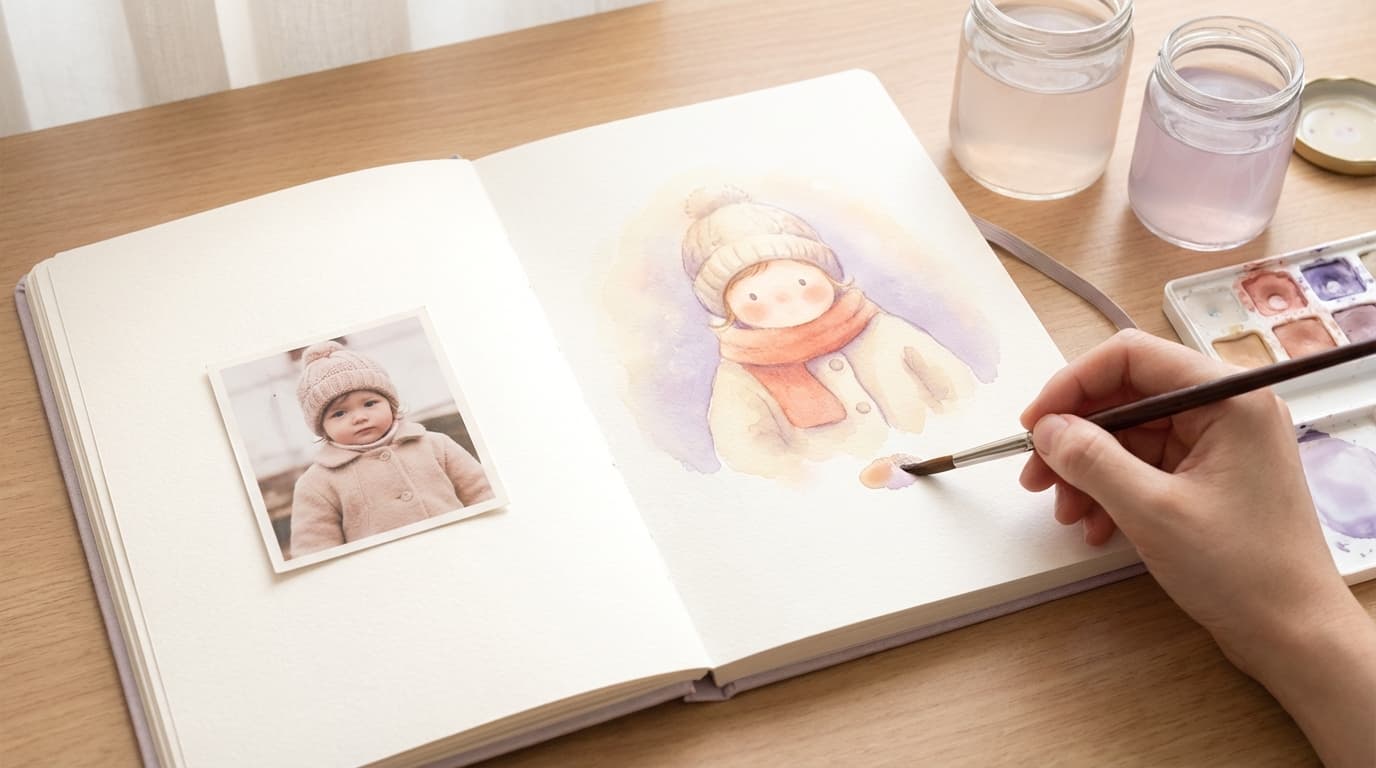
Custom illustrations for a children's book are created by transforming a child's photograph into original artwork — capturing their likeness, features, and essence across every page of a complete story. The process combines artistic technique with technology to produce illustrations that are genuinely unique to each child, not template swaps with different hair colors.
According to the Society of Illustrators (2024), the children's book illustration market has been transformed by advances in AI-assisted art tools, enabling a level of individual customization that was previously only possible through expensive commissioned artwork costing $5,000-15,000 for a single picture book.
How Does a Photo Become an Illustration?
The journey from a parent's smartphone photo to a finished illustration involves several stages. Understanding the process helps set realistic expectations and appreciate the craft involved.
Stage 1: Photo analysis. The uploaded photo is analyzed for key features — facial structure, skin tone, hair color and texture, eye shape, distinguishing features. A high-quality, well-lit photo with a clear view of the child's face produces the best results.
Stage 2: Character design. The child's features are translated into an illustration style. This is where the real artistry happens. The goal is not photorealism — it is capturing the child's essence in a style that works within a storybook context. The character must be recognizable as the child while fitting naturally into illustrated scenes.
Stage 3: Scene composition. Each page of the story requires a unique scene with the child-character in different poses, expressions, and environments. This means the illustration system must understand how the character looks from multiple angles, in different lighting, and with different emotional expressions.
Stage 4: Style consistency. Across 30 pages, the illustration style must remain consistent. The child should look like the same character on page 1 and page 30, even as scenes change dramatically.
Stage 5: Quality review and revision. The illustrations are reviewed for accuracy, quality, and consistency. Parents preview the results and can request revisions before the book goes to print.
The challenge of personalized illustration is not just capturing a likeness — it is maintaining that likeness across dozens of different scenes, poses, and expressions while keeping the art cohesive and narratively engaging. It is a significantly harder technical and artistic problem than most people realize.
What Makes a Good Source Photo?
The quality of the final illustrations depends significantly on the quality of the input photo. Here is what makes a photo work well for custom illustration:
Best practices:
- •Clear, front-facing — The child's face should be clearly visible, ideally looking at the camera
- •Good lighting — Natural light or well-lit indoor settings. Avoid harsh shadows across the face.
- •Sharp focus — A crisp, in-focus photo allows the illustration system to capture fine details
- •Neutral expression or natural smile — Extreme expressions (wide mouth, squinting) are harder to translate into versatile illustrations
- •Recent photo — Use a photo that represents how the child looks now
What to avoid:
- •Sunglasses, hats that obscure the face, or face paint
- •Group photos where the child's face is small or partially hidden
- •Heavy filters or significant editing
- •Extreme angles (looking straight up or from the side)
- •Very low-resolution or blurry images
85%
of illustration quality issues trace back to source photo problems — lighting, angle, or resolution
Source: Sherly internal production data, 2025
💡 Photo tip
You do not need a professional photograph. A well-lit smartphone photo taken at the child's eye level, with their face clearly visible and in focus, produces excellent results. The best photos are often candid shots where the child looks natural and relaxed.
How Has Technology Changed Children's Book Illustration?
Traditional children's book illustration is a labor-intensive craft. A single illustrator creating a 30-page picture book typically works for 3-6 months, with costs ranging from $5,000-15,000 for the illustration work alone, according to the Society of Children's Book Writers and Illustrators (2024).
This is why personalized children's books historically could not offer custom illustration. The economics simply did not work at an individual consumer price point. A $58 book cannot fund months of hand-illustration.
AI-assisted illustration tools have changed this equation. They enable:
- •Rapid character adaptation from a photograph
- •Style consistency across dozens of pages
- •Multiple pose and expression generation from a single source image
- •Quick iteration cycles for revisions and improvements
AI illustration tools are not replacing illustrators — they are democratizing access to personalized art that was previously available only to those who could commission bespoke work. The creative direction, quality control, and narrative integration still require human judgment. But the production efficiency allows individual families to access custom illustration at consumer pricing.
The result is a product category that simply could not exist five years ago: a fully custom-illustrated children's book, created from a child's real photo, at a price point accessible to normal families.
This is not without controversy. The art community has valid concerns about AI-assisted illustration. The key distinction is between AI that replaces creative work and AI that enables creative work that would otherwise be economically impossible. Personalized children's books fall firmly in the latter category — no illustrator was going to hand-illustrate individual books for $58 each.
What Is the Difference Between Template Art and Custom Art?
This is a crucial distinction that affects the final product significantly.
Template-based illustration uses pre-drawn character assets. You select traits (hair color, skin tone, eye color) from a menu, and the system assembles a character from existing components. The result looks like the type of child, not a specific child.
Custom illustration creates original art from the specific child's photo. The illustrations capture individual features — the exact curve of a jawline, a distinctive smile, a particular hair texture — that make the child recognizable. No two orders produce the same art.
The visible difference:
- •Template art: every brown-haired, light-skinned child's book looks essentially the same
- •Custom art: every book is visibly unique because every child is unique
According to parent feedback compiled by Publishers Weekly (2024), 73% of parents who purchased template-based personalized books said the character "somewhat resembled" their child. For photo-based custom illustration, 91% said their child immediately recognized themselves in the illustrations.
91%
of children immediately recognized themselves in custom photo-based illustrations, vs 73% for template-based characters
Source: Publishers Weekly Consumer Survey, 2024
📖 How Sherly creates illustrations
Sherly uses AI-assisted illustration to transform a child's photo into a consistent character across all 30 pages. The process captures the child's actual likeness — not an avatar approximation — and places them in richly detailed story scenes. Every book includes unlimited revisions so parents can ensure the illustrations truly look like their child.
Ready to create your child's story?
Turn your child into the hero of a 30-page illustrated hardcover book. Upload a photo and see the magic.
What Happens After the Illustrations Are Created?
Creating the illustrations is the most visible part of the process, but several important steps follow:
Text integration. The child's name and any other personalized text elements are integrated into the illustrated pages. This needs to be done carefully — text placement, font sizing, and flow must work with each unique illustration layout.
Pre-press preparation. The digital files are prepared for printing — color profiles are calibrated, bleed margins are set, and the layout is optimized for the specific paper stock and binding method.
Printing. High-quality digital printing on premium paper stock. The printing process must accurately reproduce the illustration colors and details. For 170gsm hardcover production, this includes cover creation, case binding, and quality inspection.
Quality control. The finished book is inspected for print accuracy, binding integrity, and overall quality before shipping. Any defects trigger a reprint.
Digital version creation. The same illustrations are formatted for digital reading — optimized for screen display, with proper page flow and text readability.
Audiobook production. If an audiobook is included, the narration is produced to match the page layout, so a child listening along can follow the physical or digital book.
The total production pipeline from photo upload to shipped book typically takes 1-3 weeks, depending on the company and current demand. This is longer than template-based books, which can be produced in hours, but the difference in output quality is substantial.
Can You Really Tell the Difference?
The honest answer: it depends on the company and the execution. Some custom illustration is mediocre. Some template-based illustration is polished and attractive.
But at their best, the difference between template and custom illustration is immediately apparent. Show a child a template-based book with a character that has their hair color, and they will say: "That has my name." Show them a custom-illustrated book based on their photo, and they will say: "That's me."
That is the difference that matters for a child's engagement and self-concept. Recognition versus identification. Novelty versus personal connection. A nice book versus their book.
Frequently Asked Questions
Sherly Team
Children's Reading Specialists