A personalized children's book that only swaps in your child's name is not truly personalized — it is a template with a variable. Real personalization means the story and illustrations are built around your specific child, creating a reading experience that could not exist for anyone else.
The difference matters more than you might think. Research from the University of Sussex (2024) found that children who encountered their own visual likeness in illustrations — not just their name — showed 38% higher self-identification with the protagonist and significantly deeper emotional engagement with the narrative.
What Are the Levels of Book Personalization?
Not all personalization is the same. The market includes everything from automated text replacement to fully bespoke illustration. Understanding the spectrum helps parents make informed choices.
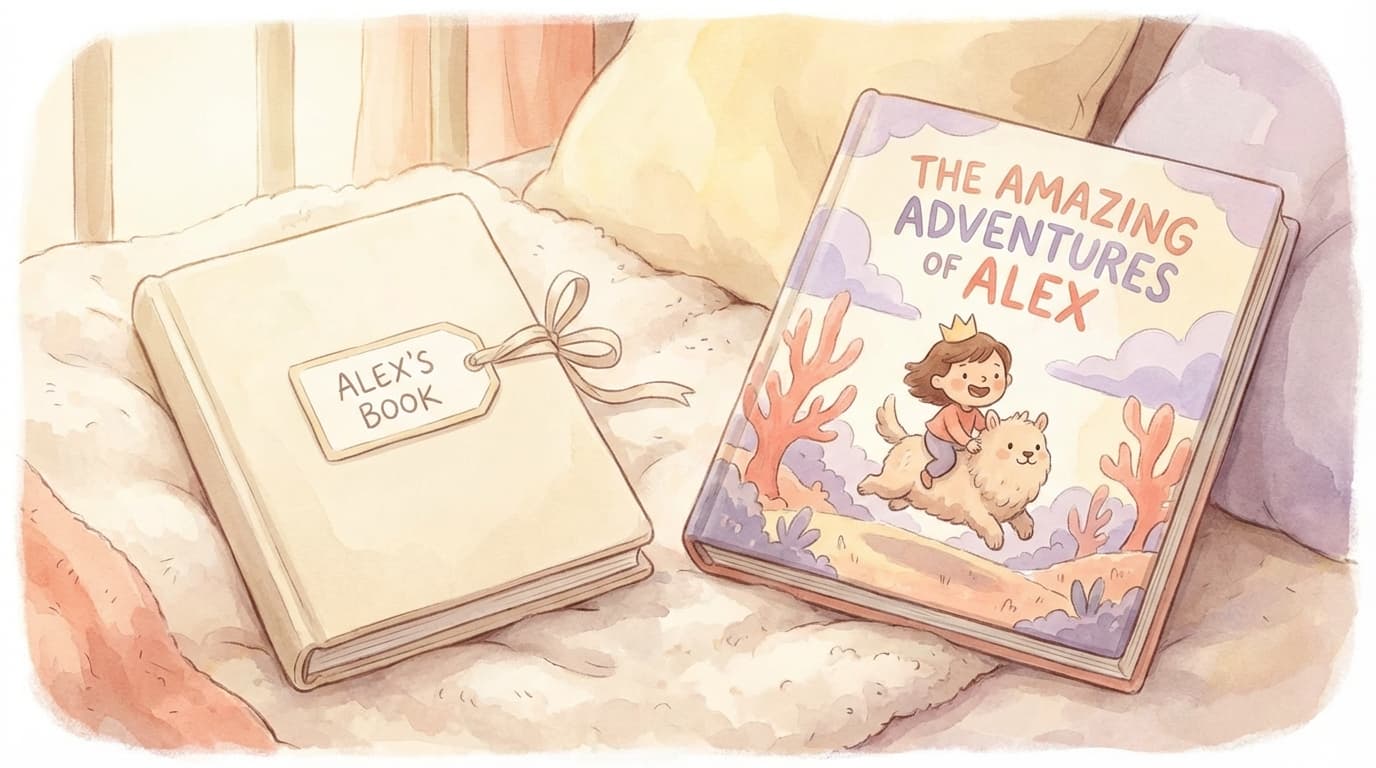
Level 1: Name insertion. The most basic form. Your child's name replaces a placeholder in an otherwise fixed story. The illustrations, plot, and characters remain identical for every child who orders. This is what most "personalized book" companies offer.
Level 2: Name + character traits. A step up. You select hair color, skin tone, and sometimes gender for a pre-drawn character template. The illustrations are still template-based, but the character loosely resembles your child.
Level 3: Name + trait selection + story choices. Some companies let you pick story elements — a favorite animal, a hobby, a location. This adds narrative variation, but the visual personalization remains template-driven.
Level 4: Full custom illustration. The child's real photo is used to create original illustrations. Every page features art that is genuinely unique to that child. The story centers their likeness, not a generic avatar.
There is a meaningful cognitive difference between reading your name in a book and seeing yourself in a book. Name recognition activates basic familiarity. Visual self-recognition activates the self-referencing network — a much deeper cognitive and emotional process that strengthens memory, engagement, and personal connection.
The gap between Level 1 and Level 4 is not incremental — it is fundamental. One gives your child a moment of recognition. The other gives them a story that is genuinely about them.
Why Does Name-Only Personalization Wear Off?
Parents who buy name-swap books often notice the same pattern. The child is excited the first time they see their name on the cover and in the text. They ask to read it immediately. The first reading is a hit.
By the third or fourth reading, the excitement around the name has normalized. What remains is the story itself — and template stories are typically short, formulaic, and written to accommodate any name insertion without awkwardness. That constraint produces bland narratives.
A 2023 study in Frontiers in Psychology measured reading engagement over a six-week period. Name-only personalized books showed engagement patterns that converged with generic books by week three. Books with visual personalization maintained elevated engagement throughout the study period.
3 weeks
is when name-only personalized book engagement drops to match generic books, according to longitudinal reading studies
Source: Frontiers in Psychology, 2023
The novelty effect is real but temporary. Once a child is accustomed to seeing their name in print, the "personalized" element stops registering as special. The book needs to earn re-reads on its own merits — story quality, illustration depth, and emotional resonance.
What Makes Visual Personalization Different?
When a child sees their actual likeness in an illustration, something different happens neurologically. This is related to what psychologists call the self-referencing effect — the well-documented finding that information processed in relation to the self is encoded more deeply and remembered more accurately.
A child looking at a generic cartoon character named after them thinks: that character has my name. A child looking at a custom illustration based on their photo thinks: that is me.
The difference in identification is not subtle. Research on the mirror effect in children's literature shows that visual self-representation in books produces measurable changes in self-concept and confidence.
Children develop their sense of self partly through narrative — the stories they hear, see, and eventually tell about themselves. When a storybook reflects a child's actual appearance and places them as a capable protagonist, it contributes to what we call 'narrative identity formation' in a uniquely direct way.
This is why representation in children's media matters so broadly, and why personalized books with custom illustrations tap into something deeper than novelty. They are not just fun — they participate in how a child constructs their sense of who they are.
According to a 2024 meta-analysis published in Developmental Psychology, children who regularly encountered visual self-representation in reading materials showed a 19% improvement in self-efficacy measures compared to control groups.
How Can Parents Tell the Difference Before Buying?
The personalized book market has grown rapidly, and marketing language can make every product sound equally special. Here are concrete things to check:
- •Look at sample pages. If every sample illustration looks like it could be any child with a different hair color applied, it is template-based personalization (Level 2).
- •Ask about the illustration process. If the company describes "selecting traits" or "choosing a character," the art is not custom. If they describe creating illustrations from a photo, it is likely Level 4.
- •Check the page count. Name-swap books tend to be short (12-20 pages) because the generic story cannot sustain much length. Fully personalized books typically run longer (24-30+ pages) because the story is crafted around the specific child.
- •Read the story description. Does the story depend on the child being the character, or could any name work? The best personalized books write stories that only make sense with the child at the center.
- •Check revision policies. Companies that create custom illustrations typically offer revisions because each order is unique. Template companies rarely need to.
💡 Quick test
Ask yourself: if I changed the name back to a generic one, would anyone notice the difference? If the answer is no, the personalization is cosmetic.
What Are Parents Really Paying For?
Price reflects the depth of personalization. Name-swap books are inexpensive to produce — the technology is straightforward text replacement and sometimes a simple avatar generator. These typically cost $20-35.
Custom illustrated books require significant creative work. An artist (or an AI-assisted creative process reviewed by artists) must create original illustrations for each order. This is why fully personalized books cost more — typically $45-65.
78%
of parents who purchased custom-illustrated personalized books rated them 'significantly more meaningful' than template-based alternatives
Source: Statista Consumer Gift Survey, 2024
The question is not whether personalized books cost more than generic ones. They do. The question is whether the specific type of personalization delivers enough additional value to justify the price difference.
For a birthday present or a holiday gift, the answer for most parents is yes — especially when the book doubles as a keepsake. For building a daily reading library of dozens of books, generic picture books are the practical choice.
📖 How Sherly approaches personalization
Sherly creates Level 4 personalization — every illustration is generated from the child's real photo, producing 30 pages of custom art. The story is a complete narrative with the child as the protagonist, not a template with an inserted name. Each book includes a digital version and audiobook.
Ready to create your child's story?
Turn your child into the hero of a 30-page illustrated hardcover book. Upload a photo and see the magic.
Does the Level of Personalization Affect How Kids Respond?
The response difference between name-only and visually personalized books is something parents notice immediately.
With name-swap books, children typically say: "That says my name!" — a recognition reaction. It is positive but surface-level.
With visually personalized books, children typically say: "That's me!" — an identification reaction. This is a fundamentally different cognitive and emotional response. The child is not recognizing a text string. They are seeing themselves inside a story.
This identification reaction is what researchers connect to the developmental benefits of personalized reading. When a child identifies as the character rather than just recognizing their name near a character, the narrative has a direct pathway to shaping self-perception.
The 'that's me!' reaction we observe when children see custom illustrations of themselves is qualitatively different from name recognition. It engages mirror neurons, activates autobiographical memory systems, and creates what we call 'narrative transportation' at a significantly higher level than text-based personalization alone.
What Does This Mean for My Choice?
The right choice depends on what you are looking for.
If you want a quick, affordable personalized gift and the primary goal is the fun of seeing a name in print, a Level 1 or Level 2 book delivers that at a reasonable price. It will produce smiles. It will get read. The engagement will likely taper off, but the gesture is meaningful.
If you want a keepsake with lasting impact — something your child will return to again and again, something that contributes to their self-concept and confidence — the depth of personalization matters. Level 4, with custom illustrations from a real photo, delivers a qualitatively different experience.
The bottom line: a name is a nice touch. A custom illustration is a transformation. Both have their place, but parents should understand what they are actually getting before the word "personalized" on the packaging shapes their expectations.
Frequently Asked Questions
Sherly Team
Children's Reading Specialists