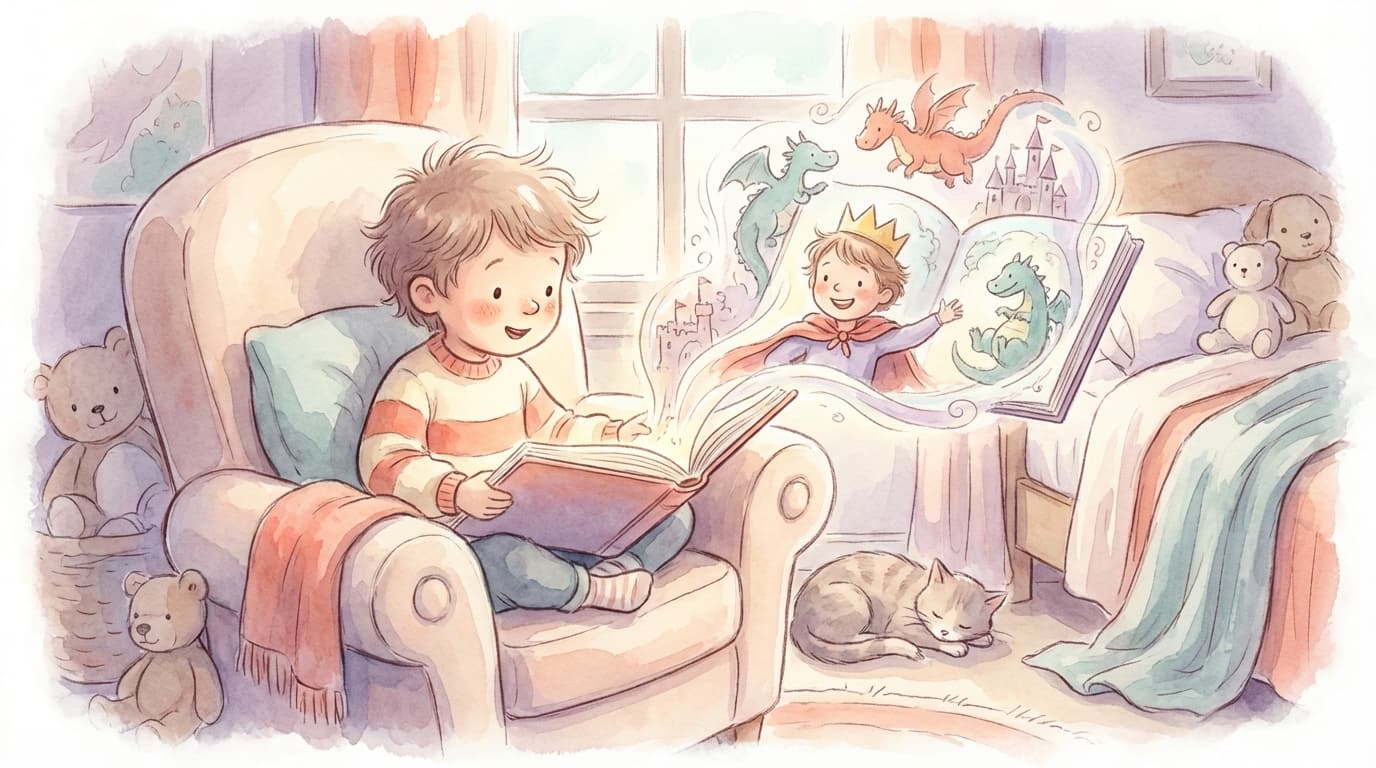
Representation in children's books matters because children use stories as mirrors to understand who they are. When kids see characters who look like them, share their name, or reflect their lived experience, they internalize a powerful message: you belong, and your story matters. This is what researchers call the mirror effect.
The concept was first introduced by Dr. Rudine Sims Bishop in 1990, who described books as "mirrors, windows, and sliding glass doors." Mirrors reflect a child's own experience back to them. A 2023 study published in the Journal of Applied Developmental Psychology found that children aged 4-7 who read stories featuring characters that resembled them showed a 23% increase in self-concept scores compared to children who read generic stories.
What Is the Mirror Effect in Children's Literature?
The mirror effect occurs when a child recognizes themselves in a story — through appearance, name, culture, family structure, or experience. This recognition triggers a cascade of psychological benefits, from heightened engagement to stronger identity formation.
When children encounter a mirror in a book, their brain processes the character's journey as partially their own. Research from the University of Virginia's Imagination and Cognition Lab found that children as young as three years old begin to map fictional characters' traits onto their self-concept, particularly when they perceive the character as similar to themselves.
When children see themselves in a story, it validates their existence. It tells them that someone thought their experience was worth writing about. That validation is foundational for healthy identity development.
This isn't just an emotional benefit — it's a cognitive one. Children who identify with characters show stronger narrative transportation, meaning they're more deeply absorbed in the story. A 2024 meta-analysis in Reading Research Quarterly found that narrative transportation increases comprehension by 31% and recall by 27% in early readers.
Why Does Seeing Themselves in Stories Build a Child's Confidence?
The connection between representation and confidence is rooted in what psychologists call self-efficacy — a child's belief in their own ability to succeed. When a child watches a character who looks like them overcome challenges, their brain rehearses that same sense of capability.
34%
increase in self-efficacy scores among children who regularly read books featuring characters similar to themselves
Source: Stanford University Graduate School of Education, 2024
Dr. Maryam Abdullah at UC Berkeley's Greater Good Science Center explains that this happens through a process called vicarious experience — one of the four pillars of self-efficacy identified by psychologist Albert Bandura.
- •Mastery experience — The character succeeds, and the child imagines themselves succeeding too
- •Vicarious experience — The child sees someone like them achieve something difficult
- •Social persuasion — The story's narrative voice affirms the character's (and by extension, the child's) worth
- •Emotional states — The positive feelings during reading become associated with the child's self-image
We know from decades of research that self-efficacy is one of the strongest predictors of achievement and well-being. Personalized stories essentially give children a rehearsal space for believing in themselves.
This is especially powerful during the ages of 3-7, when children are actively constructing their self-narrative. At this stage, the stories they consume don't just entertain them — they become building blocks of identity.
What Happens When Children Don't See Themselves in Books?
The absence of representation carries its own weight. When a child consistently reads books where no one looks like them, speaks like them, or lives like them, the implicit message is one of invisibility.
A 2022 study by the Cooperative Children's Book Center found that despite some progress, only 33% of children's books published featured characters of color as protagonists. For children with disabilities, that number drops to under 4%.
The psychological impact is real. Research from the University of Michigan found that children from underrepresented groups who lacked mirror books showed lower academic self-concept and were less likely to self-identify as readers by age 8.
- •Disengagement — Children who don't see themselves in books are more likely to lose interest in reading altogether
- •Identity confusion — Without narrative mirrors, children may struggle to articulate who they are
- •Reduced empathy — Books serve as both mirrors and windows; without mirrors, children miss the chance to develop self-understanding alongside understanding of others
📖 Every child deserves to be the hero
Sherly solves the representation gap by turning your child's actual photo into custom illustrations across 30 pages. Every child — regardless of appearance, background, or ability — sees themselves as the hero of their own story. It's the mirror effect, made literal.
How Does Personalization Amplify the Mirror Effect?
Generic representation — seeing a character of the same gender or ethnicity — is valuable. But personalization takes the mirror effect to another level entirely.
When a child sees their own name on the page, their own face in the illustrations, and a story that reflects their world, the identification isn't partial — it's complete. A 2024 study from the National Literacy Trust found that personalized books increased reading motivation by 48% compared to non-personalized books with diverse characters.
48%
increase in reading motivation when children read personalized books versus diverse but non-personalized books
Source: National Literacy Trust, 2024
The neuroscience supports this. Research using fMRI scans at the University of Sheffield found that hearing one's own name activates the medial prefrontal cortex — the brain region associated with self-referential processing. When children encounter their name in a story, this region lights up, deepening engagement and memory encoding.
This means personalized stories don't just make children feel good — they literally create stronger neural pathways for the story's content and the positive messages within it.
What Can Parents Do to Increase Representation at Home?
Building a representative home library doesn't require a complete overhaul. Small, intentional choices make a significant difference.
- •Audit your bookshelf — Look at the characters in your child's current books. Do they reflect your child's appearance, culture, and experiences?
- •Add mirror books deliberately — Seek out stories where the protagonist shares key traits with your child
- •Go beyond surface representation — The best mirror books don't just match appearance; they reflect emotions, challenges, and family dynamics your child will recognize
- •Include personalized books — A book where your child is literally the main character is the most powerful mirror you can provide
- •Read together and discuss — Ask your child, "Does this character remind you of anyone?" to actively engage the mirror effect
The quality of representation matters as much as the quantity. A single deeply personalized book where a child truly sees themselves can have more impact than a shelf of generically diverse titles.
Ready to create your child's story?
Turn your child into the hero of a 30-page illustrated hardcover book. Upload a photo and see the magic.
How Early Should Parents Start with Representative Books?
The answer is: from birth. Even before children can read or fully comprehend a story, they're absorbing visual information. Infants as young as six months show a preference for faces that resemble their own caregivers, and by 18 months, toddlers begin to recognize themselves in photographs.
A 2023 longitudinal study from the University of Cambridge tracked 400 families over five years and found that children who were regularly exposed to mirror books before age two showed significantly stronger self-recognition skills and social-emotional development by kindergarten.
The key milestones for representation:
- •0-12 months — Board books with diverse faces and simple mirror play
- •1-3 years — Personalized books with their name and photo; stories about familiar routines
- •3-5 years — Stories where characters who look like them solve problems and show courage
- •5-7 years — Chapter books and longer stories with complex characters they can identify with
- •7+ — Stories that reflect their specific interests, challenges, and aspirations
Starting early normalizes the experience of seeing themselves as protagonists. By the time they reach school age, that sense of belonging is already deeply rooted.
Does Representation in Books Actually Improve Academic Outcomes?
Yes — and the evidence is growing. A 2024 report from the National Education Association found that students who had access to culturally relevant texts scored 15% higher on reading comprehension assessments than peers who didn't.
The mechanism is straightforward: engagement drives practice, practice drives skill. When children are excited about a book because they see themselves in it, they read more. When they read more, they get better at reading. It's a virtuous cycle.
15%
higher reading comprehension scores among students with access to culturally relevant and representative texts
Source: National Education Association, 2024
Beyond comprehension, representation affects a child's relationship with learning itself. Children who feel seen in their educational materials develop what researchers call academic identity — the belief that school is a place where they belong and can succeed.
This matters particularly during transitions — starting school, changing grades, moving to a new area. A mirror book can anchor a child's sense of self during periods of change.
Frequently Asked Questions
Sherly Team
Children's Reading Specialists