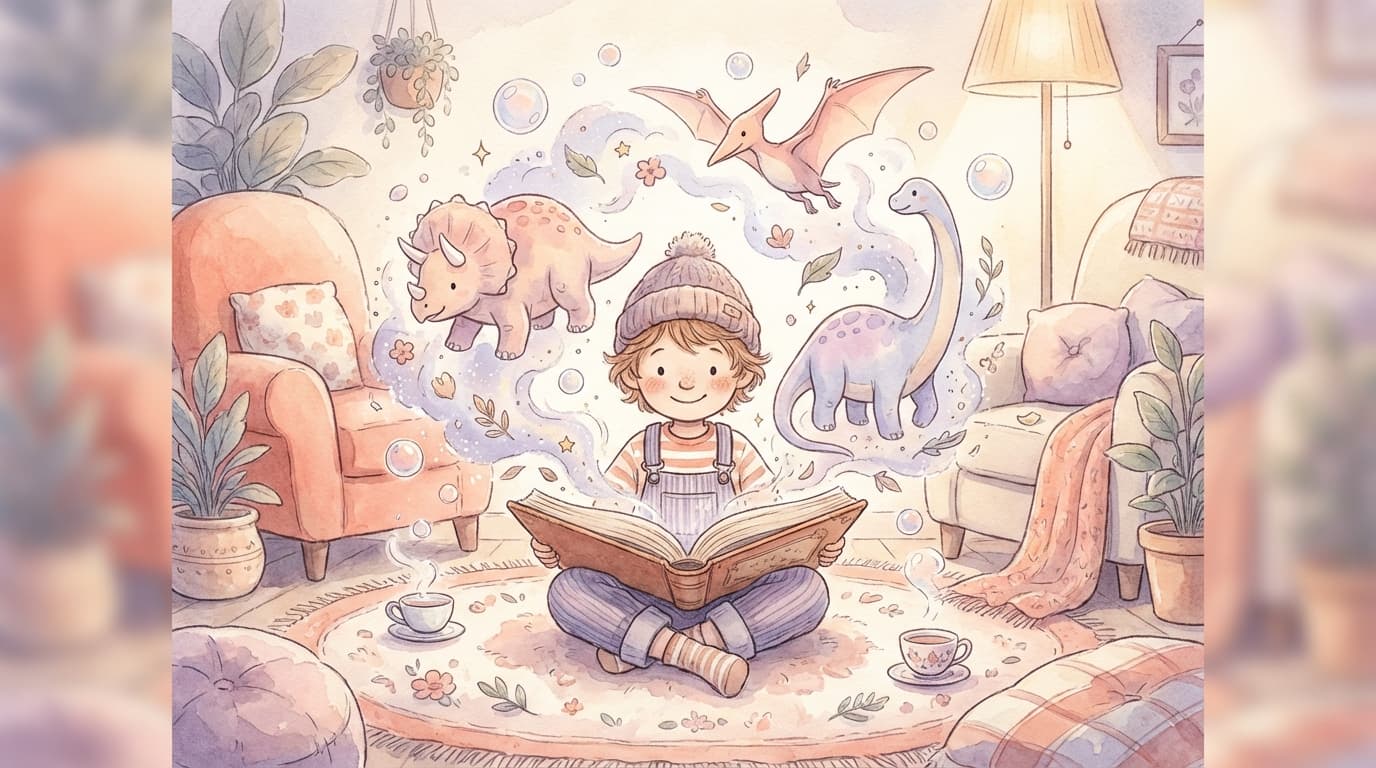
The best books for kids who love dinosaurs depend on the child's age, whether they prefer stories or facts, and how deep they want to go. Below is a curated list organized by age group and type — fiction picture books, non-fiction, and chapter books — so you can find exactly the right book for your dinosaur-obsessed kid.
A 2023 study from the University of Virginia found that children with intense interests (dinosaurs being one of the most common) demonstrate higher sustained attention, deeper information processing, and stronger persistence than peers. Feeding that interest with the right books isn't indulgence — it's fuel for cognitive development.
Why Are Kids So Obsessed With Dinosaurs?
Before diving into recommendations, it's worth understanding why dinosaurs captivate children so powerfully. Researchers call this an "intense interest" — a focused fascination that typically emerges between ages 2 and 6.
A 2008 study from the Universities of Wisconsin and Indiana found that approximately one-third of children develop an intense interest at some point, and dinosaurs are among the top three most common subjects (alongside vehicles and astronomy).
Intense interests like dinosaurs do more than entertain — they teach children how to learn. A child who can name 50 dinosaurs is practicing categorization, memorization, and knowledge acquisition. These are transferable skills that predict academic success.
The appeal of dinosaurs specifically combines several elements: they're big (children love extremes), they're real (not made up, but extinct — a fascinating concept), they're dangerous (safely, from the distance of millions of years), and they come in an enormous variety that rewards deep learning.
33%
of young children develop an intense interest, with dinosaurs among the top three subjects
Source: Universities of Wisconsin and Indiana, 2008
What Are the Best Dinosaur Picture Books for Toddlers (Ages 1-3)?
At this age, books need to be sturdy, visually bold, and simple. The goal is to build positive associations with reading while connecting to the child's interest.
- •Dinosaur Roar! by Paul and Henrietta Stickland — pairs of opposite dinosaurs (big/small, scary/sweet) with bold, colorful art. A perfect first dinosaur book.
- •Stomp, Dinosaur, Stomp! by Margaret Mayo — action verbs and movement make this ideal for active toddlers who want to stomp along.
- •Hello, World! Dinosaurs by Jill McDonald — board book introducing real dinosaur facts in toddler-friendly language with clean illustrations.
- •Dinosaurs Love Underpants by Claire Freedman — silly, irreverent, and absolutely beloved by the 2-3 crowd.
- •My First Book of Dinosaur Comparisons by Sara Hurst — size comparisons (a T-Rex is as long as a school bus) that make extinct creatures tangible.
Board book format is essential for this age. Standard paper books will be loved to destruction within weeks.
What Are the Best Dinosaur Picture Books for Preschoolers (Ages 3-5)?
This is when dinosaur obsession typically peaks. Children at this age want stories about dinosaurs, not just images and names. They're also starting to absorb real facts, so books that blend narrative with accuracy are particularly effective.
- •How Do Dinosaurs Say Goodnight? by Jane Yolen — the beloved series uses dinosaur behavior as a vehicle for teaching manners and emotional regulation. The illustrations by Mark Teague are spectacular.
- •Goldilocks and the Three Dinosaurs by Mo Willems — a hilarious parody that rewards kids who know the original fairy tale.
- •We Don't Eat Our Classmates by Ryan T. Higgins — Penelope Rex is a T-Rex starting school who keeps eating her classmates. Perfect for back-to-school anxiety.
- •If the Dinosaurs Came Back by Bernard Most — imaginative "what if" premise that sparks creative thinking.
- •Saturday Night at the Dinosaur Stomp by Carol Diggory Shields — a dance party picture book with rhyming text and real dinosaur species.
- •The Dinosaur Department Store by Lily Murray — a child visits a store selling real dinosaurs as pets, learning about each species along the way.
The picture book sweet spot is where a child's passion meets a compelling narrative. A dinosaur-loving child who encounters a great dinosaur story isn't just being entertained — they're having a peak reading experience that builds lifelong positive associations with books.
A 2024 Scholastic report found that 91% of children aged 3-5 say their favorite books feature subjects they're already interested in. Meeting children where their passion lives is the single most effective reading motivation strategy.
📖 What if the dinosaur adventurer looked like your child?
Sherly creates personalized storybooks where your child's actual photo becomes the illustrations. Imagine a book where your child goes on a dinosaur adventure — riding a T-Rex, discovering fossils, befriending a Triceratops. The Mirror Effect means they'll engage with the story more deeply because the hero is them.
What Are the Best Non-Fiction Dinosaur Books for Kids (Ages 4-8)?
For the child who wants facts, not stories. These kids can often name more dinosaur species than most adults. They want accuracy, detail, and the thrill of real scientific discovery.
- •National Geographic Little Kids First Big Book of Dinosaurs by Catherine Hughes — the gold standard entry-level non-fiction dinosaur book. Clear illustrations, age-appropriate text, real science.
- •The Big Book of Dinosaurs (DK) — DK's signature visual format works perfectly for dinosaur reference. Large format, stunning images, organized by period.
- •Dinosaurs: A Visual Encyclopedia (DK) — for the child who has outgrown the basics and wants comprehensive coverage. Over 100 species covered.
- •Dinotopia by James Gurney — technically fiction, but the illustrations are so scientifically detailed that it functions as visual non-fiction for many young dinosaur enthusiasts.
- •Fossil by Bill Thomson — a wordless picture book where a boy discovers real fossils that come to life. Bridges fiction and non-fiction beautifully.
- •The Dinosaurs of Waterhouse Hawkins by Barbara Kerley — the true story of the artist who built the first life-size dinosaur models. A Caldecott Honor book.
91%
of children aged 3-5 say their favorite books feature subjects they're already interested in
Source: Scholastic Kids & Family Reading Report, 2024
For children with intense interests, non-fiction books serve a dual purpose: they feed the passion and they develop informational text literacy — the ability to read, process, and retain factual content. This skill becomes critical in school, where much of the curriculum relies on non-fiction comprehension.
What Are the Best Dinosaur Chapter Books for Older Kids (Ages 6-10)?
When picture books are no longer enough and the child is ready for longer narratives, these chapter books keep the dinosaur connection alive while developing reading stamina.
- •Magic Tree House #1: Dinosaurs Before Dark by Mary Pope Osborne — the series that launched a million readers. Jack and Annie travel back to the Cretaceous period. Perfect first chapter book for ages 6-7.
- •The One and Only Ivan by Katherine Applegate — not about dinosaurs, but if your dinosaur kid has expanded to a general animal fascination, this Newbery winner is essential.
- •Jurassic Park by Michael Crichton — for advanced readers (ages 10+). Many dinosaur kids are ready for this by fifth grade, and the science is genuinely educational.
- •Raptor Red by Robert T. Bakker — a novel written from the perspective of a Utahraptor, by a real paleontologist. Scientifically rich and narratively gripping.
- •The Land Before Time novelizations — for children who loved the films, the chapter books extend the experience into reading.
- •Tracker's Canyon by Pam Withers — adventure fiction featuring fossil hunting and paleontology.
A 2022 study from the University of Cambridge found that children who transitioned from picture books to chapter books on topics they were already passionate about maintained reading engagement 3x longer than children assigned chapter books on teacher-selected topics.
Following a child's existing passion into progressively more complex texts is the most natural pathway to reading fluency. A child who reads five dinosaur chapter books voluntarily develops more reading skill than one who reluctantly reads two assigned novels.
How Do You Keep the Interest Alive Beyond Books?
Books are the foundation, but dinosaur-loving kids benefit from a multi-channel approach:
- •Museum visits — natural history museums with fossil exhibits turn abstract knowledge into tangible experience
- •Documentaries — BBC's Walking With Dinosaurs and Apple TV's Prehistoric Planet are visually stunning and scientifically current
- •Dig kits — paleontology excavation kits let children experience the process of discovery
- •Audiobooks — listening to dinosaur stories during car rides extends reading time without screen time
Ready to create your child's story?
Turn your child into the hero of a 30-page illustrated hardcover book. Upload a photo and see the magic.
The key is to treat the interest as a learning engine, not a phase to be managed. According to the Indiana University research, children whose intense interests are supported by parents show higher cognitive functioning on standardized assessments even years after the specific interest has faded. The interest was the vehicle; the learning skills were the destination.
What About When They Grow Out of Dinosaurs?
Many children's intense interests evolve rather than disappear. A dinosaur fascination often transitions into broader interests in:
- •Paleontology and geology — the science behind the fascination
- •Evolution and biology — understanding how life changes over time
- •History — the concept of deep time and eras
- •Science fiction — creative extensions of scientific concepts
Support the transition by providing books at the intersection of their old and new interests. A child moving from dinosaurs to space, for example, might love The Asteroid Hunter or books about extinction events.
The reading habit built during the dinosaur years is the real prize. A child who learned to love reading through dinosaur books will find the next thing to love reading about.
Frequently Asked Questions
Sherly Team
Children's Reading Specialists