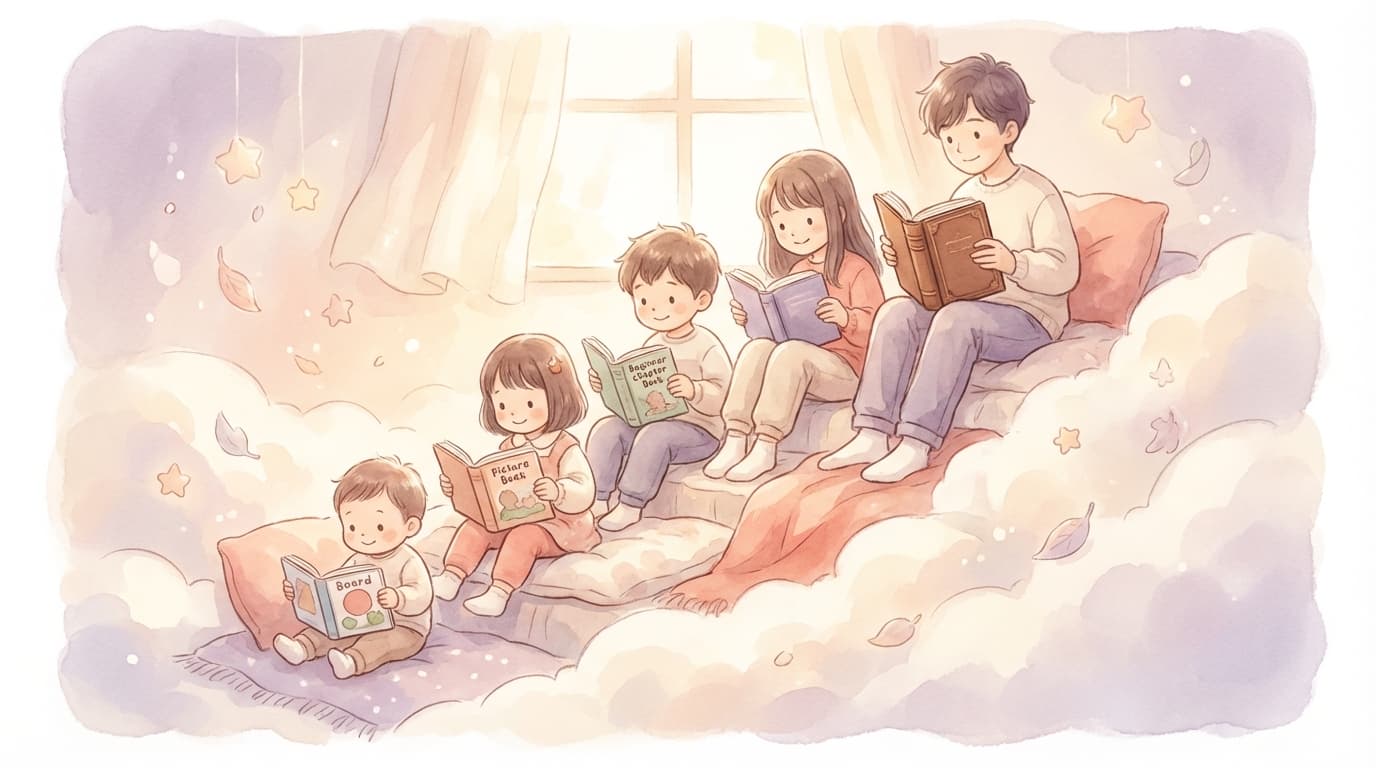
The stages of reading development follow a predictable progression from birth through adolescence: pre-reading (0-5), decoding (5-7), fluency (7-9), reading to learn (9-14), and multiple viewpoints (14+). Understanding where your child falls helps you provide exactly the right support at the right time — without pushing too hard or holding back.
These stages were originally outlined by reading researcher Jeanne Chall at Harvard and have been refined by decades of literacy research. According to the National Assessment of Educational Progress (NAEP), roughly 34% of fourth graders in the United States read below a basic proficiency level — making early awareness of these stages critical for every parent.
Stage 1: Pre-Reading (Birth to Age 5) — What Does It Look Like?
The pre-reading stage begins at birth and lays the foundation for everything that follows. During this stage, children are not reading words — they are building the oral language, phonological awareness, and print concepts that make reading possible.
Key behaviors you'll see during pre-reading:
- •Babbling and imitating speech sounds (6-12 months)
- •Recognizing familiar book covers and choosing favorites (12-18 months)
- •Pretending to read by holding books and turning pages (2-3 years)
- •Recognizing some letters, especially in their own name (3-4 years)
- •Understanding that print carries meaning — pointing at signs, logos, labels (4-5 years)
Pre-reading skills are not about letters and sounds in isolation. They're about building a rich oral language foundation. The child who enters kindergarten with 10,000 words in their vocabulary has a massive advantage over the child with 5,000.
A 2019 study from the National Institute for Literacy found that children who are exposed to phonological awareness activities — rhyming games, syllable clapping, and initial sound identification — before kindergarten are significantly more likely to become proficient readers by third grade.
How to support this stage:
- •Read aloud daily — even five minutes makes a difference for infants
- •Play with rhymes, songs, and word games
- •Point to words as you read to build print awareness
- •Let them see you reading for your own enjoyment
- •Label objects in your home to build vocabulary
Stage 2: Decoding (Ages 5-7) — When Do Children Start Actually Reading?
The decoding stage is when the "magic" happens — children begin connecting letters to sounds and sounding out words. This typically begins in kindergarten or first grade and is one of the most intensive learning periods of a child's life.
During decoding, children are learning to:
- •Map letters to sounds (phonics)
- •Blend sounds together to form words (c-a-t = cat)
- •Recognize high-frequency sight words (the, is, and, was)
- •Track text left to right with their eyes and fingers
80%
of children learn to decode successfully with systematic phonics instruction
Source: National Reading Panel, 2000
This stage requires enormous cognitive effort. A child sounding out "cat" is working as hard as an adult learning to read a new alphabet. According to the National Reading Panel's meta-analysis of over 1,900 studies, systematic phonics instruction is the single most effective approach for teaching children to decode.
Important: Some children move through decoding quickly (in months), while others take two full years. Both timelines are normal. The pace depends on prior exposure, temperament, and neurological factors — not intelligence.
💡 When to be concerned
If your child is struggling significantly with letter-sound connections by the middle of first grade, consider requesting an evaluation for dyslexia or other reading difficulties. Early intervention — before third grade — is dramatically more effective than later remediation.
Stage 3: Fluency (Ages 7-9) — How Do Children Go from Sounding Out to Smooth Reading?
Fluency is the bridge between decoding and comprehension. In this stage, children move from laboriously sounding out each word to reading accurately, quickly, and with expression. This shift frees up cognitive resources for understanding meaning.
According to research by Timothy Rasinski at Kent State University, fluent readers process text approximately three times faster than non-fluent readers of the same age. But speed alone isn't the goal — true fluency includes prosody (reading with appropriate expression, pausing, and emphasis).
Fluency is not about speed. It's about automaticity — the ability to recognize words without conscious effort, which frees the brain to focus on meaning. A child who reads fast but comprehends nothing is not fluent.
Signs your child is developing fluency:
- •They read aloud with natural phrasing rather than word-by-word
- •They self-correct errors without prompting
- •They can retell what they just read in their own words
- •They choose to read independently for pleasure
How to support fluency:
- •Repeated reading — re-reading favorite books builds automaticity
- •Echo reading — you read a sentence, they repeat it with the same expression
- •Paired reading — read together simultaneously, gradually letting them take the lead
- •Let them read books that are slightly below their maximum level — comfort builds speed
Ready to create your child's story?
Turn your child into the hero of a 30-page illustrated hardcover book. Upload a photo and see the magic.
Stage 4: Reading to Learn (Ages 9-14) — When Does Reading Become a Tool?
This is a fundamental shift. In earlier stages, children are learning to read. Now they are reading to learn. Text becomes their primary tool for acquiring new knowledge across every subject.
The NAEP reports that the fourth-grade reading assessment is particularly critical because it marks this transition. Students who are not reading proficiently by fourth grade are four times more likely to drop out of high school, according to a 2012 study by the Annie E. Casey Foundation.
4x
higher dropout risk for students not reading proficiently by fourth grade
Source: Annie E. Casey Foundation, 2012
During this stage, children encounter:
- •Longer, more complex texts across multiple genres
- •Content-area vocabulary (science, history, math terminology)
- •Abstract concepts that require inference and critical thinking
- •Multiple text structures — compare/contrast, cause/effect, problem/solution
How to support this stage:
- •Discuss what they're reading — ask questions about themes, not just plot
- •Encourage reading across genres (nonfiction, biography, historical fiction)
- •Help them develop strategies for unfamiliar vocabulary (context clues, root words)
- •Continue reading aloud to them — their listening comprehension still exceeds their reading level
Stage 5: Multiple Viewpoints (Age 14+) — What Does Mature Reading Look Like?
In the final stage, readers can analyze texts from multiple perspectives, synthesize information across sources, and form their own critical opinions. This is the reading competency required for college and career success.
Mature readers can:
- •Compare two authors' arguments on the same topic
- •Identify bias, tone, and rhetorical strategies
- •Read between the lines for implied meaning
- •Integrate information from text, graphics, and data
According to the ACT's College and Career Readiness Standards, only about 46% of high school graduates demonstrate the reading proficiency needed for college-level texts. Building strong foundations in the earlier stages directly impacts whether a student reaches this level.
📖 Building early foundations
The pre-reading and decoding stages are when children form their identity as readers. Sherly's personalized books — where your child sees themselves as the hero through custom illustrations — tap into the "mirror effect," building the intrinsic motivation that carries children through all five stages.
What If My Child Seems Behind Their Stage?
First: reading development is not a race. Children develop along a wide spectrum of normal, and comparing your child to peers often creates unnecessary anxiety.
That said, certain signs warrant professional evaluation:
- •By end of kindergarten: Cannot identify most letter sounds
- •By end of first grade: Cannot read simple CVC words (cat, sit, hop)
- •By end of second grade: Reads significantly slower than peers, avoids reading
- •At any age: Sudden regression in reading ability, persistent letter reversals after age 7
The biggest mistake I see parents make is waiting. If your gut says something is off with your child's reading, trust that instinct. Early screening and intervention can change the entire trajectory.
The International Dyslexia Association reports that approximately 15-20% of the population has some form of reading difficulty. With appropriate intervention, the vast majority of these children can become successful readers — but timing matters enormously.
Frequently Asked Questions
Sherly Team
Children's Reading Specialists