To help an anxious child calm down at bedtime, start with a predictable routine that gives them a sense of control: dim the lights 30 minutes before sleep, use a calming activity like reading together or progressive muscle relaxation, and validate their worries without dismissing them. Anxiety peaks at night because the distractions of the day fall away — and a child's brain fills that quiet space with fear.
You are not imagining it. Bedtime really is harder for anxious kids. A 2022 study published in Sleep Medicine Reviews found that up to 30% of children experience clinically significant bedtime anxiety, and the number rises to nearly 50% among children already diagnosed with an anxiety disorder. The good news: the right routine can reduce sleep-onset time by as much as 40%.
Why Does Bedtime Trigger Anxiety in Children?
During the day, your child's brain stays busy. School, play, conversation, screens — all of it occupies mental bandwidth. At bedtime, that stimulation disappears. The brain doesn't go quiet. It goes searching.
This is called the default mode network activating. When external demands drop, the brain turns inward — replaying events, anticipating tomorrow, generating worries. Adults experience this too (ever lie awake rehearsing an awkward conversation?), but children lack the cognitive tools to manage it.
Four specific triggers make bedtime uniquely hard:
- •Separation — Being alone in a dark room means losing proximity to their primary source of safety: you
- •Loss of control — Sleep requires surrendering consciousness, which feels threatening to an anxious mind
- •Darkness — Reduced visual input forces the brain to fill gaps with imagination, and an anxious brain fills them with threats
- •Transition — Moving from active to passive is a state change, and anxious children struggle with transitions of all kinds
Bedtime anxiety is not a behavior problem. It's a nervous system problem. The child's sympathetic nervous system is activating at exactly the moment it needs to deactivate. Our job isn't to talk them out of their fear — it's to help their body shift from alert mode to rest mode.
Understanding the trigger helps you respond with compassion instead of frustration. Your child isn't stalling. Their body is sounding an alarm. The techniques below help turn that alarm off.
What Are the Signs of Bedtime Anxiety?
Not every child will say "I'm scared." Anxiety at bedtime often shows up as behavior that looks like something else entirely:
- •Stalling tactics — Repeated requests for water, bathroom trips, "one more story"
- •Physical complaints — Stomachaches, headaches, or "my legs feel weird" that only appear at night
- •Clinginess — Needing you to stay, hold their hand, lie down with them
- •Rigidity — Insisting on exact sequences, specific blankets, doors open at precise angles
- •Questions on loop — "What if there's a fire? What if you don't wake up? What if I can't sleep?"
- •Anger — Some children express anxiety as rage because they lack the vocabulary to distinguish the two
30%
of children experience clinically significant bedtime anxiety, rising to nearly 50% among children with existing anxiety disorders
Source: Sleep Medicine Reviews, 2022
If your child shows several of these patterns, bedtime anxiety is likely at play. The behaviors aren't manipulation. They are coping. And they respond well to the right interventions.
5 Evidence-Based Techniques to Calm Bedtime Anxiety
These strategies come from pediatric sleep research and cognitive-behavioral therapy for children. They work because they target the body's stress response directly — not just the thoughts.
1. Progressive Muscle Relaxation (PMR)
Guide your child through tensing and releasing muscle groups, starting from the toes and moving up. "Squeeze your toes like you're grabbing sand with them. Hold... now let go." This activates the parasympathetic nervous system and gives the anxious mind something concrete to focus on.
A 2021 study in the Journal of Clinical Child & Adolescent Psychology found that children who practiced PMR before bed fell asleep 23 minutes faster and reported significantly lower anxiety scores.
Make it playful for younger kids: "Pretend you're a robot — get really stiff! Now pretend you're a cooked noodle — go totally floppy."
2. The Worry Journal (or Worry Box)
Give your child 5 minutes before the bedtime routine to write down or draw their worries. Then close the journal — or put the paper in a "worry box" — and say: "Your worries are stored. They'll be here tomorrow if you need them. Tonight, your brain can rest."
This works because it externalizes the worry. The thought moves from an invisible loop in their head to a physical object outside of them. Research from the University of Chicago shows that expressive writing about worries before a stressful event reduces anxiety and frees up working memory.
For pre-writers, a verbal version works: "Tell me two worries. I'll hold them for you tonight."
3. Guided Imagery and Breathing
Ask your child to close their eyes and describe a safe, happy place. A beach. A treehouse. A cloud. Walk them through sensory details: "Feel the warm sand. Hear the waves. Smell the salt air." Pair this with slow breathing — in for four counts, out for six.
The extended exhale is key. It stimulates the vagus nerve, which directly signals the nervous system to shift from fight-or-flight to rest-and-digest.
4. The "Brave Thought" Swap
When your child voices a fear — "What if a monster comes?" — don't dismiss it. Validate first: "That sounds scary." Then gently introduce a brave thought: "What would you do if you were the bravest kid in the world?" Let them generate the answer.
This is adapted from cognitive restructuring, a core CBT technique. It doesn't tell the child their fear is wrong. It helps them practice generating an alternative narrative — one where they have agency.
5. Reading Together as a Transition Ritual
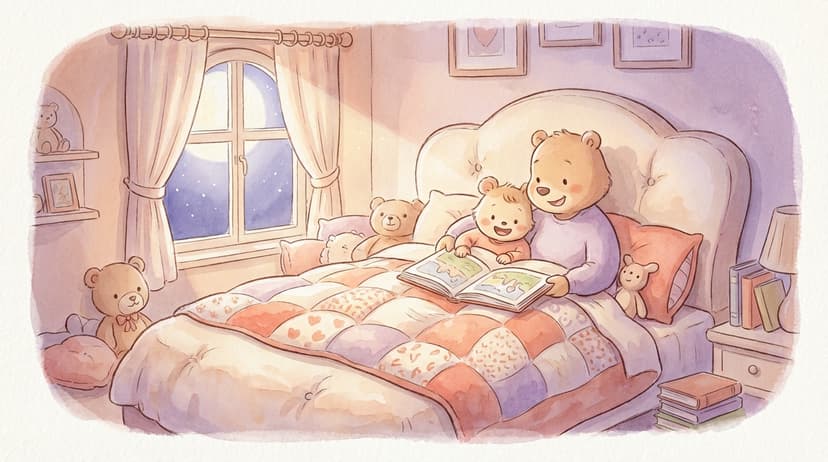
Reading is the single most effective bedtime transition activity because it accomplishes several things at once: it provides closeness (co-regulation), occupies the default mode network with narrative instead of worry, lowers heart rate through rhythmic language, and signals through routine that sleep is approaching.
For anxious children, the bedtime story isn't just a nice tradition. It's a clinical intervention. The combination of parental proximity, predictable ritual, and narrative engagement addresses the three core drivers of bedtime anxiety: separation fear, loss of control, and an overactive default mode network.
How Does Reading Together Reduce Bedtime Anxiety?
Reading before bed is more than a habit. For an anxious child, it is a neurological bridge between the alert state of daytime and the vulnerable state of sleep.
Here's what happens in the brain during bedtime reading:
Cortisol drops. The University of Sussex found that six minutes of reading reduces stress hormones by up to 68% — more than music, walking, or tea. For a child whose cortisol is spiking at bedtime, this is powerful.
Oxytocin rises. Physical closeness during reading — a child on your lap, tucked against your side — triggers oxytocin release in both parent and child. Oxytocin directly counteracts cortisol's effects and signals safety to the nervous system.
The default mode network gets redirected. Instead of generating worries, the brain follows a narrative. It processes characters, settings, and emotional arcs. The mind stays active but in a controlled, calming direction.
Predictability builds safety. An anxious brain craves certainty. A consistent reading ritual — same time, same spot, same sequence — provides the kind of predictability that gradually teaches the nervous system: "This is safe. This is what happens before sleep. Nothing bad follows."
40%
reduction in sleep-onset time for anxious children with a consistent, calming bedtime reading routine
Source: Journal of Clinical Child & Adolescent Psychology, 2021
The type of story matters. For anxious children, choose books with gentle pacing, warm resolutions, and characters who face fears and come through safely. Avoid cliffhangers, unresolved tension, or stories that introduce new fears right before lights-out.
Can Personalized Stories Help an Anxious Child Feel Brave?
When the hero of the story is your child — their face, their name, their world — something shifts. The emotional distance between reader and character collapses. Your child doesn't watch bravery from the outside. They experience it from the inside.
This is grounded in what psychologists call the self-referential encoding effect: information processed in relation to the self is remembered more deeply and felt more strongly. A 2024 study from the National Literacy Trust found that children reading personalized stories showed 47% stronger emotional engagement compared to identical non-personalized versions.
For anxious children, this matters enormously. When your child sees themselves as the hero who walks through a dark forest and finds light on the other side, their brain doesn't just store a story. It stores a template: I am someone who can be brave. I have done this before.
Over time, that template rewires anxious patterns. The child builds what psychologists call self-efficacy — the belief that they can handle difficult situations. And self-efficacy is the single strongest buffer against anxiety.
📖 A hero who looks like your child
Every Sherly book features your child as the protagonist across 30 illustrated pages — custom-drawn from their photo, navigating adventures that build courage and confidence. For a child who feels anxious at bedtime, seeing themselves as the brave hero who faces the unknown and comes through safely is more than a story. It becomes a belief they carry into the dark.
A Calming Bedtime Routine Template for Anxious Kids
Consistency is the antidote to anxiety. This template gives your child the predictability their nervous system craves. Adjust the timing to fit your family, but keep the sequence the same each night.
60 minutes before bed: Wind-down begins
- •Screens off. Dim the lights. Lower the household energy.
- •Quiet play: coloring, puzzles, building — nothing competitive or stimulating.
30 minutes before bed: Prepare
- •Bath or wash up (warm water lowers core body temperature afterward, promoting sleepiness).
- •Pajamas, teeth, bathroom — same order every night.
- •5-minute worry journal or worry check-in: "Any worries to put away tonight?"
15 minutes before bed: Connect and read
- •Settle into the reading spot (same place each night).
- •Read one or two books together. Let your child choose at least one.
- •Use a calm, gradually softening voice. Slow your pace as the story ends.
5 minutes before lights out: Body calm-down
- •Progressive muscle relaxation (2-3 minutes) or guided imagery.
- •Three slow breaths together — in for four, out for six.
- •A brief connection ritual: a specific phrase, a forehead kiss, a "brave thought" for the night.
Lights out
- •Nightlight stays on if needed (this is not a crutch — it's a valid accommodation).
- •Brief, warm goodnight. "You are safe. I am right here. See you in the morning."
💡 The power of a closing phrase
Choose a phrase you say every single night — "You are safe, you are loved, see you in the morning." Repetition turns these words into a neurological cue. Over weeks, your child's body will begin to relax the moment they hear it, because it has become associated with the safety of your presence and the predictability of routine.
What If the Anxiety Doesn't Improve?
Most children respond to consistent calming routines within two to four weeks. But some don't, and that's important to recognize without guilt.
Consider professional support if:
- •Bedtime anxiety persists for more than a month despite consistent routine changes
- •Your child's anxiety significantly impacts daytime functioning (school avoidance, social withdrawal)
- •Physical symptoms like stomachaches or headaches are frequent and unexplained
- •Your child expresses fears that seem disproportionate or fixed (the same specific fear, every night, with no variation)
- •Sleep deprivation is affecting mood, behavior, or learning
Cognitive-behavioral therapy (CBT) for childhood anxiety is highly effective. A 2023 meta-analysis in The Lancet Psychiatry found that 59% of children with anxiety disorders no longer met diagnostic criteria after a course of CBT. Many pediatric CBT programs include specific bedtime modules.
Parents sometimes feel they've failed if their child needs professional help for anxiety. The opposite is true. Recognizing that your child needs more support than a bedtime routine can provide — and seeking it — is one of the most loving things you can do.
You are not the cause of your child's anxiety. And you are not failing by asking for help.
Ready to create your child's story?
Turn your child into the hero of a 30-page illustrated hardcover book. Upload a photo and see the magic.
Frequently Asked Questions
Sherly Team
Children's Reading Specialists