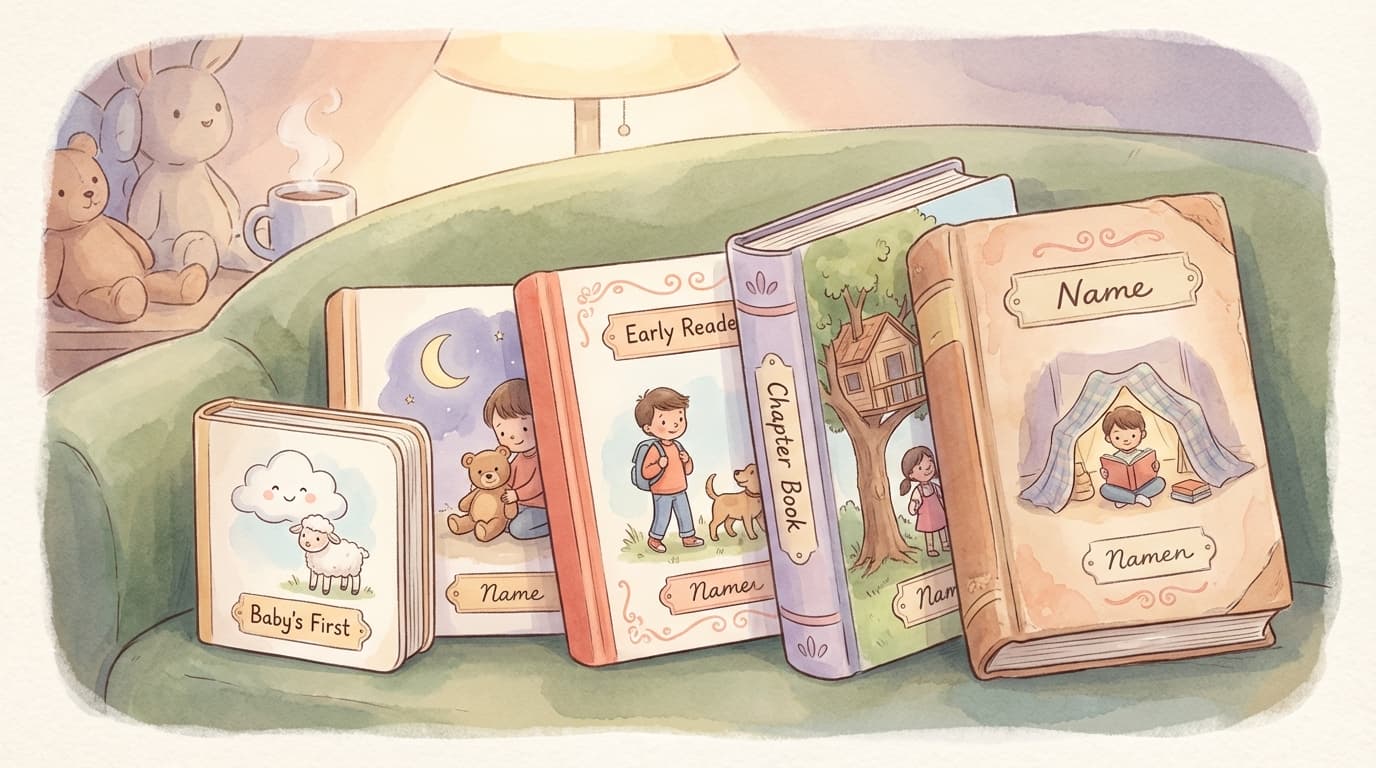
The perfect personalized book for your child's age depends on their developmental stage — not just what they can read, but how they process illustrations, narrative, and self-recognition. Children aged 0-2 benefit most from bold, simple images. Ages 3-5 thrive with full stories where they see themselves as the hero. Ages 6-8 want more complex narratives. And ages 9-10+ appreciate the emotional gesture behind a custom book.
Understanding these stages helps you choose a personalized book that will be genuinely engaging rather than something that misses the mark. According to the American Academy of Pediatrics (2023), matching reading material to developmental stage is one of the strongest predictors of sustained reading engagement in children.
What Should You Look for at Ages 0-2?
Babies and toddlers are not reading — they are looking, touching, listening, and absorbing. A personalized book for this age group serves a different purpose than for older children.
Self-recognition develops around 18-24 months. Before that, a baby sees a picture of themselves and does not yet connect it to "me." This does not mean a personalized book is wasted on an infant. It means the book functions primarily as a read-aloud experience and a future keepsake.
What matters most at 0-2:
- •Bold, high-contrast illustrations — Young eyes need clear, simple images
- •Short text per page — 1-2 sentences maximum for read-alouds
- •Durable construction — Board book format or heavy paper stock that survives teething and tossing
- •Rhythmic or repetitive language — Babies respond to patterns and sounds
- •Large, clear character images — When self-recognition begins, the child's likeness should be immediately obvious
For infants and early toddlers, a personalized book is really about the parent-child bonding experience and planting seeds for later self-recognition. By 18 months, most children can identify themselves in photos, and that is when a personalized book starts producing the 'that's me!' response we see in older children.
18 months
is the average age when children begin recognizing themselves in photos and mirrors, according to developmental research
Source: American Academy of Pediatrics, 2023
A personalized book given at birth becomes a keepsake that gains meaning as the child grows. By age 2, they will point to themselves in the illustrations with delight. The investment matures with the child.
What Works Best for Ages 3-5?
This is the peak window for personalized book impact. Children aged 3-5 are in the golden zone of self-recognition, imaginative play, and story comprehension.
At this stage, children:
- •Fully recognize themselves in illustrations
- •Understand narrative cause and effect
- •Identify strongly with protagonists
- •Are forming their self-concept and sense of capability
- •Love repetition and revisiting favorite stories
This is when the mirror effect is most powerful. A 2024 study from the University of Sussex found that self-concept improvements from personalized books were strongest in the 3-5 age range, with children showing a 27% increase in positive self-descriptors after 8 weeks of regular personalized book reading.
What matters most at 3-5:
- •Full story arc — Beginning, middle, and end. Children at this age can follow and anticipate narrative structure.
- •The child as a clear protagonist — They should be the hero, not a sidekick. The story should revolve around their actions and choices.
- •Detailed illustrations — At this age, children study illustrations closely and notice details adults might miss.
- •Emotional range — The story should include challenge, bravery, and triumph — not just happy scenes. Children need to see themselves overcoming obstacles.
- •Read-aloud quality — Most 3-5 year olds are still being read to, so the text should flow well when spoken.
Ages three to five represent what I call the 'narrative self' period. Children are not just absorbing stories — they are constructing their identity through them. A personalized book at this stage does not just entertain. It participates directly in how the child comes to understand who they are and what they are capable of.
📖 For ages 3-5
Sherly books are designed with this age range as the primary audience. The 30-page narrative places the child at the center of a story where they demonstrate bravery, kindness, and problem-solving. The custom illustrations from a real photo produce the strongest self-recognition response at this developmental stage.
What Changes for Ages 6-8?
Children aged 6-8 are beginning to read independently, and their relationship with books is changing. They are no longer just being read to — they are becoming readers themselves.
This age brings new considerations:
- •Reading level matters — The text should offer some challenge without frustration. Early readers need manageable vocabulary with occasional stretch words.
- •Story complexity increases — Children at this age can handle subplots, more complex emotions, and longer narratives.
- •Peer awareness emerges — Children become aware of what their friends read and think. A personalized book should feel "cool," not babyish.
- •Self-concept is more nuanced — They are not just asking "who am I?" but "what kind of person am I?" and "what can I do?"
According to the National Center for Education Statistics (2024), children who read voluntarily for at least 15 minutes daily at ages 6-8 scored significantly higher on reading comprehension assessments by age 10. Personalized books can contribute to building that daily habit because the inherent motivation is built in.
15 min/day
of voluntary reading at ages 6-8 correlates with significantly higher comprehension scores by age 10
Source: National Center for Education Statistics, 2024
What matters most at 6-8:
- •Longer, more complex text — Full paragraphs, dialogue, descriptive language
- •Themes of independence and capability — Stories where the child solves problems on their own
- •Detailed, sophisticated illustrations — Not "baby book" art. The style should respect the child's growing visual literacy.
- •A story they would be proud to show friends — Peer perception starts to matter
- •Reading encouragement — If the child is a reluctant reader, a personalized book can be the bridge to independent reading
What About Ages 9-10 and Older?
Older children present a different consideration. By age 9-10, most children are fluent readers with established preferences. They may be into chapter books, graphic novels, or specific genres. A picture-book-format personalized book might feel young to them.
However, the emotional value of a personalized book does not disappear — it shifts.
For this age group, a custom storybook works best as:
- •A sentimental gift — The child appreciates the gesture and the thoughtfulness, even if they have outgrown picture books
- •A keepsake — Something they put on a shelf and treasure, like a piece of art
- •A confidence builder during transitions — Starting middle school, moving to a new city, or navigating social challenges. A book that says "you are the hero" can matter at any age.
- •A memory anchor — Capturing the child at a specific age with custom illustrations
Older children may not sit on a parent's lap and ask for the book to be read again, but the emotional resonance of seeing themselves as the hero of a professionally crafted story is significant. At ages 9-12, children are often navigating self-doubt and social comparison. A personalized book can serve as a tangible reminder that they are valued and capable.
What matters most at 9-10+:
- •Mature illustration style — Avoid styles that look like toddler books
- •Meaningful narrative themes — Courage, resilience, self-discovery
- •Quality production — At this age, the physical object matters. A premium hardcover feels like a real book, not a novelty item.
- •The personal touch — Consider adding a dedication or personal message. The book becomes as much about the relationship between giver and child as the story itself.
Ready to create your child's story?
Turn your child into the hero of a 30-page illustrated hardcover book. Upload a photo and see the magic.
Quick Reference: What to Look For by Age
| Age | Primary Benefit | Key Features | Reading Mode | |-----|----------------|--------------|-------------| | 0-2 | Keepsake + early recognition | Bold images, short text, durable | Read-aloud by parent | | 3-5 | Self-concept + engagement | Full story, child as hero, detailed art | Read-aloud, beginning to follow along | | 6-8 | Reading motivation + confidence | Complex narrative, sophisticated art | Transitioning to independent | | 9-10+ | Emotional value + keepsake | Mature style, meaningful themes | Independent, values the gesture |
Common Mistakes Parents Make When Choosing
Choosing based on age label alone. Many personalized book companies list broad age ranges like "ages 1-8." A book ideal for a 2-year-old is not ideal for a 7-year-old. Look at the actual content — text complexity, illustration style, and narrative depth.
Underestimating younger children. Some parents hesitate to buy a 30-page personalized book for a 3-year-old. But children at this age absorb far more from illustrations than adults expect. They will study each page, notice details, and request re-reads dozens of times.
Overestimating the "too old" threshold. Parents of 8-10 year olds sometimes think personalized picture books are too young. But when a child sees custom illustrations of themselves, age assumptions dissolve. The response is emotional, not intellectual.
Prioritizing price over quality for milestone gifts. A birthday or holiday is an occasion where a premium book will be remembered. A low-quality personalized book may actually undermine the gift by feeling cheap.
💡 When in doubt
If you are unsure about age appropriateness, look at the illustrations and story sample. If the art style and narrative complexity feel right for your child, the personalization will handle the rest of the engagement equation.
Frequently Asked Questions
Sherly Team
Children's Reading Specialists