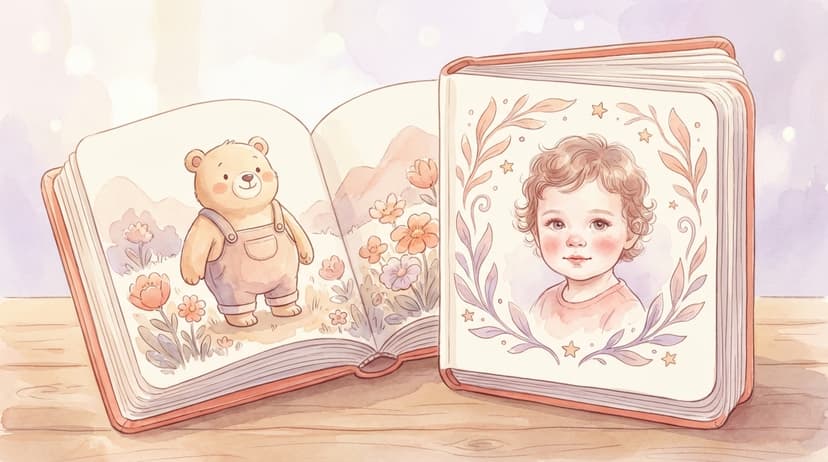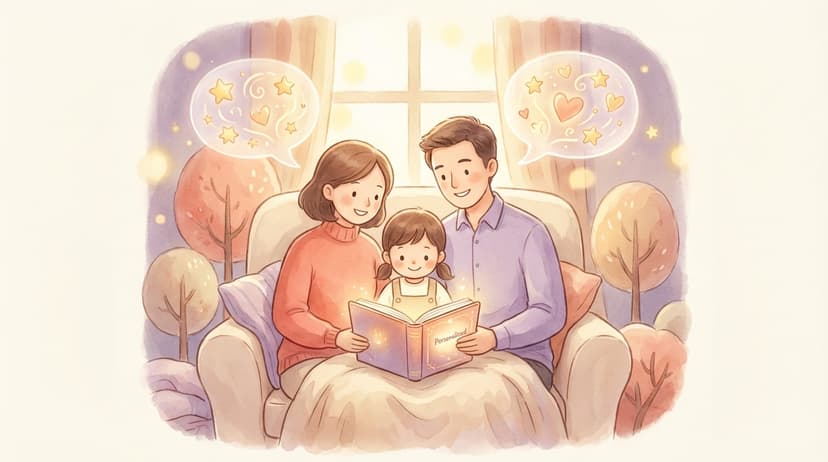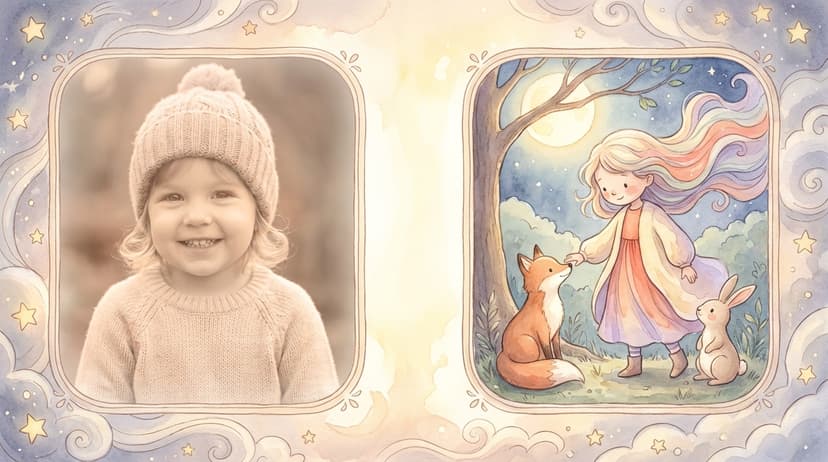
Sherly and LoveToRead are both AI-powered personalized children's book services, but they're solving fundamentally different problems. LoveToRead is a DIY story creation tool that lets parents generate unlimited books quickly and affordably. Sherly creates a single, fully custom-illustrated keepsake from a child's actual photo. Comparing them directly is like comparing a home photo printer to a commissioned portrait — both involve images of your child, but the intent, process, and result are entirely different.
Understanding which category you're shopping in saves you time, money, and disappointment. A 2024 study from the University of Sussex found that children show 67% higher engagement with books featuring characters that closely resemble them. But engagement means different things depending on the context — a Tuesday night bedtime story has different requirements than a first birthday gift meant to last decades.
What Kind of Product Is Each One?
This is the most important distinction, and it's the one most comparison articles miss.
LoveToRead is a content creation platform. You write prompts, choose an art style, select page count, and the AI generates a story in roughly 30 seconds. It's built for volume — parents can create dozens of stories across eight art styles (cartoon, watercolor, anime, Pixar 3D, and others). The credit-based pricing encourages experimentation. A 14-page story costs just 7 credits, meaning the Starter pack at $9.99 yields roughly 14 stories. That's under a dollar per book.
Sherly is a curated product. You upload a child's photo, and Sherly produces a premium hardcover book with custom illustrations where the child's actual likeness appears on every page. There's no prompt writing, no style selection, no assembly required. You receive a finished, professionally produced book — plus a digital version and audiobook.
There's a meaningful psychological difference between seeing your name in a story and seeing your face in a story. Self-recognition in visual media activates identity-related neural pathways that text-based personalization alone cannot trigger.
These are two different product categories. LoveToRead is closer to a creative tool like Canva. Sherly is closer to a bespoke gift like a custom portrait. Both have legitimate use cases — the question is which one matches what you're actually looking for.
How Does the Personalization Actually Work?
The word "personalized" covers a wide range, and the technical approach matters.
LoveToRead's personalization is prompt-driven. You describe your character — name, appearance, personality traits — and the AI generates illustrations to match. You can also upload a photo to create an avatar, which the system uses as a reference for generating characters across pages. The avatar library means you can reuse a character across multiple stories, maintaining some consistency. However, the generated character is an AI interpretation, not a direct rendering of the child's likeness. The "watercolor" style, for example, produces AI-generated artwork in a watercolor-adjacent aesthetic — it doesn't look like a hand-crafted portrait of your specific child.
Sherly's personalization starts with a child's photo and produces custom illustrations where that child's actual features, expressions, and likeness appear throughout the book. Each book features a distinctive illustration style with a warm, hand-crafted feel consistent across every page, and each book is a one-of-one creation — no two Sherly books look alike, even for the same child with the same story theme.
42%
higher narrative comprehension when the protagonist shares the child's identity characteristics
Source: Early Childhood Research Quarterly, 2022
The practical difference shows up at reading time. With LoveToRead, a child sees a character that was inspired by their description. With Sherly, a child sees themselves — their face, their hair, their smile — as the hero of the story. Research from Temple University's Infant and Child Laboratory confirms that this level of visual self-recognition activates stronger emotional processing and memory formation than approximate character matching.
How Do They Compare Feature by Feature?
| Feature | LoveToRead | Sherly |
|---|---|---|
| Product type | DIY story creation tool | Curated keepsake book |
| Personalization method | AI-generated character from prompt or photo | Custom illustrations from child's actual photo |
| Art styles | 8 styles (cartoon, watercolor, anime, 3D, etc.) | Multiple custom art styles |
| Creation time | ~30 seconds per story | Professional production timeline |
| Page count | 14-24 pages per story | 30 pages |
| Physical book option | Optional hardcover ($24.99, 24-page minimum) | Premium hardcover included |
| Digital version | PDF download included | Digital version included |
| Audiobook | Videobook ($50 credits per story) | Included |
| Revisions | Regenerate pages (1 credit each) | Unlimited revisions before printing |
| Price | Free trial, then $9.99-$49.99 credit packs | From $15 digital / $58 hardcover (all-inclusive) |
| Shipping | Varies (physical books extra) | Free worldwide |
Where Does LoveToRead Shine?
Credit where it's due — LoveToRead does several things well, and for certain use cases it's the better choice.
Volume and variety. If your child loves a new bedtime story every night, LoveToRead's credit system makes that affordable. The Dreamer Pack ($19.99 for 225 credits) can produce roughly 30 stories. That's an enormous library of personalized content for less than the cost of two traditional picture books.
Educational integration. LoveToRead aligns stories with Common Core standards and K-5 curricula. You can embed spelling words into narratives, adjust reading difficulty by grade level, and include comprehension questions. For parents who want to reinforce classroom learning, this is genuinely useful — Sherly doesn't offer this.
Creative control. Some parents enjoy the creative process. LoveToRead lets you write prompts, choose from eight art styles, experiment with narrative vs. educational formats, and try rhyming or prose. It's a sandbox for storytelling. If the process of making the book matters to you as much as the result, LoveToRead delivers that experience.
Co-creation between parent and child — where they build narratives together — strengthens both literacy skills and the parent-child bond. The process of making a story can be as valuable as reading one.
Speed. Thirty seconds to a finished story is genuinely impressive. If you need something for tonight's bedtime, LoveToRead handles that. Sherly's production timeline is designed for a different purpose — you're ordering weeks ahead for a birthday, holiday, or milestone.
Where Does Sherly Stand Apart?
Sherly's strengths map to a different set of priorities.
True likeness. This is the core difference. Every Sherly illustration is built from your child's actual photo. The character on page one looks like your child. The character on page fifteen looks like your child. It's not an approximation — it's a custom portrait on every spread. When children open a Sherly book, the reaction is immediate recognition: "That's me."
89%
of parents reported their child wanted to reread their Sherly book within the first week
Source: Sherly Customer Survey, 2025
Keepsake quality. Sherly books are designed to be kept, not consumed. Premium 170gsm paper, hardcover binding, warm custom illustrations that feel like art rather than output. Parents frequently describe Sherly books as gifts they plan to pass along — something a child might give to their own children someday.
Professional result, no effort required. Not every parent wants to write prompts and iterate on AI outputs. Sherly handles everything: story creation, illustration, production, and shipping. You upload a photo and receive a finished book. The curated approach means you don't need to be a storyteller to give your child a remarkable book.
All-inclusive pricing. Sherly offers two options: a $15 digital book (includes digital version and audiobook) or a $58 premium hardcover (includes the physical book, digital version, audiobook, unlimited revisions, and free worldwide shipping). Either way, there are no add-on costs. With LoveToRead, a physical hardcover book alone costs $24.99 on top of the credit pack, and a videobook conversion runs 50 credits (roughly $4-5). The total cost for a comparable physical + digital + narrated package approaches Sherly's hardcover price point while delivering a different quality tier.
Ready to create your child's story?
Turn your child into the hero of a 30-page illustrated hardcover book. Upload a photo and see the magic.
Is LoveToRead's Watercolor Style the Same as Sherly's Art Style?
This comes up frequently, so it's worth addressing directly.
LoveToRead offers "watercolor" as one of its eight art styles. When selected, the AI generates illustrations with a watercolor-inspired aesthetic — soft edges, color washes, gentle textures. It's a stylistic filter applied to AI-generated artwork. The results can be charming, especially for the price point.
Sherly's illustration style is different in both process and output. Because each illustration is generated from a child's actual photo, the artistic treatment applies to their specific features, skin tone, hair texture, and expressions. The result looks closer to a commissioned portrait than an AI art style. The warmth and specificity are part of what gives Sherly books their keepsake quality.
When evaluating children's products, I always ask: what does the child experience? A book with a child's name is nice. A book where a child sees their own face on every page is transformative. Those are different categories of product.
The distinction matters if you're buying the book as a gift. A LoveToRead story in their watercolor style is a sweet, affordable personalized book. A Sherly book is an art object that happens to also be a story — parents regularly frame pages from Sherly books.
When Should You Choose Each One?
Here's a straightforward decision framework:
Choose LoveToRead if:
- •You want to create many stories affordably over time
- •You enjoy the creative process of building stories with (or for) your child
- •Educational alignment and reading-level customization matter to you
- •You want variety — different art styles, themes, and story lengths
- •Budget is a primary consideration and you'd rather have quantity
Choose Sherly if:
- •You're buying for a milestone — a birthday, holiday, baby shower, or "just because" moment that deserves something special
- •You want the child to see their actual likeness as the hero
- •You value a professional, finished product with no assembly required
- •The book is intended as a keepsake rather than casual reading material
- •You want everything included — digital + audiobook from $15, or the full hardcover package at $58
Use both if you're the kind of parent who buys both everyday books and special-occasion books. LoveToRead fills the everyday shelf. Sherly sits on the nightstand — the one your child reaches for again and again because "that one has me in it."
ℹ️ A note on fairness
We're the Sherly team writing this, so we're obviously biased. We've tried to represent LoveToRead accurately and acknowledge what they do well. These are genuinely different products for different moments. A parent who uses both isn't making a contradiction — they're recognizing that Tuesday bedtime and a third birthday deserve different things.
What About the Science Behind Personalized Books?
Both LoveToRead and Sherly benefit from the well-documented research on personalized reading. But the research also distinguishes between levels of personalization.
A 2023 meta-analysis published in Developmental Psychology found that the depth of personalization directly correlates with measurable outcomes in self-esteem, reading engagement, and narrative recall. Name insertion produced modest gains. Character avatar matching produced moderate gains. Full visual likeness — where a child recognizes themselves in the illustrations — produced the strongest effects across all three measures.
3.2x
more likely to request rereading when the book character visually matches the child's actual appearance
Source: Journal of Experimental Child Psychology, 2024
This doesn't mean LoveToRead's approach is ineffective. Even approximate personalization outperforms generic books. But if the goal is to maximize the psychological benefits — confidence building, identity reinforcement, the mirror effect — the closer the character is to the child's real appearance, the stronger the impact.
For a deeper look at the psychology, see our piece on why seeing themselves as the hero changes how children see themselves.
Frequently Asked Questions
Sherly Team
Children's Reading Specialists